 Do Son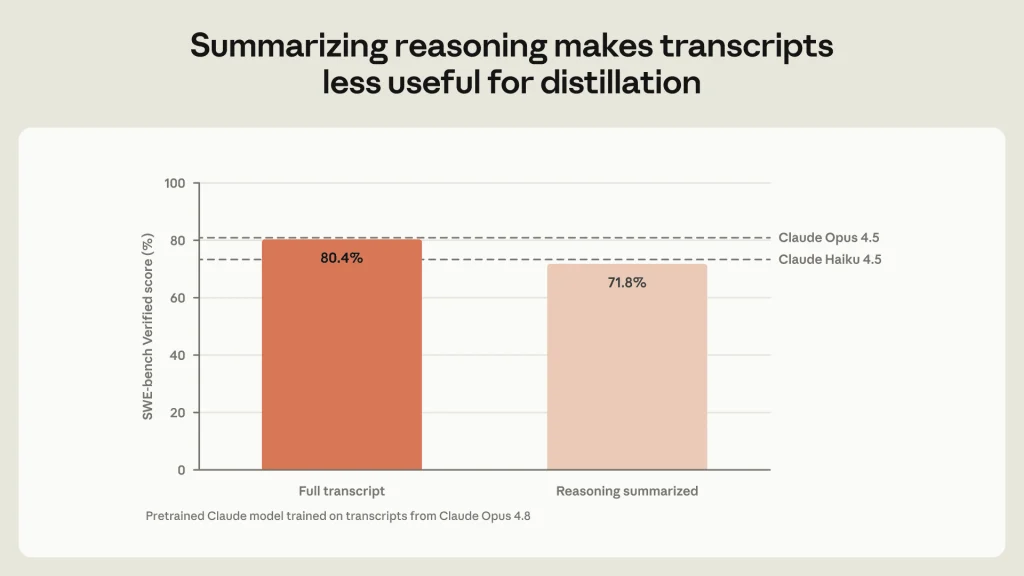
Summarizing Claude's reasoning makes its transcripts less useful for distillation. A model trained on transcripts with summarized reasoning scored 71.8% on SWE-bench Verified, compared to 80.4% for a model trained on the full reasoning.
To combat unauthorized model distillation, Anthropic recently fortified its protective mechanisms. These defenses secure the reasoning outputs of Claude AI. Internal estimates show these novel safeguards are highly effective. They plummeted the volume of extracted reasoning data by 90 to 99 percent. Previously, the corporation deployed mechanisms to enhance cognitive retention. These rules prohibited altering the model’s prior conversational context. They also restricted the cross-model retrieval of reasoning logs.
Prioritizing the Protection of Model Reasoning
Model distillation conventionally trains inferior models using sophisticated responses from advanced counterparts. The distillation attacks referenced by Anthropic involve massive request volumes. Operators harvest the responses and reasoning logs of Claude AI. Subsequently, they utilize this data to replicate its profound capabilities. Anthropic asserts that reasoning logs explicitly illuminate the cognitive pathway. Therefore, they possess a significantly higher training value than the final answer alone.
Internal evaluations by Anthropic demonstrate a clear performance gap. Models trained utilizing comprehensive reasoning logs achieved an impressive 80.4 percent on programming benchmarks. Conversely, those trained merely upon reasoning summaries scored a lower 71.8 percent. This specific assessment powerfully illustrates the immense training value of complete logs. However, the precise dynamics of distillation may fluctuate. The ultimate training outcomes depend upon the specific methodologies and model architectures involved.
Restricting Cross-Session Data Proliferation
Anthropic has implemented a robust cognitive retention mechanism for specific Claude models. For API accounts established on or after August 31, 2026, strict rules apply. Users are explicitly prohibited from editing the preceding conversational context of Claude. Furthermore, the company stringently restricts the inter-model retrieval of reasoning logs. They confine the reasoning records of Claude Sonnet 5.5 exclusively within the originating organization.
Additionally, Anthropic employs a sophisticated two-stage classifier. This tool identifies and thwarts requests attempting to extract concealed reasoning. Engineers continuously update their defensive paradigms to counter novel evasion tactics. For instance, they block malicious prompts demanding the model to translate previous reasoning. They also detect attempts to encapsulate cognitive processes within specific structural tags. Accounts persistently engaging in such transgressive attempts face severe consequences. They may endure strict usage restrictions or face permanent suspension.
Diminished Extraction Volumes and Costs
Anthropic reports a dramatic success following the deployment of this advanced classifier. The volume of reasoning tokens extracted from its platform plummeted significantly. Consequently, administrators enacted the definitive banishment of tens of thousands of malicious accounts. Nevertheless, the corporation concedes that these cognitive retention mechanisms impose certain burdens. They compel developers to reconfigure their established interface integrations. Furthermore, the classifier may occasionally intercept perfectly legitimate requests.
Fortunately, the overarching false-positive rate remains astonishingly low at under 0.1 percent. Notably, these intercepted requests will still incur standard billing charges. Anthropic has not yet observed highly sophisticated, perpetually adaptive evasion maneuvers. Therefore, whether this substantial reduction in data extraction can be sustained remains uncertain.
Support Our Threat Intelligence
Find our tech and OS security coverage helpful? Support our work today and unlock a 100% ad-free reading experience!
 Buy Me a Coffee
