Beyond Cellular: Qualcomm’s New Wearable Chips Bring Satellite Communication to Your Wrist
 Do Son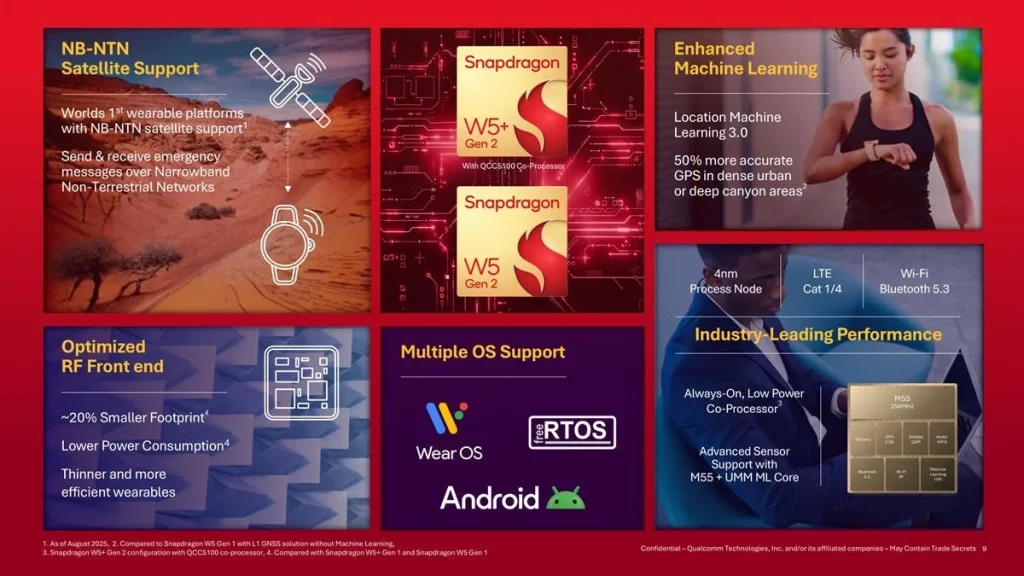
With Google’s announcement of the new Pixel Watch 4, Qualcomm swiftly followed by unveiling its updated wearable processor platforms: the Snapdragon W5+ Gen 2 and Snapdragon W5 Gen 2. Notably, these solutions integrate two-way satellite communication based on NB-NTN (Narrowband Non-Terrestrial Network) technology, significantly enhancing the connectivity of smartwatches in critical moments.
Among the two processors, the Snapdragon W5+ Gen 2 continues its established positioning while incorporating a dedicated co-processor for refined power management. This auxiliary chip, operating at ultra-low power, handles continuous tasks such as background sensor data, notification delivery, and the Always-On Display. Meanwhile, the main processor is reserved for more demanding applications and interactive operations, ensuring a seamless user experience while maximizing battery endurance.
The standard Snapdragon W5 Gen 2, by contrast, forgoes the co-processor, targeting simpler devices with lighter always-on requirements—such as children’s smartwatches or specialized enterprise solutions.
The most significant enhancement in this generation is support for the NB-NTN satellite network, powered by satellite service provider Skylo. This means that smartwatches built on this platform will be able to send and receive emergency messages, enabling two-way communication even in remote areas lacking cellular or Wi-Fi coverage, provided a satellite signal is available.
This “killer” safety feature—once reserved for flagship smartphones—has now been extended to wearables, offering a profound new layer of security for users engaged in outdoor sports, expeditions, and other high-risk activities.
From a hardware perspective, the Snapdragon W5 Gen 2 series is built on the 4nm process, delivering notable improvements in power efficiency. Compared with the previous generation, Qualcomm’s Positioning Machine Learning 3.0 technology enhances GPS accuracy by as much as 50%.
Furthermore, a redesigned RF front-end module reduces chip size by approximately 20% while simultaneously lowering power consumption, enabling OEMs to create slimmer, lighter, and longer-lasting wearable devices.
In terms of connectivity, beyond its headline satellite communication feature, the platform fully supports Wi-Fi 6 and Bluetooth 5.3, ensuring stable and high-speed wireless performance in everyday scenarios. Qualcomm emphasizes that, through advanced power management, the new platform achieves a superior balance between high-performance computing and battery longevity.
Related Posts:
- Microsoft to Unveil New Copilot+ PC and Surface Device
- Apple’s “Apple Ring” Rumors Reignite: Mark Gurman Hints at Subtle Wearable Health & Control Device
Support Our Threat Intelligence
Find our tech and OS security coverage helpful? Support our work today and unlock a 100% ad-free reading experience!
 Buy Me a Coffee
