 Do Son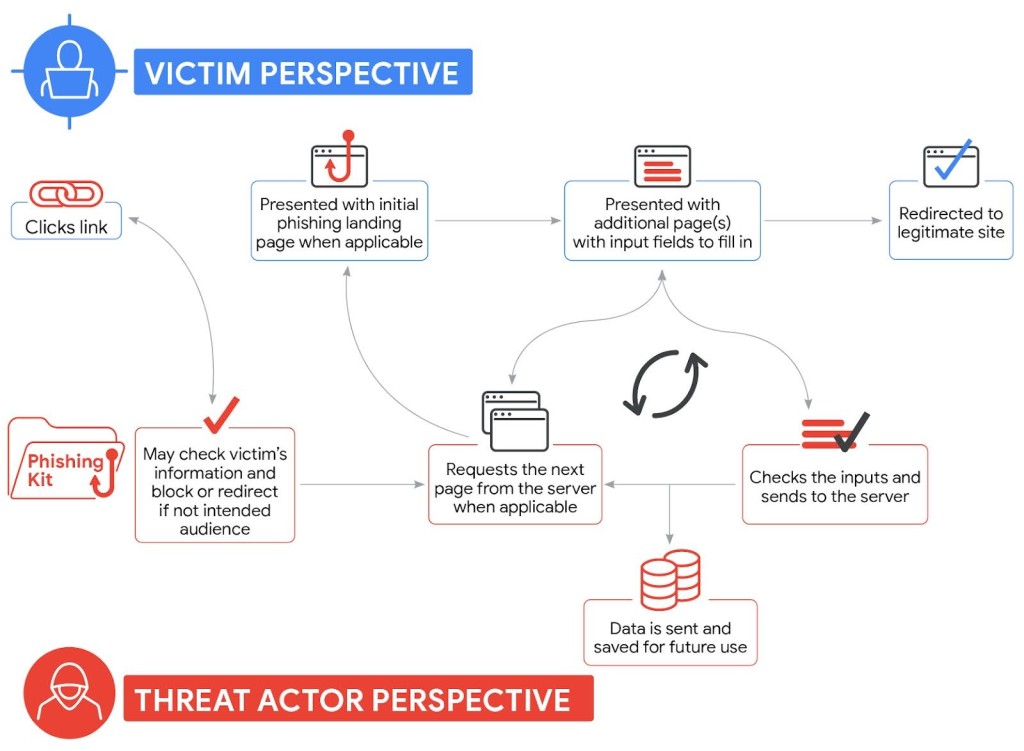
Example phishing site chain | Image: Google Threat Intelligence Group
A powerful network of cyber criminals is expanding rapidly in the digital underground. Specifically, the Chinese PhaaS ecosystem represents a growing threat to global mobile users. Analysts from the Google Threat Intelligence Group (GTIG) discovered this trend during a recent corporate threat investigation. They analyzed a dozen mature platforms operating openly within localized communication channels. Furthermore, these malicious services lower the technical barrier for low-skilled attackers. Consequently, international organizations face new waves of highly effective identity theft scams.
Shifting to Real-Time Token Interception
To begin with, the criminal network changed its primary operational objectives. Traditional phishing kits usually focus on harvesting static user passwords. However, modern operators prefer immediate session hijacking and automated credential reuse. The official threat intelligence report highlights this technical evolution clearly. According to the analysis, “Within this ecosystem, GTIG has observed a fundamental move away from static password harvesting towards real-time interception and tokenization.” Therefore, traditional passive security monitoring cannot prevent these network intrusions.
Bypassing Multi-Factor Authentication
Furthermore, the attack chain utilizes live administration panels to interact with victims in real-time. When a user enters their credentials, the portal displays the text instantly to the attacker. Simultaneously, the adversary triggers an automated one-time passcode (OTP) verification request on the legitimate site. The user provides the token on the spoofed interface without any initial suspicion. Next, the threat actor captures the code seconds before it expires. This interactive process allows them to bypass multifactor authentication protocols instantly.
Exploiting Encrypted Channels and Digital Wallets
Rich Communication Delivery Systems
Additionally, the distribution mechanism bypasses traditional mobile telecom security protections. Rather than sending basic SMS text messages, developers prefer modern messaging protocols. For instance, they heavily leverage Apple’s iMessage platform and Rich Communication Services (RCS). Because these channels use end-to-end encryption, carrier security filters cannot inspect the malicious links. Moreover, these messages support advanced engagement features like rich media layouts. Consequently, the deceptive lures look remarkably genuine to the average consumer.
Financial Monetization via Wallet Provisioning
Subsequently, the attackers capitalize on the stolen information through a unique financial conversion method. Instead of simply browsing the account, they enroll the card data directly into mobile payment apps. This approach gives them long-term access to corporate and personal funds. The report explains that “Instead of simply gaining account access, these operations focus on exploiting digital wallet provisioning to transform stolen payment data into tokenized assets within ecosystems.” Ultimately, the Chinese PhaaS ecosystem prioritizes direct, unauthorized control over financial accounts.
AI Automation and Global Localization
Meanwhile, software developers are integrating machine learning models into their core infrastructure. The Chinese PhaaS ecosystem now leverages advanced text and layout systems to optimize campaigns. The report states: “Multiple Chinese-language PhaaS operators have adopted AI for their operations to enable scale and stealth.” For example, the Darcula platform uses automated page generators to clone real sites instantly. By supplying a legitimate URL, attackers create unique layouts with perfect HTML and CSS. Because each generated page features a unique signature, legacy defensive scanners fail to block them.
Case Study of YY Lai Yu
Furthermore, a platform called YY Lai Yu demonstrates this modular localization model. Launched in August 2024, the service provides pre-built infrastructure targeting 119 countries. Specifically, the creators design highly localized templates tailored to the Japanese economic market. The service mimics major regional transport apps, e-commerce giants, and loyalty point rewards. To evade automated detection, the platform forces users to clear an anti-bot puzzle before viewing the lure.
Technical Defensive Enhancements
Ultimately, organizations must move beyond basic user awareness training. While education helps, technical security controls provide the best defense against token theft. Enterprises should transition immediately to FIDO2 and WebAuthn hardware security keys. These keys successfully block real-time interception schemes. Concurrently, banking institutions must implement advanced device fingerprinting during wallet activation. Making stolen credentials impossible to weaponize remains the ultimate goal for modern cybersecurity teams.
Support Our Threat Intelligence
Find our threat intelligence and malware analysis helpful? Support our work today and unlock a 100% ad-free reading experience!
 Buy Me a Coffee
