Zero-Trust Voice: Discord Finalizes Mandatory “DAVE” Encryption for All Audio and Video Streams
 Do Son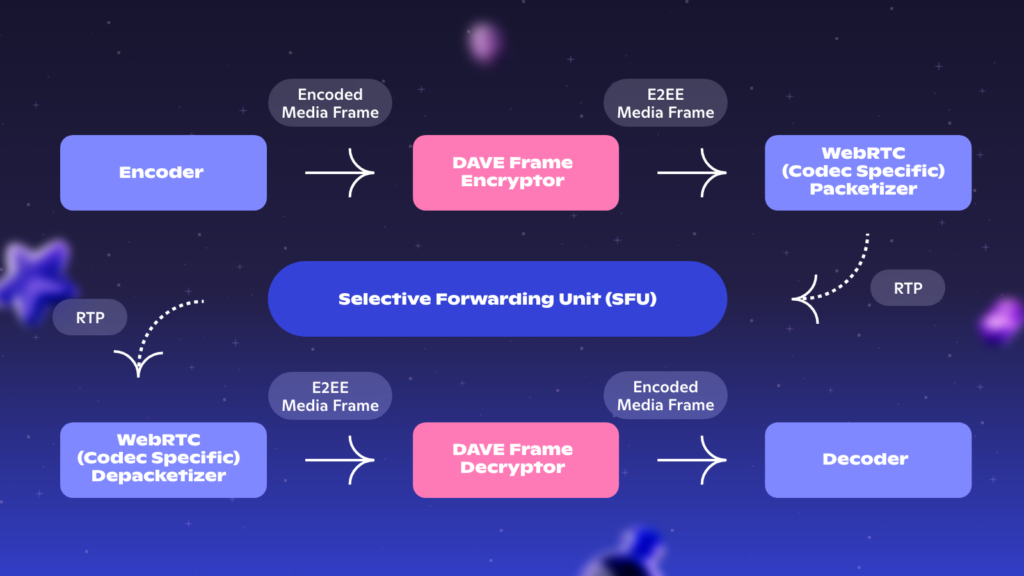
Image: Discord
Discord, the widely celebrated communications architecture tailored for the global gaming constituency, has announced the universal initialization of mandatory end-to-end encryption (E2EE) across all voice and video transmissions. The deployment of this structural safeguard effectively immunizes user interactions against opportunistic interception, rendering it mathematically impossible for any external entity—including Discord’s own infrastructure—to capture or parse the raw audio-visual stream. For privacy-centric consumers, this milestone represents a monumental victory for data sovereignty.
This cryptographic enhancement spans Discord’s entire cross-platform matrix, encompassing desktop clients, mobile applications, web interfaces, and home entertainment consoles. The protection uniformly cloaks direct messages, group ring-fences, server voice sanctuaries, and real-time media broadcasts. At the core of this defensive barrier is the proprietary Discord DAVE protocol, an encryption framework that has successfully undergone rigorous, independent third-party code verification by elite cybersecurity auditing firms.
Crucially, Discord explicitly clarified that the protocol boundary does not extend to textual communications. The enterprise confirmed it harbors no strategic intention to introduce end-to-end encryption for text-based messages in impending software lifecycles. This deliberate architectural omission ensures the continuous efficacy of automated content moderation and abuse-prevention engines; many server operators rely extensively upon plaintext keyword heuristics to enforce structural community guardrails and neutralize algorithmic spam.
Furthermore, Discord maintains native, platform-level anti-abuse frameworks engineered to suppress malicious advertising and automated adversarial campaigns. Introducing end-to-end encryption across textual repositories would fundamentally blind these structural detection daemons, rendering core telemetry mechanisms entirely non-functional—an operational friction Discord is unwilling to tolerate.
Because this end-to-end encryption architecture was retrofitted onto a mature codebase, legacy clients lack the low-level primitives required to negotiate the contemporary security handshake. Consequently, users persisting on outdated software builds will find themselves unable to establish audio-visual sessions; restoration of functionality strictly necessitates upgrading to the current upstream release or migrating directly to the web application interface.
Under the hood, the Discord DAVE protocol leverages modern WebRTC Encoded Transform APIs to programmatically encrypt every discrete audio and video frame utilizing symmetric keys unique to the transmitting origin. The underlying key distribution architecture relies upon the Messaging Layer Security (MLS) protocol to seamlessly arbitrate multi-party cryptographic handshakes. This implementation ensures that only authenticated participants possessing the corresponding private keys can reconstitute the media stream; the central routing nodes function purely as blind traffic relays, entirely devoid of the cryptographic metadata required to decrypt the payloads they transport.
The phased deployment of this default end-to-end encryption matrix commenced globally on March 2, 2026. This week, Discord formally declared the comprehensive integration of the DAVE framework across its global user base, mandating only a standard client update to solidify the user’s cryptographic perimeter.
Support Our Threat Intelligence
Find our tech and OS security coverage helpful? Support our work today and unlock a 100% ad-free reading experience!
 Buy Me a Coffee
