 Do Son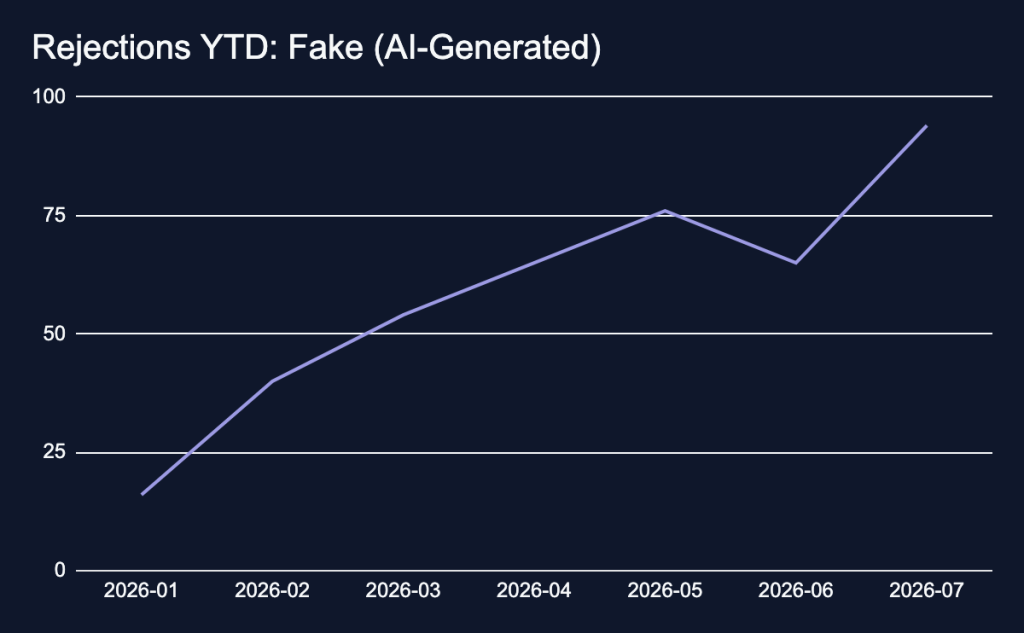
Image: VulnCheck
The cybersecurity landscape is currently facing a massive influx of fake AI PoCs polluting public code sharing platforms. Security researchers rely on public exploit repositories to study vulnerabilities and build accurate detection tools. However, recent data reveals that the signal-to-noise ratio is rapidly deteriorating. The Initial Access Intelligence team at VulnCheck recently shared their insights on this growing problem. As detailed in their report, researchers have already reviewed over 17,800 proof-of-concept scripts by mid-August 2026. This puts the industry on track to easily surpass the volume seen last year.
See a CVE's exploit risk spike before it becomes a headline.
Get EPSS spike alertsThe Drop in Legitimate Exploit Code
The sheer volume of submissions to exploit repositories does not equal quality. Historically, the acceptance rate for GitHub-hosted exploits hovered around 51 percent. In 2026, that acceptance rate dropped to approximately 45 percent. “The team reviewed and curated roughly 20,000 exploits in 2025,” but a massive portion of new submissions fail basic validation. The most common reason for rejecting a repository is that it simply does not contain any exploit code. Instead, these submissions are often stylized AI write-ups or empty placeholders. These fake AI PoCs pad their word counts without providing any functional code.
Identifying the AI “SloPoC”
Fake AI PoCs have distinct hallmarks that make them relatively easy to spot if you know what to look for. These repositories often feature an excessive use of emojis and highly stylized formatting. Furthermore, they utilize high-level summaries that require hundreds of words to explain what could be said in a single sentence. The report notes, “Al is finding real vulnerabilities, but it’s also generating a whole lot of slop code and stylized noise with no real value.”. Many of these fake AI PoCs are created to spread disinformation or artificially inflate a developer’s resume. Thankfully, most users are not fooled, as these fake repositories typically have zero to five GitHub stars.
Analyzing a Fake Exploit
The report highlights a fake repository for CVE-2026-55200, an out-of-bounds write flaw in libssh2. The repository features a detailed technical root cause breakdown and ASCII diagrams, but the actual C code reveals the deception. The code claims to exploit a memory corruption vulnerability. However, it lacks necessary elements like memory offsets, return-oriented programming gadgets, or shellcode. Instead, it merely opens a local server socket and waits for a reverse shell connection that will never arrive. Furthermore, the code skips the required encryption protocols completely.
Malicious PoCs and Hidden Dangers
While fake AI PoCs are annoying, malicious exploit repositories pose a direct threat to researchers. Threat actors frequently upload repositories that claim to be functional exploits but actually contain hidden malware. In one notable instance, an attacker modified a legitimate VulnCheck scanner for CVE-2023-36845. They added malicious code that downloaded and executed a disk-wiping payload from a remote server.
Another common tactic involves hiding malicious payloads within base64-encoded blobs. For example, a supposed exploit for the CVE-2026-41940 authentication bypass vulnerability utilized a double base64-encoded Python script to install a backdoor. Security professionals must treat unexplained base64 strings with extreme suspicion. The researchers offer a blunt warning regarding this obfuscation: “If you can’t understand the code, it’s because you weren’t meant to.”.
Crypto Scams and Obfuscated Code
Beyond malware, scam artists also use exploit repositories to steal cryptocurrency. The research team identified “pay link” repositories that contain zero code. Instead, they provide a terminal output screenshot, a sales description, and a link to a third-party payment site asking for crypto.
Additionally, some authors use tools like Pyarmor to completely obfuscate their Python scripts. Giving away code for free while actively preventing anyone from reading it is a massive red flag. These obfuscated scripts are almost always malicious. Researchers should report these fake AI PoCs and malicious repositories to GitHub immediately, as the platform typically removes them within a week.
Verifying Your Threat Intelligence
As the volume of exploit code grows, security teams must adapt their vetting processes. Fake AI PoCs and malicious scripts are now a daily reality in threat intelligence. Relying blindly on unverified code from public repositories can lead to severe network compromises. Always read and understand the code before executing it in any environment.
Support Our Threat Intelligence
Find our vulnerability reports and weekly recaps helpful? Support our work today and unlock a 100% ad-free reading experience!
 Buy Me a Coffee
