 Do Son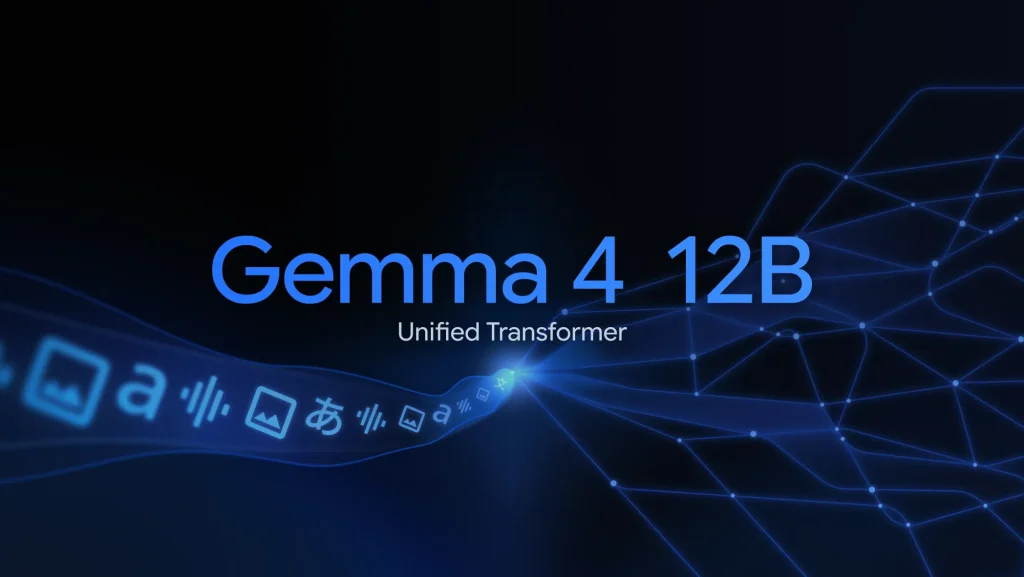
Google recently released and open-source distributed the Gemma 4 12B multimodal model. This architecture empowers standard consumer devices to execute artificial intelligence natively. According to corporate benchmarks, the system operates flawlessly on computers with 16GB of memory. This efficiency stems directly from its compact 12-billion parameter design. Remarkably, the model delivers cognitive capabilities that rival the larger Gemma 26B variant.
Core Architectural Advantages
A Unified Framework
The system completely discards separate multimodal encoders. Consequently, it natively processes text, images, video, and audio inputs simultaneously.
Elevated Cognitive Reasoning
Furthermore, its benchmark performance closely approaches the Gemma 26B Mixture-of-Experts model. Therefore, it easily executes complex, multi-step logical operations locally.
Streamlined Memory Footprint
Moreover, the model requires a mere 16GB of video or system memory for local deployment. Naturally, expanded hardware allocations will further optimize computational velocity.
Open-Source Accessibility
Additionally, Google released the weights under the permissive Apache 2.0 license. Thus, creators enjoy robust ecosystem support from both corporate and community networks.
Token Speculation Engines
Finally, Gemma 4 12B incorporates specialized token prediction selectors. This innovation effectively minimizes inference latency during live interactions.
Deep Technical Innovations
In standardized benchmarks, Gemma 4 12B demonstrates intellectual parity with the prior 26B Mixture-of-Experts architecture. However, it requires significantly fewer hardware resources. Consequently, everyday users can experience sophisticated agentic workflows directly on standard laptops.
Furthermore, the architecture radically simplifies how the system ingests visual and acoustic data. Traditional multimodal frameworks usually rely on independent, disparate encoders. These legacy components convert sensory data before transmitting representations to the core language model. Unfortunately, this split-encoder methodology heavily inflates memory consumption and operational latency.
Encoder-Free Processing
To solve this friction, Google engineered an encoder-free architecture for Gemma 4 12B. Therefore, the network integrates sensory inputs directly into its main matrix.
For visual processing, a lightweight embedding module elegantly replaces the traditional visual encoder. Specifically, this module utilizes only a solitary matrix multiplication alongside positional embedding and normalization. As a result, the primary network backbone assumes direct sovereignty over visual synthesis.
Concurrently, engineers completely excised the dedicated audio encoder for acoustic processing. Instead, the framework projects raw acoustic waveforms directly into the identical dimensional space as text tokens.
Model Deployment and Accessibility
Presently, the Gemma 4 12B model resides across multiple prominent digital distribution platforms. Interested developers can experience its capabilities directly within the Ollama environment. Alternatively, practitioners can download the weights via HuggingFace or Kaggle. Finally, teams can leverage the Unsloth framework to execute highly efficient fine-tuning routines for bespoke applications.
- Ollama: https://ollama.com/library/gemma4
- HuggingFace: https://huggingface.co/collections/google/gemma-4
- Unsloth: https://unsloth.ai/docs/models/gemma-4
Support Our Threat Intelligence
Find our tech and OS security coverage helpful? Support our work today and unlock a 100% ad-free reading experience!
 Buy Me a Coffee
