 Do Son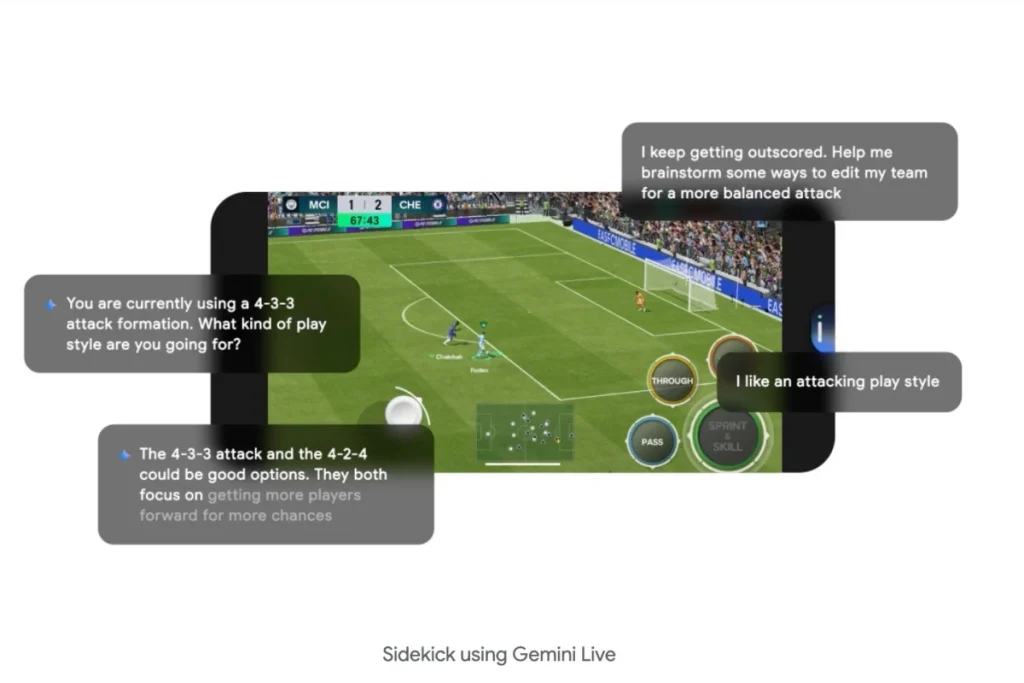
Google has introduced a bold new experiment for Android gamers with the launch of Play Games Sidekick, a gaming interface enhanced by the integration of its generative AI service, Gemini Live. This addition allows players to receive real-time tips, strategies, and guidance during gameplay, while also elevating the broader Google Play Store gaming experience.
When activated, the Sidekick panel appears as a movable overlay within any game downloaded from the Play Store. From this interface, players can quickly access tools for screenshots and screen recording, or even launch a YouTube Live stream directly. Sidekick also provides instant access to achievements and gameplay statistics, consolidating the experience into a single hub.
Yet the true highlight lies in Gemini’s role as an AI “game coach.”
With Gemini Live, even the simplest prompts or a shared screen can yield strategy recommendations, gameplay hints, or even lighthearted jokes. In one demonstration, Gemini instantly proposed an optimal opening strategy for the turn-based civilization game The Battle of Polytopia and offered situational advice based on the live game screen.
Though not intended to replace full strategy guides or community walkthroughs, the assistant offers immediate and convenient answers, saving players the effort of searching online. In this respect, it closely mirrors Microsoft’s efforts with its own Gaming Copilot.
For now, Gemini’s functionality will be available only for a selection of partner titles, including major releases from EA and NetMarble such as Star Wars: Galaxy of Heroes, FC Mobile, and Solo Leveling: Arise. Over time, support will expand to additional games. For those who prefer uninterrupted play, Sidekick can be minimized entirely, leaving only subtle notifications.
Beyond Sidekick, Google is rolling out a series of updates to the broader Play Games platform. These include a unified player profile that synchronizes achievements and statistics across multiple games and devices, AI-generated avatars, and social features that let players follow one another, see what friends are currently playing, and join dedicated forums for discussion and Q&A.
The success of these initiatives will depend heavily on developer adoption and player engagement. Google’s previous foray into large-scale gaming, the Stadia cloud service, ultimately faltered due to misaligned strategy and lackluster player reception. This time, the company is taking a more cautious approach — focusing on assistive tools and community-building features to gradually strengthen platform loyalty.
At the same time, Google announced that Google Play Games for PC has officially exited its beta phase, positioning itself as a direct competitor to Steam and Epic Games by offering cross-platform play and achievement synchronization. For players eager to enjoy Android mobile games on their PCs, this represents a far more polished and mature option.
Taken together, these updates reflect Google’s determination to reclaim a stronger foothold in the gaming market. By combining the power of Gemini AI with deeper community integration, the company aims to transform Play Games into a platform that responds to players’ evolving needs — not merely a storefront for downloads, but a living ecosystem for play, connection, and discovery.
Related Posts:
- Google Unleashes “Search Live”: Converse with AI in Real-Time for Mobile Search
- Google Boosts Real-Time Protection Against Scams and Malware on Android Devices
- Google Play removed 700,000 illegal applications in 2017
Support Our Threat Intelligence
Find our tech and OS security coverage helpful? Support our work today and unlock a 100% ad-free reading experience!
 Buy Me a Coffee
