 Do Son
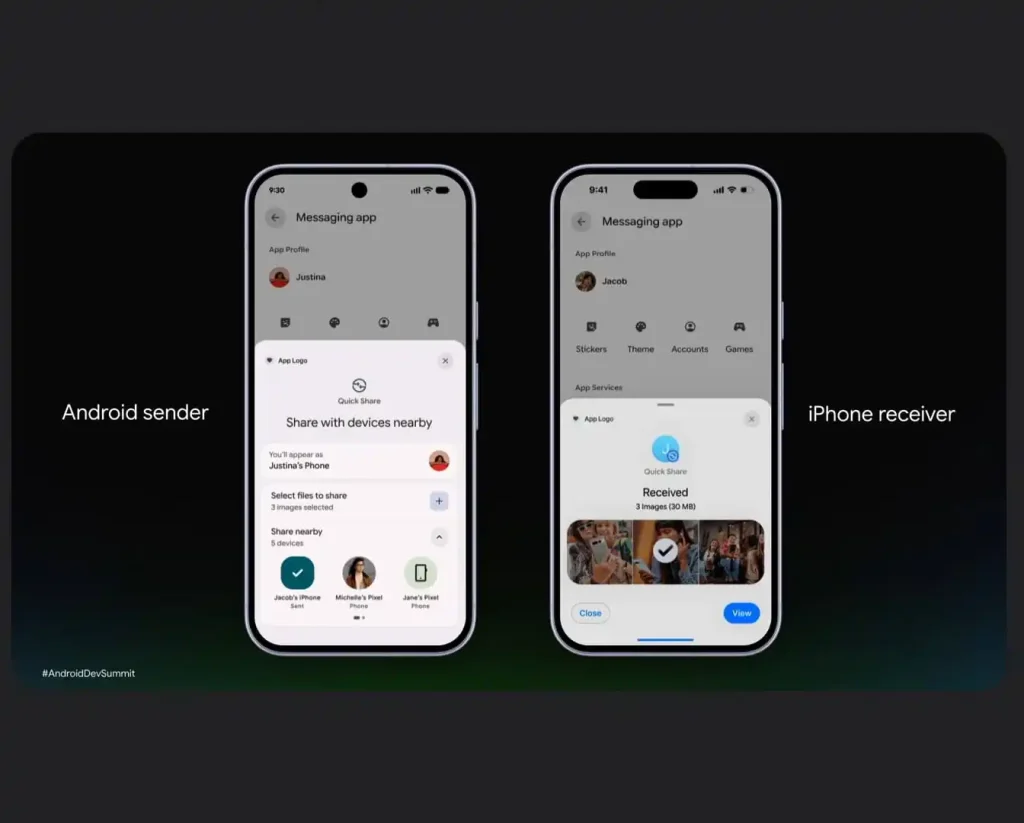
Google officially announced plans to launch a dedicated Quick Share SDK for Android and iOS in early 2027. Specifically, the upcoming Google Quick Share SDK enables developers to embed rapid file transfer capabilities directly into mobile applications. Users will soon exchange files across ecosystems without opening cumbersome operating system menus. Furthermore, the toolkit introduces direct interoperability with Apple AirDrop protocols. Consequently, this update bridges long-standing software barriers between rival mobile ecosystems.
Native In-App Transfers Replace Clunky Menus
Traditionally, Quick Share requires users to navigate system-level share sheets to send local media. Users must select files, summon system prompts, and locate recipient devices manually. In contrast, the software development kit allows engineers to embed custom transfer sheets directly into their user interfaces. When users initiate a share action, a compact bottom sheet appears instantly. Therefore, users can preview pending assets and browse nearby recipients without leaving their current application.
High-Fidelity Transfers and Peer-to-Peer Connectivity
Under the hood, the framework coordinates direct peer-to-peer connections through Wi-Fi Direct and temporary local hotspots. The transmission protocol enforces end-to-end encryption to preserve data confidentiality across all transactions. Additionally, media files retain uncompressed original resolutions throughout the transfer process. As demonstrated in the Google Quick Share SDK presentation video, the transfer engine functions seamlessly without active internet connections. Consequently, travelers can exchange large multimedia files in remote environments lacking cellular coverage.
AirDrop Compatibility and Developer Integration
Crucially, the architecture expands compatibility with Apple AirDrop mechanisms across supported hardware tiers. Android devices running compatible implementations can transmit assets directly to iPhones without third-party companion tools. Furthermore, Google provides auxiliary sharing workflows using temporary QR codes for unsupported platforms. By delivering turnkey device discovery protocols, the toolkit eliminates months of proprietary network engineering for independent developers. Ultimately, this universal standard modernizes cross-platform collaboration across the broader mobile software landscape.
Support Our Threat Intelligence
Find our tech and OS security coverage helpful? Support our work today and unlock a 100% ad-free reading experience!
 Buy Me a Coffee
