Skip to content
July 21, 2026
  • Linkedin
  • Twitter
  • Facebook
  • Youtube

Daily CyberSecurity

Zero-hour alerts. Unmatched analysis.

Primary Menu
  • Home
  • CVE Data
    • CVE Watchtower
    • Top Exploited CVEs
    • CVE Stats by Vendor
    • Q2 2026 Report
  • Cyber Criminals
  • Data Leak
  • Linux
  • Malware
  • Vulnerability
  • Submit Press Release
  • Weekly Recap
Light/Dark Button
  • Home
  • News
  • Cyber Security
  • Hackers use Browser-in-the-Browser attacks to steal Steam accounts
  • Cyber Security

Hackers use Browser-in-the-Browser attacks to steal Steam accounts

Do Son September 14, 2022 2 minutes read
Steam Browser-in-the-Browser

Image: Group-IB

Add Daily CyberSecurity as a preferred source on Google
According to a research report released by security firm Group-IB, there has been an increasing number of recent cases of phishing of Steam players through Browser-in-the-Browser technology, mostly affecting Steam players. These player accounts were stolen and sold on the black market for $100,000 to $300,000. Some players suffered heavy losses, so Steam players should pay attention to this issue to avoid being phished.

Hackers impersonate some well-known gaming tournaments to invite targeted Steam accounts to participate in so-called tournaments. The hacker’s own website imitates the websites of various competitions, and players must log in to their Steam accounts if they want to sign up.

Image: Group-IB

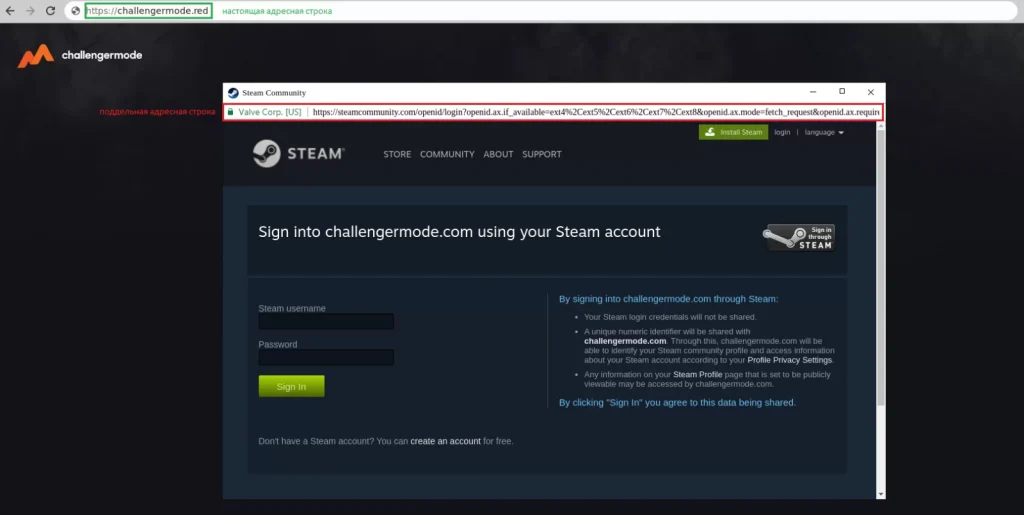
When you click to log in, the website will pop up the official Steam login address (in fact, it is fake), which is nested in your browser windows by hackers using iframes.

Image: Group-IB

Once the player enters their credentials, a new form prompts them to enter the 2FA code. After logging in, the player must also provide a 2FA verification code. Once the account authority is provided, the hacker will control it, and then the information will be changed so that the real player cannot control his account.

Group-IB claims that phishing attacks through Browser-in-the-Browser technology are increasing, not just against Steam, but also against other users such as business users. Hackers forge fake Google and Microsoft account login windows for phishing, which can be said to be hard to prevent for many non-professional users.

Browser-in-the-browser phishing differs significantly from traditional phishing:

Traditional phishing Browser-in-the-browser phishing
Displays a phishing data entry form or redirects users to it. Displays a data entry form in a pop-up browser window.
The address bar displays a URL that differs from the legitimate one. It is therefore obvious to users that entering confidential information on this website is not safe. The address bar contains the URL of a third-party website that the victim wants to visit. The URL in the pop-up window is identical to the legitimate one.
The phishing resource cannot have an SSL certificate. The fake window always displays an SSL certificate lock symbol.

Get Zero-Hour Vulnerability Alerts

Critical CVEs, CVSS scores, and PoC updates — straight to your inbox every week.


We respect your inbox. Unsubscribe anytime.

Related coverage

  • Cloudflare DDoS threat report for 2023 Q3: Countering the 100M RPS HTTP/2 DDoS Onslaught
  • U.S. Prosecutes 10 Iranian Hackers: Attacked Universities and HBO
  • North Korea’s “Contagious Interview” Floods npm with 200 New Packages, Using Fake Crypto Jobs to Deploy OtterCookie Spyware
  • Cyber Espionage Alert: APT41 Strikes Global Industries, Steals Sensitive Data
  • Over 1,200 Entities Hit by TA571’s Forked IcedID Offensive
Track all actively exploited CVEs →

Support Our Threat Intelligence

If you find our CVE report and cybersecurity news helpful, consider supporting our work.

Buy Me a Coffee Logo Buy Me a Coffee PayPal
Crypto QR Code
USDT (TRC20):
TN8BdV8cp4T1Cd28gK9qTAnZknzzuwyUtm
USDT (ERC20):
0x3725e1a7d3bc5765499fa6aaafe307fabcd75bce

Share this article:

Facebook Post LinkedIn Telegram
Written by
@DdoS · Security Researcher

Do Son

Do Son is the Founder and Editor of SecurityOnline.info. Working in cybersecurity since 2013, he reports on vulnerabilities, malware, and emerging threats, providing timely analysis to help organizations and individuals stay ahead of evolving risks.

Search

Translation

CVE WATCHTOWER
🚨

Receive alerts for vulnerabilities being exploited in the wild.

⚡

Get notified instantly when a Proof of Concept (PoC) exploit is published.

🔍

Access critical info on vulnerabilities even when marked as "RESERVED".

🧠

Insights powered by decades of expertise and global intelligence sources.

🎯

Customize alerts with up to 10 keywords for your specific tech stack.

📊

Export the raw CVE database for SIEM integration and reporting.

Upgrade Package

🚨 Active Exploits in the Wild

  • CVE-2026-50522CVSS 9.8
    Deserialization of untrusted data in Microsoft Office SharePoint allows an unauthorized attacker to execute code over a network.
    Admin intel📅 Updated: Jul 21, 2026
  • CVE-2026-63030CVSS 9.8
    WordPress 6.9.x before 6.9.5 and 7.0.x before 7.0.2 is affected by a REST API batch endpoint route confusion...
    Admin intelCISA KEV📅 Added to KEV: Jul 21, 2026📅 Updated: Jul 21, 2026
  • CVE-2026-60137CVSS 5.9
    WordPress 6.8.x before 6.8.6, 6.9.x before 6.9.5, and 7.0.x before 7.0.2 does not properly sanitise the author__not_in parameter...
    Admin intelCISA KEV📅 Added to KEV: Jul 21, 2026📅 Updated: Jul 21, 2026
  • CVE-2026-0770CVSS 9.8
    Langflow exec_globals Inclusion of Functionality from Untrusted Control Sphere Remote Code Execution Vulnerability. This vulnerability allows remote attackers...
    CISA KEV📅 Added to KEV: Jul 21, 2026
  • CVE-2021-27137CVSS 8.1
    An issue was discovered in router/upnp/src/ssdp.c in DD-WRT before 45724. An unsafe strcpy in the UPnP handling functionality...
    CISA KEV📅 Added to KEV: Jul 21, 2026
  • CVE-2026-6875CVSS 9.5
    ServiceNow has addressed a remote code execution vulnerability that was identified in the ServiceNow AI platform. This vulnerability...
    Admin intel📅 Updated: Jul 18, 2026
  • CVE-2026-39808CVSS 9.8
    A improper neutralization of special elements used in an os command ('os command injection') vulnerability in Fortinet FortiSandbox...
    CISA KEV📅 Added to KEV: Jul 16, 2026
  • CVE-2026-25089CVSS 9.8
    A improper neutralization of special elements used in an os command ('os command injection') vulnerability in Fortinet FortiSandbox...
    CISA KEV📅 Added to KEV: Jul 16, 2026
Powered by CVE Watchtower

🔴 Live Critical Threats

  • CVE-2026-64825CVSS 9.3
    Home Assistant Core before 2026.6.0 contains a path traversal vulnerability that allows...
  • CVE-2026-28321CVSS 9.1
    SolarWinds Serv-U is affected by a broken access control vulnerability that could...
  • CVE-2026-28317CVSS 9.1
    SolarWinds Serv-U is affected by an insecure direct object reference (IDOR) vulnerability...
  • CVE-2026-28316CVSS 9.1
    SolarWinds Serv-U is affected by an insecure direct object reference (IDOR) vulnerability...
  • CVE-2026-28314CVSS 9.1
    SolarWinds Serv-U is affected by an insecure direct object reference vulnerability that...
  • CVE-2026-28313CVSS 9.1
    SolarWinds Serv-U is affected by an insecure direct object reference (IDOR) vulnerability...
  • CVE-2026-28312CVSS 9.1
    SolarWinds Serv-U is affected by a privilege escalation vulnerability. This would elevate...
  • CVE-2026-28310CVSS 9.1
    SolarWinds Serv-U is affected by a privilege escalation vulnerability that allows a...
  • CVE-2026-28309CVSS 9.1
    SolarWinds Serv-U is affected by a broken access control vulnerability that allows...
  • CVE-2026-28308CVSS 9.1
    SolarWinds Serv-U is affected by an insecure direct object reference (IDOR) vulnerability...
Powered by CVE WATCHTOWER

Our Websites
  • Penetration Testing Tools
  • The Daily Information Technology
  • Top Exploited CVEs
  • Daily CyberSecurity

    • About SecurityOnline.info
    • Advertise with us
    • Announcement
    • Contact
    • Contributor Register
    • Login
    • Disclaimer
    • DCMA
    • Privacy Policy
    • About SecurityOnline.info
    • Advertise on SecurityOnline.info
    • Contact Us

    When you purchase through links on our site, we may earn an affiliate commission. Here’s how it works

    • CVE Watchtower
    • CVE Statistics by Vendor 2026
    • Q2 2026 Report
    • Top Exploited CVEs
    • Linkedin
    • Twitter
    • Facebook
    • Youtube
    © 2017 - 2026 Daily CyberSecurity. All Rights Reserved.