 Do Son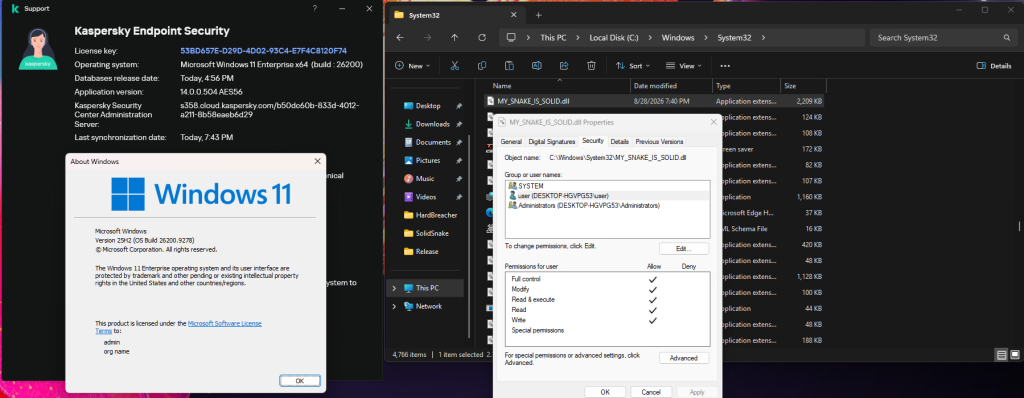
A protective security product can inadvertently transform into a highly vulnerable intrusion point. An independent security researcher utilizing the pseudonym Nightmare Eclipse recently published an experimental exploit dubbed HardBreacher. The creator designed this tool specifically to target Kaspersky Endpoint Security. Furthermore, the researcher claims to have uncovered a previously unknown zero-day vulnerability. This critical flaw allegedly allows an ordinary, unprivileged user to maliciously bypass established Windows privilege boundaries.
See a CVE's exploit risk spike before it becomes a headline.
Get EPSS spike alertsAnalyzing the HardBreacher Proof-of-Concept
The author meticulously tested the published Proof-of-Concept (PoC) code on a fully updated Windows 11 25H2 system. This test environment specifically utilized Kaspersky Endpoint Security version 14.0.0.504. Upon successful execution, HardBreacher illicitly generates a file named `MY_SNAKE_IS_SOLID.dll` directly within the highly restricted `C:\Windows\System32` directory. Subsequently, it aggressively grants the current, standard user absolute access to this newly created object.
Normally, a standard user account absolutely should not possess the capability to freely write files into the critical System32 folder. Therefore, this specific outcome strongly indicates a severe violation of the fundamental Windows rights management mechanism.
Current Limitations and Instability
Nightmare Eclipse remains entirely transparent regarding the current iteration of HardBreacher. The exploit currently operates with significant instability. The execution process frequently terminates with an error. Consequently, the researcher had to repeatedly launch the script to achieve a successful outcome. The author firmly believes developers could eventually transform this discovered mechanism into a stable, highly stealthy exploit. Such a weaponized version would reliably trigger upon a single execution. However, a polished, production-ready variant of that caliber does not presently exist.
The Underlying Interface Vulnerability
According to the researcher’s detailed description, the fundamental problem involves how Kaspersky Endpoint Security interacts with its own dedicated interface process. After successfully wresting control over this specific interface process, the protective software begins behaving erratically. Nightmare Eclipse asserts they successfully disrupted the product’s core functionality and directly influenced sensitive file access operations. Currently, the researcher has only partially disclosed the complex technical details regarding this mechanism. Therefore, independently evaluating the entire potential spectrum of devastating consequences remains exceedingly difficult.
Unconfirmed Status and Missing CVE
Classifying HardBreacher as a finalized, reliable method for instantaneously seizing absolute control over a Windows system remains premature. The public PoC successfully demonstrates illicit object creation within a protected system directory. However, the author has not yet demonstrated a stable, reproducible chain that consistently culminates in arbitrary code execution utilizing SYSTEM privileges.
Furthermore, independent third-party researchers have not yet successfully reproduced the HardBreacher exploit. As of August 31st, security authorities have not assigned a CVE identifier to this vulnerability. Crucially, Kaspersky has neither publicly confirmed the existence of the claimed problem nor specified a definitive list of potentially affected software versions.
The Broader Impact of Endpoint Vulnerabilities
A significant, lingering question concerns the actual, true scale of this potential vulnerability. Nightmare Eclipse exclusively tested Kaspersky Endpoint Security version 14.0.0.504. Therefore, security professionals cannot safely extrapolate these specific conclusions to other builds or variations of the product. Additionally, it remains entirely unknown whether a successful attack necessitates a highly specific security configuration or if HardBreacher functions flawlessly against standard, default settings.
Nightmare Eclipse previously attracted significant industry attention by publishing several vulnerabilities affecting Microsoft Defender. During the spring, the researcher released multiple PoCs, notably including BlueHammer, RedSun, and UnDefend. Later, security specialists at Huntress definitively observed malicious actors utilizing Nightmare Eclipse’s developments during an active, real-world attack. In that specific incident, the attackers eagerly attempted to leverage the published tools after successfully penetrating a corporate network. Fortunately, the vast majority of their exploitation attempts ultimately failed.
The emergence of HardBreacher vividly highlights a particularly unpleasant characteristic inherent to endpoint security solutions. Antivirus and Endpoint Detection and Response (EDR) agents inherently operate with extremely high privileges. They constantly intercept vital file operations and integrate deeply within the core Windows architecture. Consequently, a severe error residing inside such a product potentially grants an attacker vastly more destructive capabilities than a vulnerability found within a standard user application. While HardBreacher currently remains an unconfirmed and unstable experimental PoC, the publication of functioning code significantly intensifies the urgent interest in thoroughly verifying this claimed problem.
Update:
Kaspersky fixed the bug found in the HardBreacher research. Consequently, users can run the app without fear of tool slowdowns.
The bug could cause the app to lose some of its key features. Fortunately, Kaspersky solved the problem by updating its virus database. Therefore, users do not need to install a whole new build.
Impacted Windows Tools
This bug affects Kaspersky Endpoint Security for Windows versions 14.0 and 14.1. Specifically, older files leave these two builds open to the bug.
Safe Build Requirements
Kaspersky fixed the bug in database updates from August 30, 2026, and later. Furthermore, both builds stay safe once users update them. Ultimately, teams should check the database date in the app right away.
Support Our Threat Intelligence
Find our vulnerability reports and weekly recaps helpful? Support our work today and unlock a 100% ad-free reading experience!
 Buy Me a Coffee
