 Do Son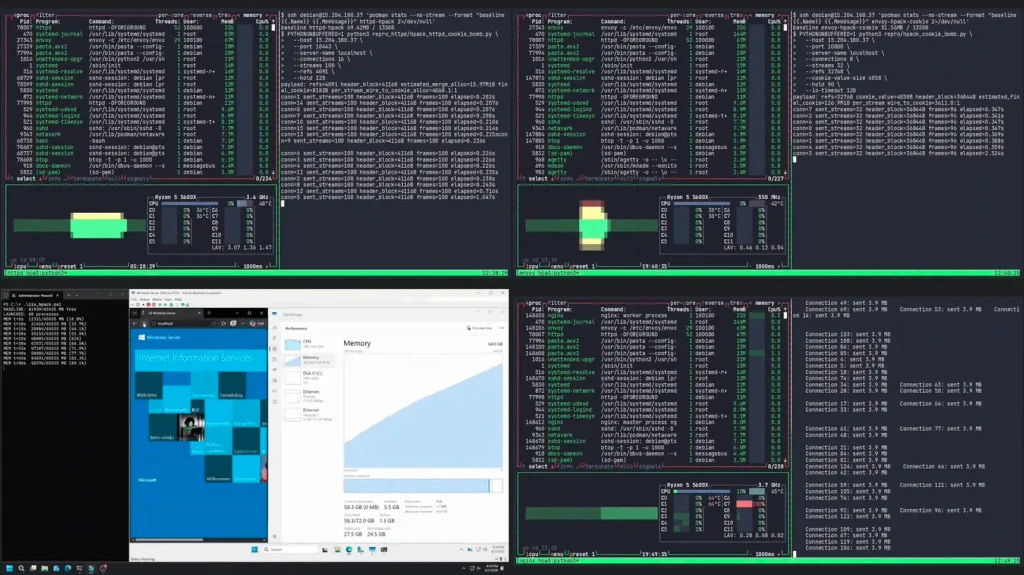
Image: Calif
A devastating network security threat has shocked the web hosting industry this week. Specifically, Calif, a security firm from California, publicly published full details regarding a dangerous HTTP/2 Bomb exploit across public channels. This novel mechanism enables remote attackers to trigger severe denial-of-service conditions against major web architectures. Shockingly, the underlying vulnerability affects the default configurations of almost all prominent modern web servers. Consequently, system administrators must act immediately to secure their endpoints.
Understanding the Attack Mechanics
The underlying technique combines historical infrastructure manipulation strategies into a new, highly dangerous offensive chain. According to the published documentation, “The attack was discovered by Codex, which chained two techniques known to humans for a decade: a compression bomb and a Slowloris-style hold.” First, the malicious process targets HPACK, which serves as the core header compression framework for modern web transport configurations. Furthermore, by exploiting this compression model, a single wire byte can effortlessly expand into an enormous allocation block on the receiving machine.
Consequently, this behavior generates unprecedented memory amplification ratios. Traditional defense mechanisms typically monitor incoming headers to prevent out-of-bounds data payloads from overwhelming resources. However, this strategy completely fails against the new methodology. The report highlights that “Our variant goes the other way: the header is nearly empty, and the amplification comes from the per-entry bookkeeping the server allocates around it.” Therefore, standard volume filters remain completely blind to the threat.
The Devastating Impact of Memory Exhaustion
The true danger of the HTTP/2 Bomb exploit stems from its incredible resource consumption speeds. For instance, an adversary using a basic home internet connection can easily paralyze an unprotected enterprise data center. Analysts verified that “Against Apache httpd and Envoy, a single client can consume and hold 32GB of server memory in roughly 20 seconds.”

Moreover, the malicious connection uses a zero-byte flow-control window to maintain memory pressure indefinitely. The attacker transmits tiny periodic update signals to prevent the backend system from executing standard connection timeouts. Thus, the corrupted memory stays pinned in place. Furthermore, this tactic pushes the host environment into heavy swap space cycles instead of forcing a clean process crash. As a result, legitimate user requests crawl to a complete halt. Additionally, Shodan search parameters indicate that over 880,000 active public web portals currently expose this vulnerable protocol configuration.
Global Disclosure and Vulnerable Systems
Because the publicly disclosed PoC scripts are now accessible online, the window for remediation is shrinking fast. The research firm initially shared its findings with the nginx open-source team in April. Fortunately, those developers responded immediately by integrating an advanced header counting directive into their latest software build. Subsequently, investigators disclosed the bug to the Apache software foundation on May 27. Maintainers deployed an emergency patch on the exact same day to address the flaw, tracking the fix as CVE-2026-49975.
However, many other core application layers do not have formal security updates ready yet. Specifically, platforms like Microsoft IIS, Envoy, and Cloudflare Pingora remain completely exposed to the vulnerability. The researchers warned that automated intelligence systems can seamlessly transform public source diffs into active network payloads. Therefore, the lack of available vendor patches creates an immediate exposure vector for enterprise networks.
Recommended Defensive Mitigations
System engineers must implement alternative structural controls until formal software patches become accessible. If your operational environment can tolerate the protocol shift, you should disable modern web transport features entirely. For example, reverting your central perimeter configuration to classic HTTP/1.1 protocols will eliminate the exploit path completely. Alternatively, administrators can front their vulnerable infrastructure with an intermediate gateway that enforces a strict maximum cap on incoming header fields.
Additionally, security teams can restrict the overall blast radius by applying rigid container resource constraints. Enforcing memory limits via localized cgroups or ulimit tools ensures the kernel will terminate a malicious worker swiftly. The advisory states that “letting the kernel kill one early is a better failure mode than letting the attacker hold the whole machine at 95%.” Ultimately, executing proactive network adjustments is the only way to safeguard your digital operations against this public threat.
Support Our Threat Intelligence
Find our vulnerability reports and weekly recaps helpful? Support our work today and unlock a 100% ad-free reading experience!
 Buy Me a Coffee
