Disrupted: How the “Trapdoor” Ad Fraud Ring Weaponized 455 Android Apps for 659 Million Daily Fake Bids
 Do Son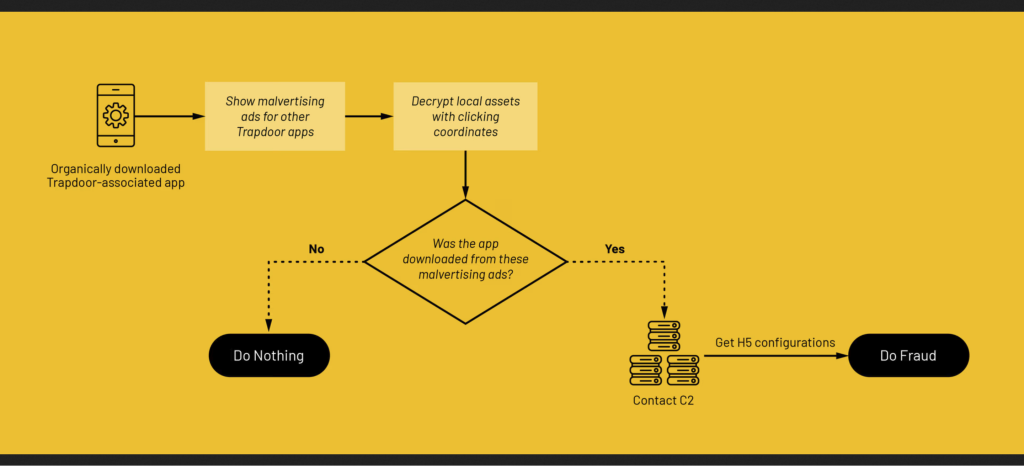
Diagram outlining the Trapdoor threat | Image: HUMAN
The Satori Threat Intelligence and Research Team at HUMAN has successfully disrupted a massive ad fraud and malvertising pipeline. Dubbed “Trapdoor,” this highly stealthy mobile scheme operated through a massive network of 455 malicious Android apps. Furthermore, the threat actors controlled 183 command-and-control (C2) domains to orchestrate their operations.
At its peak performance, the infrastructure generated an astonishing 659 million fraudulent ad bid requests every single day. Unsuspecting users downloaded the compromised apps more than 24 million times globally. Consequently, this operation represents one of the most sophisticated mobile advertising threats uncovered this year.
The Self-Sustaining Cycle of Fraud
To maximize profits, the threat actors designed Trapdoor to feed into itself continuously. The pipeline relies on a dangerous combination of deceptive ads and automated click machinery. As the official report notes:
“Trapdoor is, essentially, a self-sustaining cycle of fraud.”
Stage 1: The Organic Trap
Initially, users willingly install a basic utility app from the app store. These utilities typically look like harmless PDF readers, file managers, or device cleanup tools. Therefore, they attract a large user base without raising immediate security red flags.
Stage 2: The Fake Update Push
Once installed, the app triggers targeted malvertising campaigns on the device. Users suddenly see urgent alerts claiming their current application is entirely outdated or unsupported. Clicking the update button does not upgrade the tool, however. Instead, it covertly installs a secondary, threat-actor-owned application.
Stage 3: Hidden WebViews and Clicks
This secondary app launches a fullscreen WebView that remains completely hidden from the user’s sight. Meanwhile, it loads threat-actor-owned HTML5 news or gaming domains. It uses these specific “cashout domains” to quietly request and render digital advertisements.
Outsmarting the Analysts: Advanced Evasion
Trapdoor stands out because of its advanced anti-analysis engineering. Specifically, the creators mastered the art of hiding from security researchers.
Weaponizing Attribution Tools
The operation explicitly abuses mobile marketing attribution platforms to filter its targets. These platforms normally help marketers track how a user discovered an app.
Instead, Trapdoor checks the installation data values. If the software detects an organic download from a researcher, it displays purely benign behavior. The report clarifies this mechanic perfectly:
“The malicious payload activates exclusively for users who arrived through the threat actors’ own advertising campaigns.”
Defensive Scanners and Environment Checks
Additionally, the C2 infrastructure actively blocks reverse engineers. The malware issues explicit API requests to scan for rooted devices and debugging indicators. Moreover, it performs strict checks for active VPN usage. Since analysts rely heavily on VPNs to intercept local traffic, this check identifies researcher environments instantly.
To make static analysis even harder, the developers utilized a native code packer. They combined this packing with advanced code virtualization and heavy string encryption. Some variants even impersonated legitimate advertising SDK code structures to pass basic security audits.
Faking the Human Touch
Once the malware confirms a valid victim, it drops an encrypted ZIP archive containing coordinate files. These assets contain pre-programmed scripts detailing specific coordinates and timing intervals.
The application deserializes these data coordinates into active model classes. Subsequently, it leverages Android’s native dispatchTouchEvent system. This feature allows the app to generate automated touches, swipes, and taps. As a result, the device simulates highly realistic human interactions directly on hidden ad banners.
Ultimately, this disruption marks an important victory for mobile security. For enterprise CISOs, it underlines the critical need to monitor hidden background WebView traffic. For everyday users, it highlights why you should never trust a random pop-up ad screaming that your app is outdated.
Support Our Threat Intelligence
Find our threat intelligence and malware analysis helpful? Support our work today and unlock a 100% ad-free reading experience!
 Buy Me a Coffee
