 Do Son
TL;DR
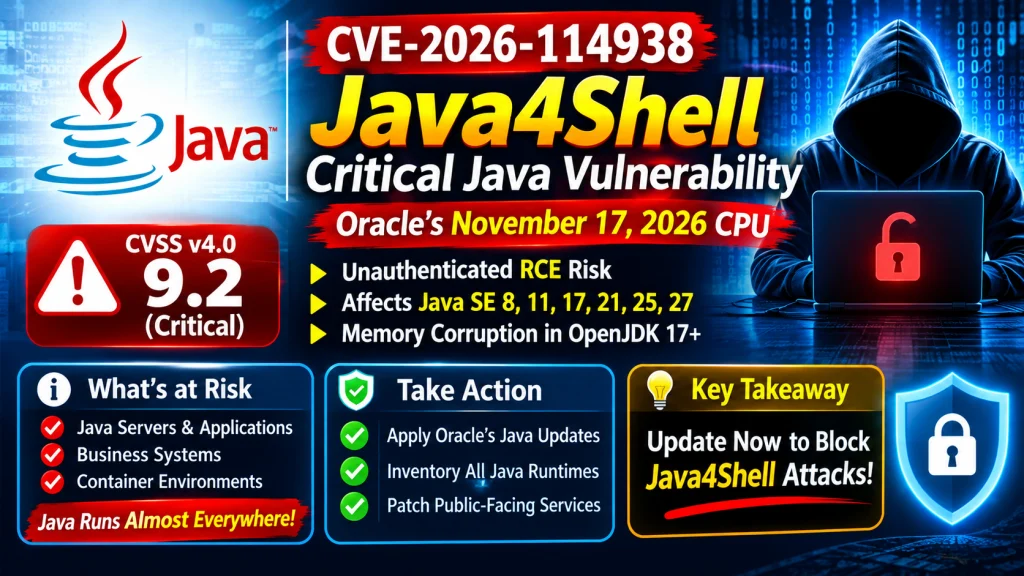
Oracle’s November 17, 2026 Critical Security Patch Update includes 11 Java SE fixes. All of them cover flaws that may be exploitable over a network without authentication. One of them, CVE-2026-114938, has already picked up a name: Java4Shell. Early reports describe the Java4Shell bug as unauthenticated remote code execution in OpenJDK 17. However, Oracle has not yet confirmed the details.
Reports rate CVE-2026-114938 at 9.2 under CVSS 4.0 and trace it to memory corruption in OpenJDK 17.0.6 and later. Oracle lists Java SE 8, 11, 17, 21, 25 and 27 as affected by this month’s Java patches. No exploitation and no public proof-of-concept have been reported so far.
Why It Matters
The Details Leaked Early
Researchers at Calif say they found the flaw. In a post on X, Calif wrote: “Since the vulnerability has leaked: Calif discovered and reported Java4Shell.” The firm added that it would publish technical details “by 1 PM Pacific today, after Oracle releases a patch.”
Security firm watchTowr also acknowledged the reports. However, in its own post on X, it cautioned that the technical details were still unconfirmed.
Java Runs Almost Everywhere
Java powers servers, business applications and many container images. As a result, finding every Java runtime in a large network takes time. Defenders should start that inventory now, before full details appear.
How the Attack Works
Few technical facts are public yet. Early reports name memory corruption as the root cause. They cite an advisory attributed to South Korea’s National Cyber Security Center. If that scope holds, the flaw has existed in Java 17 since OpenJDK 17.0.6 shipped in January 2023.
Notably, running Java does not by itself make a service exploitable. The risk depends on whether attacker-controlled input can reach the vulnerable code. Oracle has not named the affected component.
Why the Scores Differ
The 9.2 score uses CVSS 4.0. In contrast, Oracle uses CVSS 3.1, and its highest Java SE score this month is 8.1. The two figures may describe the same bug, or two different ones. Oracle’s risk matrix will settle that.
Affected Versions
The Oracle Critical Security Patch Update lists these builds as affected:
- Oracle Java SE 8u511, 11.0.33, 17.0.21, 21.0.13, 25.0.5 and 27.0.1
- Oracle GraalVM for JDK 17.0.21 and 21.0.13
- Oracle GraalVM Enterprise Edition 21.3.20.0.3
- Oracle JavaFX 21.0.13, 25.0.5 and 27.0.1
OpenJDK builds from other vendors, such as Eclipse Temurin, Amazon Corretto and Azul Zulu, follow their own schedules.
Patch and Mitigation
Apply the Java updates as soon as fixed builds are available. Oracle’s planned builds include 8u513, 11.0.33.1, 17.0.21.1, 21.0.13.1, 25.0.5.1 and 27.0.1.1. No workaround has been published.
- List every Java runtime, including bundled JDKs and container base images.
- Patch internet-facing Java services first.
- Watch each OpenJDK vendor’s advisory for its fixed build number.
Finally, expect the risk from Java4Shell to rise once Calif publishes its write-up.
Support Our Threat Intelligence
Find our vulnerability reports and weekly recaps helpful? Support our work today and unlock a 100% ad-free reading experience!
 Buy Me a Coffee
