Linear Freedom: Apple Overhauls the Mac Store to Unleash Bespoke M5 AI Powerhouses
 Do Son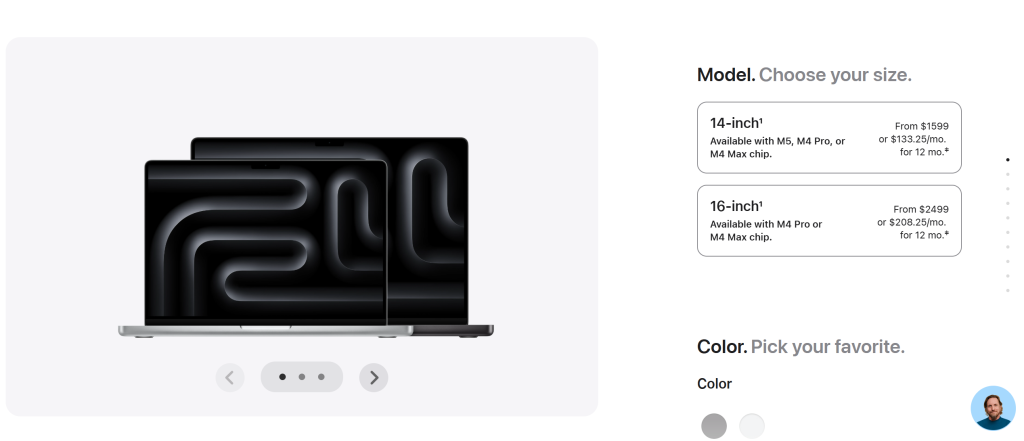
In a subtle departure from its traditional procurement model—wherein the online storefront presented a static inventory of pre-configured Mac specifications—Apple has inaugurated a transformative, streamlined purchasing experience. Previously, consumers were required to select from fixed configurations before fine-tuning specificities such as memory, storage, or pre-installed professional software like Final Cut Pro. Now, the process mirrors the intuitive flow of the iPhone selection, inviting users to first designate their preferred screen dimensions, chromatic finishes, and processor tiers before cascading into memory and storage gradations. This shift liberates the consumer from rigid templates, eliminating erstwhile constraints such as the inability to pair entry-level silicon with expansive memory capacities.
Under this novel architecture, the procurement journey evolves into a sophisticated, linear progression:
- Aesthetics: Initial selection of color and finish.
- The Core: Designation of processor performance tiers (e.g., M5, M4 Pro, or M4 Max).
- Specifications: Granular configuration of unified memory and solid-state storage.
- Peripherals & Software: Finalization of power adapter wattage and the inclusion of professional creative suites.
While this expansion slightly prolongs the journey, it fosters a profound transparency regarding the fiscal impact of each incremental upgrade. It empowers users to orchestrate bespoke machines that harmonize perfectly with their individual requirements, finally permitting the marriage of fundamental processors with maximum memory allocations.
The recently unveiled M5 processor features a radically refined GPU architecture, integrated Neural Processing Units, and significantly augmented bandwidth within the Unified Memory Architecture. These enhancements are engineered to catalyze the efficacy of on-device artificial intelligence. Furthermore, the integration of Thunderbolt 5 and RDMA (Remote Direct Memory Access) technology enables the Mac Studio and MacBook Pro to be linked into “low-latency computational clusters.” This breakthrough allows privacy-conscious small enterprises, burgeoning startups, and medical institutions to execute substantial private models locally.
Consequently, the demand for M5-equipped Mac hardware is anticipated to pivot toward entry-level silicon paired with disproportionately high memory and storage—a configuration optimized for large language model inference. This interface metamorphosis is not merely an aesthetic refinement of the web interface; rather, it serves as a testament to Apple’s unrivaled confidence in its supply chain orchestration.
Historically, “Standard Configurations” were prioritized to facilitate inventory management for distributors. The pivot toward universal customization suggests that Apple has achieved a zenith of precision in production and logistical scheduling. By diminishing the reliance on pre-assembled stock, the firm mitigates the risk of stagnant inventory while aligning its assembly lines more closely with authentic consumer demand. For the seasoned user, the benefits of such flexibility are manifold; however, for the uninitiated, the absence of “ready-made” packages may inadvertently introduce a degree of decision fatigue.
Related Posts:
Support Our Threat Intelligence
Find our tech and OS security coverage helpful? Support our work today and unlock a 100% ad-free reading experience!
 Buy Me a Coffee
