 Do Son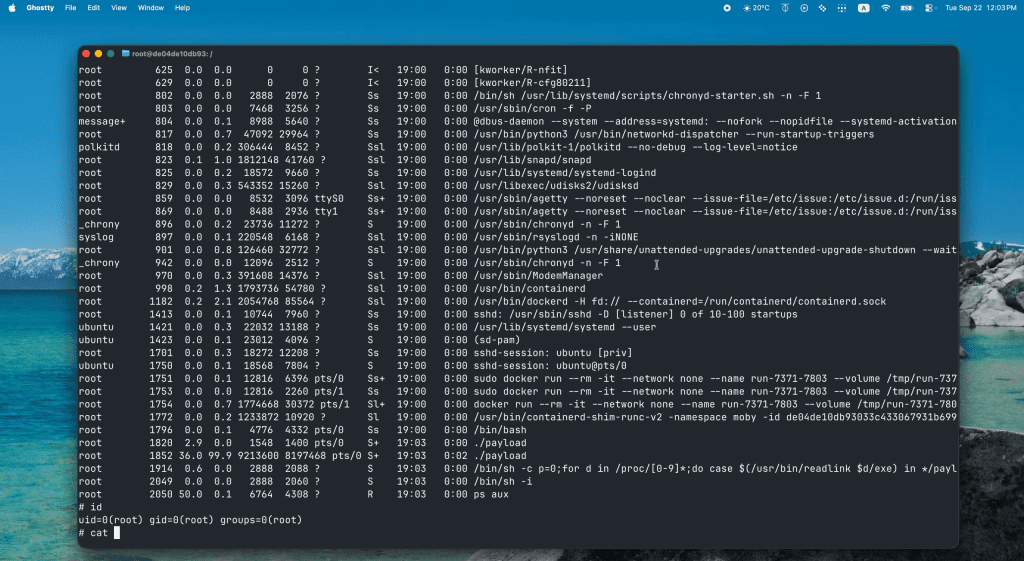
TL;DR
Security researchers disclosed a critical Linux container escape flaw affecting the core operating system kernel. The vulnerability allows an unprivileged attacker to break out of isolated environments by triggering a use-after-free condition. Technical details and a functional exploit are now public, leaving unpatched cloud deployments exposed to host takeover.
- CVE: CVE-2026-80521
- CVSS: 7.8 (High · CVSSv3)
- Product: Linux
- Affected: 5dfd283f4651d04dbb70ceb9ae5c4a30eda3c52a, de7921631ff323369aa63a4324695ab54ea4047e, 4090fa373f0e763c43610853d2774b5979915959, 6.1.141, 6.6.93, 6.10
- Impact: af_unix: Unlink scc_entry in unix_del_edge().
- Status: No confirmed exploitation yet
- Patched in: 2b6c2842692d08e7acaf32d1eb47f95def35f3fe, 6fda5c51b8e43a8440f76e65c89d9f95ddb2ef33, 1293fd69a50d188a5788b08ba3741a3e86be1608, fe198b077864feafd4aa4b33b1a5ce26f50195a2 (+8 more)
- EPSS: 0.2% (30-day)
- Action: Update to 2b6c2842692d08e7acaf32d1eb47f95def35f3fe, 6fda5c51b8e43a8440f76e65c89d9f95ddb2ef33, 1293fd69a50d188a5788b08ba3741a3e86be1608, fe198b077864feafd4aa4b33b1a5ce26f50195a2 (+8 more) now
Why It Matters
Millions of enterprise servers deploy container engines to isolate microservices. Therefore, a failure in this isolation model threatens multi-tenant cloud platforms worldwide. Attackers who escape a container gain direct access to the underlying host system. From there, an intruder can compromise every co-located workload on the physical node.
Security researcher Zhenpeng Lin from DepthFirst AI discovered the flaw using the dfs-large1 vulnerability detection model. In July 2026, researchers demonstrated a zero-day exploit to win a slot in Google’s kernelCTF competition. Security teams have confirmed no active exploitation by cybercriminal groups in the wild. However, researchers publicly published both technical analysis and working exploit code. Lin warned in the advisory that “Containers are not a safe security boundary anymore.” Consequently, defenders must re-evaluate their perimeter assumptions.
How The Attack Works
The vulnerability resides within the AF_UNIX socket family, which handles local inter-process communication. Specifically, the flaw affects the garbage collection routine for SCM_RIGHTS messages. Lin explained that “The vulnerability resides in the AF_UNIX garbage collection (GC) mechanism, specifically within how it handles SCM_RIGHTS messages.” When processes exchange file descriptors, the kernel tracks circular socket references to avoid memory leaks.
During message delivery, the kernel publishes graph edges before safely queuing the socket buffer. This timing gap lets the garbage collector observe new edges prematurely. If the collector frees a vertex, it neglects to unlink it from the cached component ring. Lin noted, “The fatal flaw is that nothing removes the vertex from its persistent scc_entry ring before it is freed.” When the next collection pass runs, the kernel dereferences the stale pointer. This action triggers a use-after-free memory corruption. An attacker inside a restricted sandbox can trigger this race condition to execute kernel-level code.
Containers are no longer a security boundary.
Over the past few months, we’ve seen a crazy amount of Linux kernel vulnerabilities and exploits. This has forced us to rethink the security of infrastructure that relies heavily on the underlying kernel, especially containers.
As… pic.twitter.com/ItocRhMwa3
— Zhenpeng (Leo) Lin (@Markak_) September 22, 2026
Affected Versions
The vulnerability affects Linux kernel builds supporting AF_UNIX garbage collection. Testing confirmed that the published exploit code runs against Ubuntu 26.04 systems. In addition, the flaw undermines user-space isolation tools such as nsjail, Firejail, and Bubblewrap.
Patch Or Mitigation Steps
Upstream kernel developers are preparing security patches to address the faulty garbage collection logic. In the meantime, administrators must take immediate defensive steps to safeguard multi-tenant infrastructure.
Security teams can examine the complete research write-up on the DepthFirst AI research portal. Furthermore, engineers can audit the released proof of concept in the kernelCTF exploit repository on GitHub. To defend against this Linux container escape flaw, organizations should isolate untrusted workloads using microVM platforms. These virtualization tools assign a dedicated lightweight kernel to each workload. As a result, exploiting this Linux container escape flaw will only compromise an ephemeral guest instance.
Support Our Threat Intelligence
Find our vulnerability reports and weekly recaps helpful? Support our work today and unlock a 100% ad-free reading experience!
 Buy Me a Coffee
