 Do Son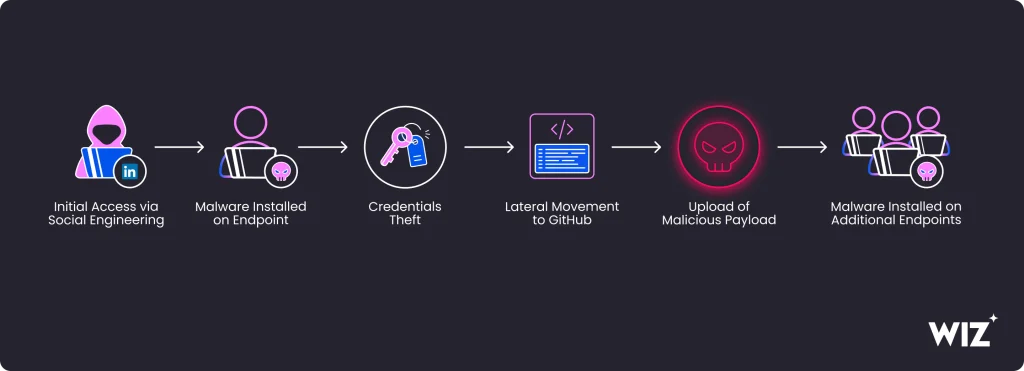
The Attack Chain | Image: The Wiz Customer Incident Response Team
The Wiz Customer Incident Response Team recently uncovered a dangerous global cyber threat. Specifically, a new wave of macOS cryptocurrency malware aggressively targets software developers at financial firms. A previously unknown group handles these focused attacks. Security experts track this financially motivated cluster under the moniker JINX-0164. Furthermore, the attackers focus deeply on compromising enterprise deployment pipelines.
Recruitment Schemes and Social Engineering
The threat actors initiate contact through legitimate-looking social networking channels. For example, they utilize highly credible LinkedIn profiles to message prospective targets. The fake profiles showcase realistic employment histories and relevant industry alignments to build trust rapidly. Consequently, targets readily accept invitations to online business meetings.
However, the meeting links point to fake teleconferencing platforms. When a victim joins the call, the site displays an artificial technical error. The page then instructs the developer to download a camera or audio patch script to resolve the issue. “The initial contact pattern has been similar to the incident detailed above, typically involving a job-related approach, followed by a meeting that has a fake technical error and a malicious ‘fix’ leading to malware installation.”
Deconstructing the Core Malware Architecture
Once the victim runs the script, the computer fetches a stealthy second-stage implant. The group leverages two main families of macOS cryptocurrency malware to execute commands. The primary utility is AUDIOFIX, which functions as a compiled Python information stealer. This malicious application actively harvests sensitive credentials from local password storage vaults.
Deep Credential Harvesting
The data harvesting process targets a wide array of vital developer information. Specifically, AUDIOFIX collects Keychain files, browser history data, and active secure shell keys. The malware also compromises active sessions from communication utilities like Slack and Discord. Most importantly, it extracts secret keys belonging to cloud platforms like AWS and Azure. The threat actors then utilize specialized tools to exfiltrate these secrets automatically.
Aggressive Lateral Movement and Supply Chain Infiltrations
Surprisingly, the network intruders demonstrate very little interest in traditional cloud data pivoting. Instead, they focus their intense efforts on altering internal code repositories. The threat actors inject malicious payloads straight into unverified software branches. To remain hidden, they manually modify committer name fields to impersonate legitimate developers.
Executing the NPM Supply Chain Attack
This malicious code manipulation directly enables larger supply chain operations to further the JINX-0164 developer campaign. For instance, the group successfully trojanized a public developer package on the npm registry. They modified the package initialization scripts to download a backdoor named MINIRAT automatically. According to the report, “The source code on Github was not modified, suggesting that the attackers only had access to NPM credentials.” Consequently, downstream client architectures faced immediate infection risks upon importing the corrupted package.
Infrastructure Characteristics and Defense Recommendations
The operational infrastructure of JINX-0164 remains completely separate from other known groups. For example, analysts found zero overlap with previously documented state-sponsored infrastructure. However, their operational focus closely mirrors historical threat patterns. Both MINIRAT and AUDIOFIX route their primary outbound communications through the datahub.ink domain. Additionally, the threat actors hide their locations by routing internet traffic through anonymous virtual private networks.
Securing the Development Environment
Organizations must apply rigid verification models to defend their software pipelines. For example, turning on GitHub’s Vigilant Mode helps administrators spot unauthorized developer impersonation quickly. Security teams should also inspect unverified badges on incoming repository commits. Finally, avoid executing unknown installation scripts from unverified web portals. Ultimately, continuous behavioral monitoring will keep your private development repositories perfectly safe.
Support Our Threat Intelligence
Find our threat intelligence and malware analysis helpful? Support our work today and unlock a 100% ad-free reading experience!
 Buy Me a Coffee
