 Do Son
At a Glance
| Malware Family | MoldyRoost malvertising delivering Coruna, DarkSword, SilkPath, and GhostWave iOS exploit kits |
|---|---|
| Threat Actor | Unattributed group or affiliate ring; leaked code ties one cluster to an alias named “Nano” |
| Targets | iPhone users in over 47 countries, led by Hong Kong, Japan, Singapore, and the US |
| Delivery Vector | Online ads across 480+ domains leading to cloaked sites and hidden browser frames |
| Key Capabilities | One-click drive-by hacks that steal crypto seed phrases, Keychain passwords, texts, and photos |
TL;DR
Between May 12 and November 17, 2026, MoldyRoost malvertising used 480+ ad domains to hit iPhones in 47 countries. Tapping an ad and loading a page fired hidden iOS exploit kits to steal crypto wallets and passwords. However, Apple fixed the known bugs in newer iOS builds, so updated phones stay safe.
Delivery: Paid Ads and Device Cloaking
Researchers at Confiant tracked this drive-by ad threat for six months. According to Confiant’s MoldyRoost research report, the crew bought web ads using verified business accounts. Those accounts were likely bought or stolen to slip past ad checks.
Once a user tapped an ad, the browser opened a fake site. Meanwhile, a hidden frame ran the attack in the background. Confiant wrote: “Just loading the landing page of a MoldyRoost ad on a vulnerable iPhone is enough to get infected.” Also, Confiant added: “The exploit runs while the landing page loads, with no decoy download or ClickFix-style command to paste.”
Six Groups Across 47 Countries
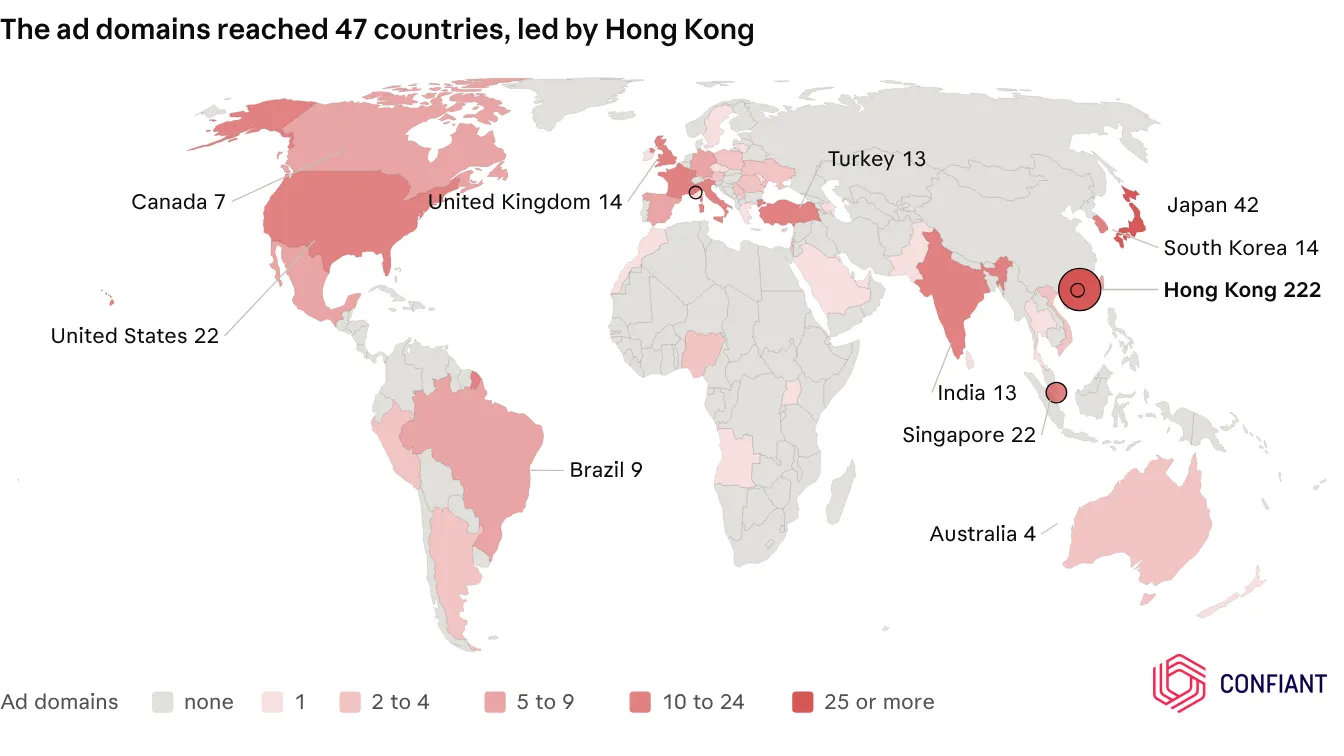
Confiant split MoldyRoost malvertising into six sub-clusters, labeled A through F. Group A was the biggest, with 403 ad domains aimed at 35 countries. Specifically, Hong Kong saw 222 domains overall, while Japan saw 42. Both Singapore and the US saw 22 domains each.
Lure themes changed across each group. For example, group A built fake blogs on travel, health, and forex. In contrast, group C cloned brands like Agoda, Airbnb, and Booking.com to trick Hong Kong users. Other groups used mini-games, crypto guides, or fake security checks.
Cloaking and Delay Tricks
To dodge scanners, the crew used strict device cloaking. Only iPhones running Safari, or select in-app browsers, got the real attack. Desktop users and ad reviewers saw clean decoys or blank frames instead. As a result, desktop-only ad checks often missed the threat.
In addition, some pages stalled users to give the code time to run. On cloned travel sites, a fake load bar held users for 18 seconds before sending them to the real brand. Similarly, group D showed a fake Cloudflare check to keep users on the page.
Infection Chain: From Ad Tap to Kernel Access
MoldyRoost did not write its own iOS exploit kits. Instead, it acted as a delivery engine for spyware-grade tools. In March 2026, Google Threat Intelligence Group (GTIG) and iVerify first exposed Coruna and DarkSword. GTIG noted that these kits showed “an active market for ‘second hand’ zero-day exploits.”
Conceptually, the attack chain moves through four steps after the hidden frame loads:
- Device Check: A script reads the screen size and user agent to spot the iPhone model and iOS build.
- Browser Hack: The chosen kit hits a Safari WebKit bug to run code inside the browser.
- Sandbox Escape: Next, more flaws break the code out of the browser sandbox into system tasks.
- Kernel Takeover: Finally, a kernel flaw grants full control and loads an in-memory data thief.
Routing Across Four iOS Exploit Kits
A version router matched each iPhone to one of four iOS exploit kits. First, phones on iOS 13.0 to 17.2.1 got Coruna, which packs 23 exploits in five chains. Devices on iOS 17.2.2 to 18.3 went to a kit named SilkPath.
Next, phones on iOS 18.4 to 18.7.2 got DarkSword, a JavaScript kit chaining six bugs, including three former zero-days. Finally, devices on iOS 18.7.3 and newer went to a branch named GhostWave. Although the router checked for iOS 26, Confiant saw no working iOS 26 exploit code.
Command-and-Control and Data-Exfiltration Behaviour
After taking over the phone, the payload hunted for financial and private data. Coruna hooked wallet apps like MetaMask, Phantom, and Trust Wallet. It also scanned Apple Notes for seed phrases and read QR codes in saved photos.
Meanwhile, DarkSword stole iMessage, WhatsApp, and Telegram chats along with Keychain logins, Wi-Fi keys, and location logs. Its backdoor could also snap screens, record audio, and wipe crash logs. Infected phones then sent encrypted files over HTTPS to remote servers, tagged by the ad channel that won the click.
Confirmed Versus Suspected Attribution
Confiant confirmed key facts after an exposed Git server leaked group F’s code in November 2026. The commits, written in Chinese by an alias named “Nano,” built per-channel payloads to track stolen wallets. Confiant also confirmed that MoldyRoost is separate from the November 16 Optimizely web attack.
However, full actor ties remain unconfirmed. Confiant thinks one supply chain backs all six groups, yet it is unclear if one crew runs them all or rents access to affiliates. Confiant gave no victim count or dollar loss for MoldyRoost. For context, iVerify said at least 42,000 iPhones fell to an earlier Coruna crime wave.
Defense and Detection Guidance
Updating your iPhone is the best way to block MoldyRoost malvertising. Apple fixed all six DarkSword bugs by iOS 26.3, and both GTIG and iVerify urge users to install iOS 18.7.6, iOS 26.3.1, or newer builds. Therefore, turn on automatic updates under Settings, General, and Software Update.
Furthermore, GTIG advises turning on Apple’s Lockdown Mode for high-risk users or older phones. Crypto users should never keep seed phrases in Notes, photos, or cloud backups. Instead, store backup phrases offline and open official apps directly rather than tapping web ads.
Finally, ad platforms and security teams must change how they test ads. Because MoldyRoost hides payloads from desktops, defenders should scan ad pages with iPhone Safari user agents. Teams can also watch logs for zero-pixel frames, fresh brand-clone domains, and forced jumps to Safari.
Support Our Threat Intelligence
Find our threat intelligence and malware analysis helpful? Support our work today and unlock a 100% ad-free reading experience!
 Buy Me a Coffee
