 Do Son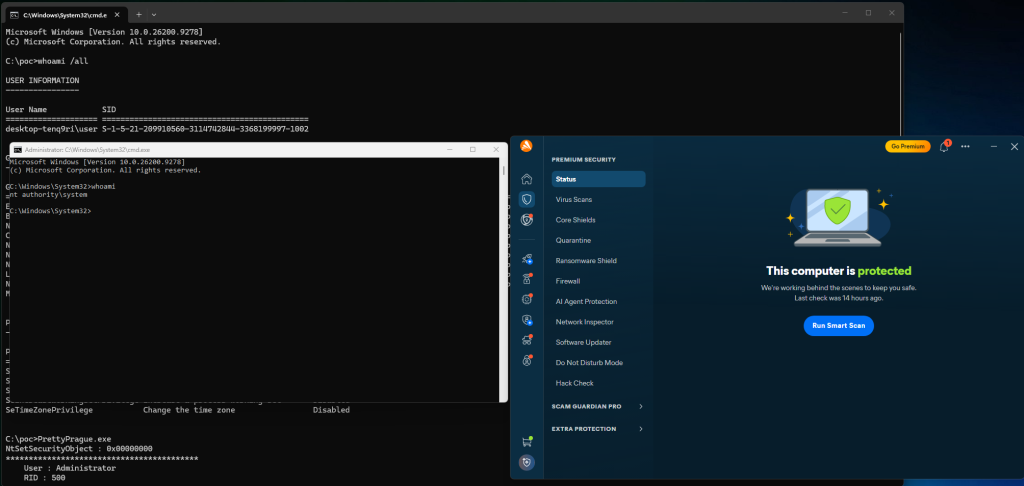
The infamous NightmareEclipse public vulnerability series recently expanded its scope significantly. It rapidly transcended its initial Windows focus to simultaneously impact three distinct security and system products. The author recently published demonstration code targeting Avast Antivirus, Kaspersky Endpoint Security, and specific NVIDIA components. Crucially, none of these alarming discoveries have yet received an official CVE designation. Furthermore, independent security researchers have not confirmed them, nor have the respective manufacturers issued any official security bulletins.
CISA KEV isn't the only exploit signal for Microsoft CVEs. Pro/Team adds a second confirmed-exploit feed.
Try free for 14 daysThe PrettyPrague Avast Sandbox Exploit
The PrettyPrague attack vector directly targets a hypothesized vulnerability residing within the Avast sandbox environment. The author claims this flaw enables a standard local user to successfully acquire absolute SYSTEM privileges. Consequently, the attacker can illicitly copy the sensitive SAM database. Windows utilizes this specific database to securely store critical password hashes. The author reportedly tested this Proof-of-Concept (PoC) on a fully updated Windows 11 25H2 system utilizing the latest Avast version. However, any potential, cascading impact upon related AVG and Norton products currently remains entirely speculative.
HardBreacher Targets Kaspersky Endpoint Security
The second released PoC, designated HardBreacher, specifically targets Kaspersky Endpoint Security version 14.0.0.504. This malicious code aggressively intercepts control over the protective software’s dedicated interface process. It then attempts to illicitly write a library file directly into the highly restricted System32 folder, utilizing the permissions granted to the current user. NightmareEclipse openly acknowledges the inherent instability of this specific demonstration. Users frequently must repeat the execution process to achieve a successful system compromise.
GreenSection Exposes NVIDIA Memory Flaws
The GreenSection discovery involves a shared memory region utilized by various NVIDIA components. Notably, all local users possess both read and write access to this specific area. The system subsequently reprocesses modified memory structures without implementing sufficient security validation checks. This fatal oversight predictably leads to dangerous out-of-bounds memory writes. The provided code successfully induces application crashes involving Vulkan or OpenGL components. However, it does not currently hijack those affected processes entirely.
Potential Escalation Scenarios
NightmareEclipse theorizes that developers could potentially evolve the GreenSection vulnerability further. A refined exploit could successfully interfere with the active processes belonging to another user. Alternatively, it might compromise the critical Desktop Window Manager (dwm.exe). However, the author has not presented a finalized, functional exploit capable of executing such advanced scenarios.
These three distinct publications clearly demonstrate varying levels of immediate risk. The author presents PrettyPrague as a fully functional, reliable privilege escalation method. Conversely, HardBreacher remains demonstrably unstable in its current iteration. Finally, GreenSection currently only achieves localized memory corruption and subsequent application crashes.
The History of NightmareEclipse
The NightmareEclipse saga initially commenced earlier this spring. The author released a massive series of discoveries affecting Microsoft Defender, BitLocker, and core Windows system services. This impressive portfolio included named vulnerabilities like BlueHammer, RedSun, UnDefend, YellowKey, GreenPlasma, MiniPlasma, RoguePlanet, LegacyHive, and ShieldBreak. Certain PoCs permitted attackers to secure SYSTEM privileges or effectively bypass critical disk protection mechanisms. Microsoft subsequently addressed and patched several of these specific vulnerabilities.
Conflict Regarding Vulnerability Disclosure
A highly publicized conflict with Microsoft accompanied these initial publications. NightmareEclipse vociferously claimed the corporation violated established agreements and unjustly closed their vulnerability reporting account. Microsoft countered by formally accusing the author of engaging in uncoordinated, irresponsible disclosure. The technology giant even mentioned potential law enforcement involvement. However, Microsoft later clarified its stance, stating it harbored no intention to prosecute good-faith security professionals.
Currently, Avast, Kaspersky, and NVIDIA have not issued official responses. Therefore, organizations must proactively restrict the execution of unknown programs. Administrators must vigilantly monitor manufacturer bulletins and rapidly deploy all necessary security patches.
Support Our Threat Intelligence
Find our vulnerability reports and weekly recaps helpful? Support our work today and unlock a 100% ad-free reading experience!
 Buy Me a Coffee
