NVIDIA’s New NVLink Fusion Initiative Is Building a “Trillion-Scale AI Superfactory”
 Do Son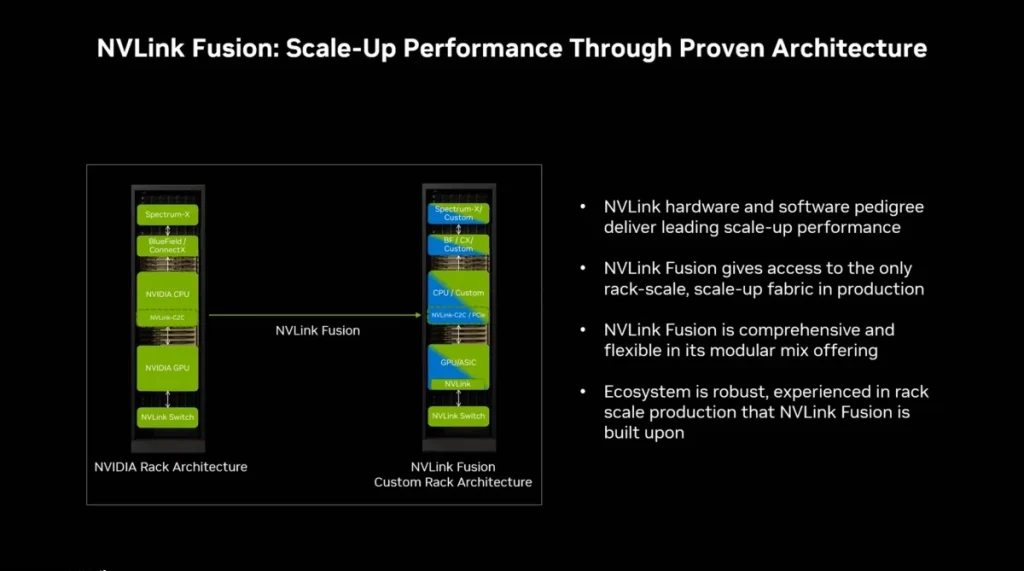
At Computex 2025, NVIDIA announced the launch of its NVLink Fusion semi-custom AI infrastructure initiative, a program designed to allow third-party chipmakers to integrate their own custom processors with NVIDIA’s Blackwell GPUs and even its upcoming Rubin CPUs through NVLink and NVLink-C2C interconnect technologies. This strategy aims to create AI computing platforms tailored to diverse workloads, and NVIDIA has already established partnerships with industry leaders such as Alchip, Marvell, Qualcomm, Cadence, and Synopsys.
Further details unveiled at the Hot Chips conference clarified that NVLink Fusion is not limited to NVIDIA’s own products. Instead, chipmakers adopting this design can interconnect custom processors with virtually any type of accelerator—be it GPUs, NPUs, or XPUs—broadening the scope of heterogeneous computing while accelerating the adoption of NVLink as an industry standard.
With this move, NVLink Fusion positions itself as a new platform for ecosystem expansion, enabling vendors to build heterogeneous compute solutions around NVLink while also encouraging tighter integration with NVIDIA’s own accelerators, such as the Blackwell GPU architecture or Grace CPUs built on Arm.
NVIDIA has indicated that NVLink Fusion will support three configuration models:
- A custom CPU,
- A custom XPU (representing any compute accelerator),
- Or a combination of CPU and XPU.
If one endpoint consists of a standalone XPU, it can be bridged through the open UCIe interface and then linked to other compute elements via NVLink—without being restricted solely to NVIDIA’s hardware. In cases where a custom processor is paired with an NVIDIA GPU, NVIDIA recommends adopting NVLink-C2C for native high-speed interconnect. For scenarios involving two third-party custom processors, NVIDIA has not yet disclosed detailed topologies but expects NVLink-C2C to serve as the foundation for such connectivity.
As AI and HPC systems drive insatiable demand for compute bandwidth, high-speed chip-to-chip interconnects have become indispensable. By opening NVLink Fusion to the industry, NVIDIA enables chipmakers to connect their custom processors with a wider array of heterogeneous accelerators, leveraging the maturity of NVLink technology to accelerate co-processing, system integration, and ecosystem growth.
Members of the NVLink Fusion alliance are already charting varied application paths. MediaTek is using NVLink to advance automotive chips, co-developing the GB10 compute platform with NVIDIA. Qualcomm intends to re-enter the data center space using NVLink-enabled solutions, with further announcements expected at this year’s Snapdragon Summit in Hawaii. Fujitsu, meanwhile, is collaborating with RIKEN to integrate NVLink with NVIDIA GPUs in the upcoming “Fugaku Next” supercomputer.
NVLink Fusion is built on the Open Compute Project’s (OCP) MGX modular architecture, providing partners with a standardized framework to design rack-scale systems equipped with NVLink. For AI and HPC environments requiring ultra-high bandwidth and low latency, NVLink Fusion offers a scalable, flexible, and highly efficient interconnect strategy.
In essence, the open strategy behind NVLink Fusion extends NVIDIA’s ecosystem beyond its own products, empowering third-party chipmakers to accelerate the development of high-performance systems in the era of heterogeneous computing, while propelling AI and HPC platforms toward faster, broader-scale deployment.
Related Posts:
- NVIDIA’s New Ethernet Tech Turns Distributed Data Centers Into a Single AI “Superfactory”
- Red Hat Unveils llm-d: Scaling Generative AI for the Enterprise
- NVIDIA Brings CUDA to RISC-V: A Game-Changer for AI and Heterogeneous Computing
- VmWare release the patch to fix use-after-free and integer-overflow vulnerabilities
- Broadcom Addresses Critical Vulnerabilities in VMware ESXi, Workstation, and Fusion
Support Our Threat Intelligence
Find our tech and OS security coverage helpful? Support our work today and unlock a 100% ad-free reading experience!
 Buy Me a Coffee
