The CLAW Trap: How a Sophisticated Phishing Syndicate is Hunting Developers on GitHub
 Do Son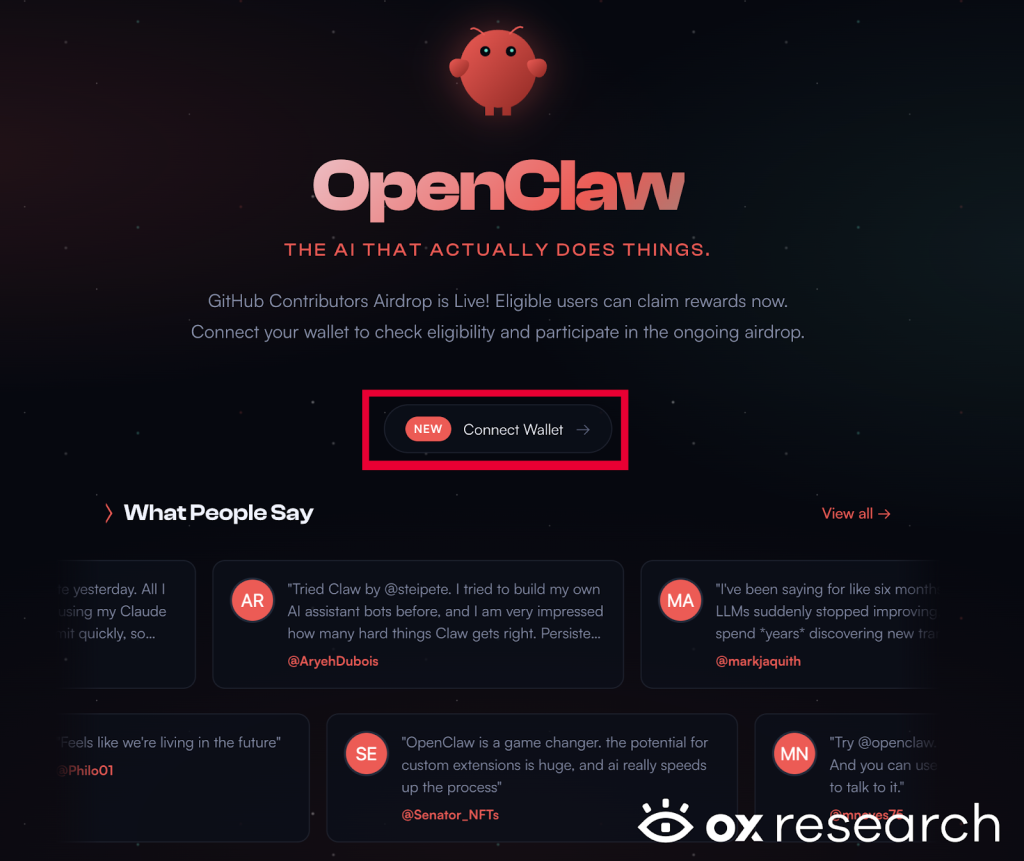
Image: OX Security
The cybersecurity firm OX Security recently promulgated a report exposing an insidious cryptocurrency artifice targeting the OpenClaw AI bot initiative. The syndicate orchestrating this machination has set its sights upon patrons and developers devoted to the project, alluring them with the fabricated promise of dispersing five thousand dollars’ worth of CLAW cryptographic tokens.
Should an unsuspecting individual traverse the provided hyperlink, they are ushered into a counterfeit facsimile of the official OpenClaw domain. Herein, the patron is implored to tether their cryptographic wallet and bestow operational sovereignty to claim the elusive tokens; alas, upon capitulation, the marauders mercilessly drain the wallet of its entire contents. The syndicate’s choreography of deceit unfolds as follows:
- The inauguration of a sovereign, public repository ostensibly tethered to OpenClaw, yet entirely subjugated by the malefactors.
- The mass fabrication of repository issues, deliberately tagging developers and enthusiasts whose gaze is fixed upon the OpenClaw endeavor.
- The ensuing barrage of notifications dispatched to these tagged individuals, masterfully engineered to beguile them into visiting the assailants’ phishing sanctuary.
- Within this deceptive expanse, the syndicate demands the tethering of the patron’s wallet and the surrender of operational dominion under the guise of dispensing the promised CLAW tokens.
- The exact moment this sovereignty is yielded to the phishing domain, the syndicate instantaneously exfiltrates the absolute totality of the wallet’s balance.
Following a rigorous forensic dissection, the OX security vanguard postulates that the syndicate likely pinpoints its quarry by meticulously scanning the OpenClaw fork repositories nestled within GitHub. The underlying rationale suggests that these profoundly invested patrons are exponentially more susceptible to the allure of such notifications.
Alternatively, the marauders may possess mechanisms to systematically identify patrons who have bestowed a star upon the OpenClaw repository. After all, a haphazard bombardment of GitHub’s colossal user base would likely yield a meager harvest, rendering this precise, calculated targeting vastly more efficacious.
The OX vanguard observed that this syndicate had previously spawned a multitude of covert accounts explicitly for disseminating these venomous issues; however, mere hours following the commencement of this phishing crusade, these accounts suffered righteous banishment at the hands of GitHub. This swift retribution implies that GitHub’s intrinsic risk-mitigation architectures had successfully detected the underlying anomaly.
At this present juncture, it remains shrouded in ambiguity whether any patrons have suffered financial decimation amidst this charade. Nevertheless, the paramount imperative for the digital commonwealth is to remain fiercely skeptical of serendipitous windfalls and, under absolutely no circumstances, surrender wallet sovereignty to an unverified, alien domain.
Support Our Threat Intelligence
Find our threat intelligence and malware analysis helpful? Support our work today and unlock a 100% ad-free reading experience!
 Buy Me a Coffee
