 Do Son
Severe Infrastructure Exposure Discovered
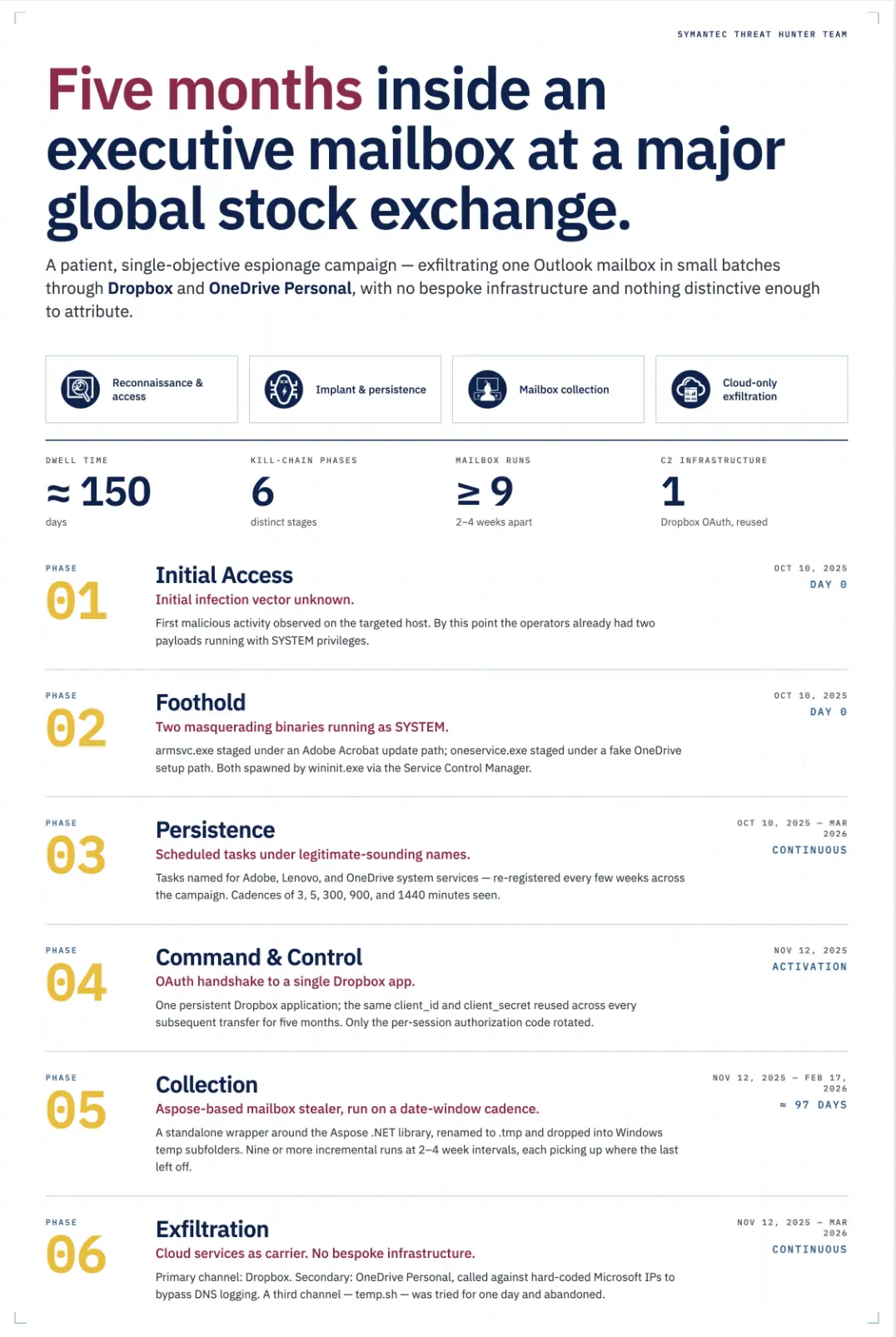
An unknown threat actor recently executed a highly disciplined cyber operation against a major financial institution. Specifically, hackers managed to sustain a five-month executive espionage campaign targeting a senior leader. During this initial entry period, the attackers focused their efforts entirely on quiet, persistent Outlook mailbox theft. They systematically drained critical corporate intelligence in small, incremental batches. Consequently, corporate security teams failed to notice the malicious data transfers because the network traffic closely mirrored legitimate everyday cloud usage.
The Strategic Value of Executive Communications
According to a recent report from the Symantec Threat Hunter Team, this intrusion represents a textbook example of targeted intelligence gathering. For an espionage actor, a corporate leader’s inbox is a high-value intelligence target. This profile yields secret details regarding external negotiations, internal business deliberations, and executive travel patterns. Furthermore, global stock exchanges routinely hold non-public records about listings and market-moving events. Therefore, prolonged access allows adversaries to map out an organization’s near-term strategic direction. Crucially, the threat actors achieved this deep level of visibility without ever moving laterally across the internal network.
Establishing a Stealthy Foothold
The initial infection vector remains completely unknown to investigators. However, security analysts first observed active malicious activity on October 10, 2025. By that time, the operators already controlled two masquerading binaries running with maximum SYSTEM privileges. Specifically, they selected clever file paths to mimic harmless software deployments. For example, they dropped a fake binary named armsvc.exe into an Adobe Acrobat update directory. Meanwhile, they placed a second binary named oneservice.exe into a fake OneDrive setup path.
To maintain their long-term access, the attackers built a robust scheduled-task layer. They re-registered tasks every few weeks under legitimate-sounding names, such as a Lenovo system-health check. Consequently, these scheduled tasks ensured that their malicious code executed reliably across a five-month span.
Mechanics of the Outlook Mailbox Theft
The primary engine of this operational campaign was a customized data harvesting tool designed explicitly for Outlook mailbox theft. Specifically, the hackers utilized a standalone wrapper built around a legitimate software resource. As noted in the Symantec analysis:
“Aspose is a legitimate commercial .NET library with support for parsing Outlook OST and PST mailbox files.”
The attackers renamed this custom executable using innocuous temporary file extensions. Next, they dropped the tool directly into deep Windows temporary subfolders to avoid scrutiny.
The custom stealer operated on a very strict date-window cadence. Over five months, the attackers executed at least nine incremental extraction runs spaced two to four weeks apart. Each new script run specified a precise date range that adjoined the previous timeframe. This calculated method allowed the operators to quietly pick up exactly where their last harvest ended. Therefore, they successfully generated small, unnoticeable archives. Ultimately, this continuous Outlook mailbox theft granted them a complete record of the executive’s professional life.
Advanced Cloud Exfiltration Tactics
To move the stolen files out of the environment, the adversaries used trusted public cloud infrastructure. They established a primary command and control channel through a single persistent Dropbox application. For five months, they reused the exact same client credentials for all data transfers. However, they rotated the individual authorization codes for each unique session. This disciplined operational behavior effectively prevented defensive systems from flagging the cloud connection as anomalous.
Furthermore, the attackers deployed a secondary exfiltration channel using OneDrive Personal to bolster their resilience. To achieve maximum stealth, they deliberately avoided using standard web hostnames. Instead, they made direct network calls to hard-coded Microsoft IP addresses. The Threat Hunter Team highlighted the cleverness of this specific technique:
“By switching from the hostname to a hard-coded IP, the attackers were able to reach OneDrive without producing any DNS queries for onedrive.live.com, a useful evasion against perimeter logging or DNS-based blocking.”
Ultimately, the absolute lack of bespoke infrastructure leaves very few clues regarding the attackers’ true identities. As a result, this sophisticated executive espionage campaign remains entirely unattributed to any known threat group.
Support Our Threat Intelligence
Find our threat intelligence and malware analysis helpful? Support our work today and unlock a 100% ad-free reading experience!
 Buy Me a Coffee
