
 Do Son
Dell Technologies has issued a critical security advisory addressing multiple vulnerabilities in its CloudLink encryption management software,...
Latest news

Apple has recently released the iOS 26.2 beta for developers, and within this version, some developers have...

Apple is reportedly preparing to launch a new, far more advanced version of Siri in 2026, powered...

By default, Apple’s Apple Watch automatically syncs with the Wi-Fi networks connected to its paired iOS device,...

Microsoft has recently introduced a multi-app batch installation option in its application store, designed to address the...

Google has announced plans to further expand the integration of Gemini AI across its suite of services....

Google and Epic Games have jointly announced that they have reached a settlement in their long-running antitrust...

Amazon recently issued a formal notice to AI startup Perplexity, demanding that its Comet browser immediately cease...

A frustrating issue that has surfaced before has once again reappeared. According to Microsoft’s latest support documentation,...
Microsoft has recently released a new test build for participants in the Windows Insider Preview Program —...

Tycoon 2FA operates by using an adversary-in-the-middle (AitM) approach. Its primary function is to harvest session cookies

The flaw, tracked as CVE-2024-27793, was discovered by Willy R. Vasquez, a security researcher at The University of Texas at Austin.

A high-severity security vulnerability (CVE-2024-32655) has been discovered in Npgsql, a widely used open-source data provider

Technical details have emerged about a significant security vulnerability, CVE-2024-21115, which has been discovered in Oracle VM VirtualBox

The flaw, designated CVE-2024-4671, is a "use after free" bug located within the browser's "Visuals" component.

Recent discoveries have exposed CVE-2024-34350 & CVE-2024-34351 which could compromise user data and server operations

CVE-2024-4701 (CVSS 9.9) has been discovered in Genie, Netflix's popular open-source job orchestration engine for big data processing

CVE-2024-3806 (CVSS 9.8): An unauthenticated LFI vulnerability within the porto_ajax_posts function of the Porto theme

TRU have uncovered a disturbing trend in FIN7 attacks demonstrating the notorious cybercrime group's evolving tactics for infiltrating systems

CVE-2024-32980 (CVSS 9.1) has the potential to allow network sandbox escapes in specifically configured Spin applications.

The Qt Group has released a security advisory and accompanying patch in response to a vulnerability (CVE-2024-33861)

eSentire's Threat Response Unit (TRU) has detailed a sophisticated intrusion campaign by the SocGholish cyber threat group
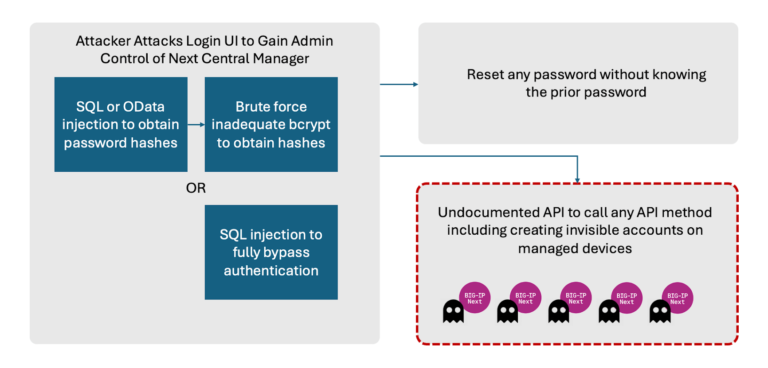
A recent investigation by Eclypsium, a prominent supply chain security firm, has unveiled a series of critical...

These flaws could potentially allow arbitrary code execution (CVE-2024-24787) and cause infinite loops (CVE-2024-24788) in DNS operations

Researchers have exposed a dangerous set of vulnerabilities within CyberPower's PowerPanel Business Software

AsyncRAT, which stands for Asynchronous Remote Access Trojan, is a sophisticated malware variant meticulously engineered

CVE-2024-34346 (CVSS 8.5) presents a significant risk as it allows for permission escalation through the mishandling of privileged files

Trend Micro has released a security update for its Maximum Security software suite, addressing a privilege escalation flaw (CVE-2024-32849)

CVE-2024-29212 carries a high severity rating with a CVSS score of 8.8, primarily due to its potential to allow remote code execution (RCE)

Attackers are weaponizing two critical vulnerabilities, CVE-2023-46805 and CVE-2024-21887, to spread the notorious Mirai botnet malware

zEus stealer launches a series of checks to determine if it is under analysis, avoiding detection by comparing the computer name

Designated as CVE-2024-4367 in PDF.js and CVE-2024-34342 in React-PDF, this flaw hinges on the improper handling of JavaScript