
 Do Son
At Connect 2025, Meta officially unveiled its first smart glasses with a built-in display — the Ray-Ban...
Latest news

SonicWall, a leading provider of network security solutions, has disclosed a recent security incident involving the exposure...

Jenkins, one of the most widely used open-source automation servers, has released a new security advisory addressing...

India’s digital infrastructure has become a high-value battleground for hacktivists. A new analysis from CYFIRMA highlights how...

Google has released a Stable Channel update to version 140.0.7339.185/.186 for Windows and Mac, and 140.0.7339.185 for...

The Taiwan Computer Emergency Response Team / Coordination Center (TWCERT/CC) has issued a security advisory warning of...

Microsoft’s Digital Crimes Unit (DCU) has dismantled the infrastructure behind RaccoonO365, one of the fastest-growing phishing kit...

State-aligned Chinese threat actor TA415 (also tracked as APT41, Brass Typhoon, Wicked Panda) has launched a series...

Researchers from Acronis’ Threat Research Unit (TRU) have uncovered a rare in-the-wild FileFix campaign, marking the first...
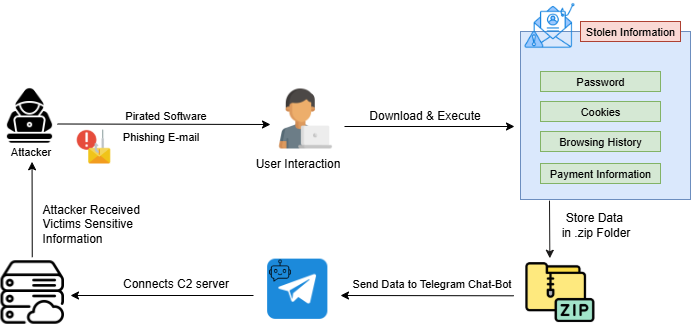
Raven Stealer, a new entrant in the commodity malware ecosystem, is emerging as a stealthy yet powerful...

CVE-2023-36884, characterized as a high-severity flaw, plagues both Office and Windows, offering attackers a dangerous platform to execute arbitrary code

CVE-2023-37266 could allow unauthenticated attackers to craft arbitrary JWTs and access features that usually require authentication

CVE-2023-3696 bug, which carries a significant CVSS score of 10, stands testimony to its gravity and potential for wreaking havoc

CVE-2023-37466, a critical CVSS score of 9.8, exposed the VM2's sandbox, allowing rogue elements to bypass Promise handler sanitization

The CVE-2023-38198 flaw, allowing for the execution of arbitrary commands via 'eval', has reportedly been exploited in the wild in June 2023

Cisco released security updates to address a critical severity vulnerability (CVE-2023-20214) found in the Cisco SD-WAN vManage software

Power BI, Microsoft’s powerful business intelligence tool, empowers users to transform raw data into actionable insights. One...

In Apache RocketMQ, the black hole takes the form of CVE-2023-37582, a lingering vulnerability threatening the secure performance of this reliable platform

CVE-2023-33308 in FortiOS and FortiProxy might allow a remote attacker to execute arbitrary code or commands via carefully crafted packets

recent revelations highlight some vulnerabilities in the system that have been silent undercurrents, threatening to unseat us from our boards

CVE-2023-24492 vulnerability, discovered in the Citrix Secure Access client for Ubuntu, bears a CVSS score of 9.6

Technical issues, maintenance, and weather affect; these are some of the reasons that can cause internet disruptions....

CVE-2022-42009, is a notable case of Spring Expression Language injection. A malicious authenticated user can execute arbitrary code remotely

CVE-2023-37450 zero-day exploit allows ill-intentioned hackers to execute arbitrary code on targeted devices

Mobile marketing campaigns pack a punch. You can create them anywhere, and there’s a wide variety of...

IMY considers that the data transferred to the US via Google's statistics tool is personal data because the data can be linked with other unique data

With a towering CVSS score of 9.9, CVE-2023-36460 allowed attackers to create arbitrary files anywhere, using specially crafted media files

After trace analysis, Kaspersky discovered 34 analogous extensions on the Chrome Web Store. While these extensions offer specific functionalities

The CVE-2023-20185 security loophole is specific to Cisco Nexus 9000 Series Fabric Switches in ACI mode running releases 14.0 and later

An unauthenticated attacker could potentially exploit the CVE-2023-36934 flaw to gain unauthorized access to the MOVEit Transfer database

CVE-2023-21250 is a critical-severity remote code execution (RCE) flaw affecting Android releases 11, 12, 12L, and 13.

StackRot (CVE-2023-3269) refers to a flaw discovered in the Linux kernel's handling of stack expansion, specifically within versions 6.1 through 6.4