TGR-STA-0049 Deploys PerfectPioneer RAT and KUKURAT Against Southeast Asian Governments
 Do Son
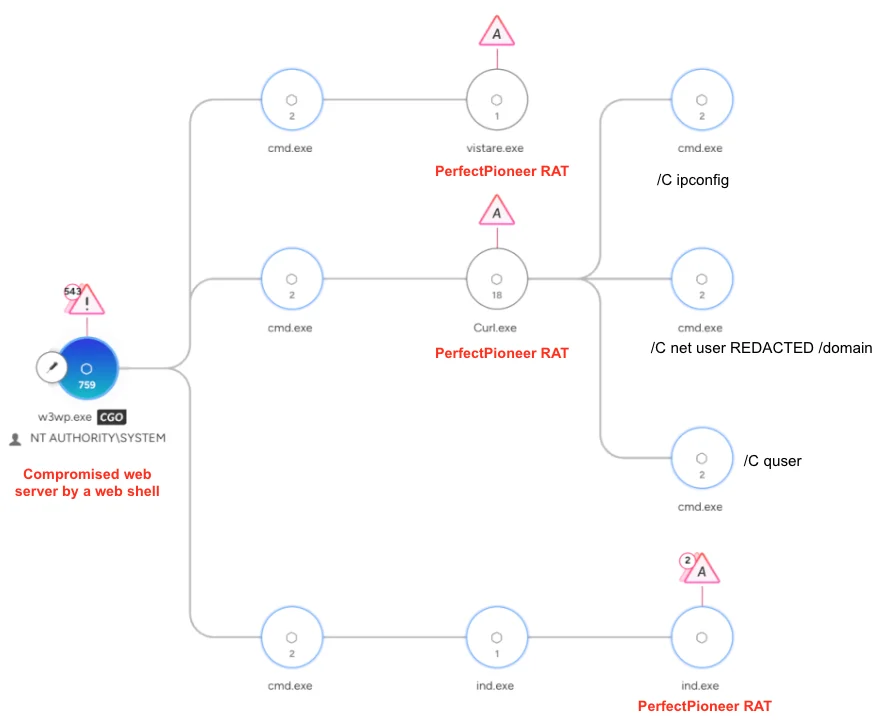
Execution of the PerfectPioneer RAT from a web shell, as shown in Cortex XDR | Image: Unit 42
TL;DR
Since July 2025, an espionage group tracked as TGR-STA-0049 has targeted Southeast Asian government networks using two newly uncovered malware families: PerfectPioneer RAT KUKURAT. In this TGR-STA-0049 PerfectPioneer RAT KUKURAT campaign, the attackers communicate over UDP-based HTTP/3 channels to slip past traditional TCP firewall inspections. Furthermore, the malware includes a built-in safety switch to block noisy operator commands and a spoofing engine that generates fake browser and file activity.
What Happened in the Espionage Campaign
Over a nine-month period starting in July 2025, threat actors breached government organizations across Southeast Asia using a dual-track initial access strategy. According to an investigation into custom RATs targeting Southeast Asian governments by Palo Alto Networks Unit 42, the attackers primarily exploited unpatched Microsoft Exchange and web servers to drop web shells such as ASPXSpy, Godzilla, Bysunue.aspx, and Suo5. As a secondary vector, the group sent spearphishing emails containing executable files disguised as PDF notices about the 2025 Myanmar Prime Minister election, alongside decoy Palo Alto Networks GlobalProtect installers and DLL side-loading packages.
Once inside, the operators deployed PerfectPioneer RAT in July 2025 before transitioning compromised networks to a modular C++ successor named KUKURAT in March 2026. Both tools rely on HTTP/3 over UDP (QUIC) on port 443 as their primary command-and-control (C2) transport, falling back to HTTP/2 only if connections fail. Because legacy deep-packet inspection engines focus primarily on TCP traffic, UDP-based QUIC connections often pass through corporate firewalls uninspected.
PerfectPioneer RAT and the Operator Safety Switch
Written in Go, PerfectPioneer RAT evolved across six distinct variants, including newhttp3, Pioneer, and rat_http3_cc. Beyond standard file transfers, SOCKS5 proxying, and process injection, the malware enforces strict resource hygiene. Specifically, a cleanup routine deletes temporary files and forces Go’s runtime garbage collection whenever memory usage exceeds 100 MB.
Most notably, the Pioneer and rat_http3_cc variants include a function named isDangerousCommand. “Before executing any incoming command from the C2, the isDangerousCommand routine cross-references the instruction against a list of hard-coded commands. If it finds a match, the command is blocked entirely,” Unit 42 researchers wrote. This blocklist contains both Windows and Linux syntax, stopping human operators from running loud or destructive administrative commands that would trigger endpoint alerts.
KUKURAT Modular Design and Heuristic Camouflage
Introduced in March 2026, KUKURAT strips post-exploitation code out of its core binary and loads at least 12 distinct DLL modules directly into memory from the C2 server. The attackers also used KUKURAT to deploy a standalone remote execution service (PsExecService.exe) that creates a \\.\pipe\PSEXEC pipe and uninstalls itself after five minutes of inactivity. A companion watchdog binary hidden in C:\ProgramData\Cyvera\Ransomware\ polls a named pipe (WINDOW_SEC_WATCHDOG) every second and restarts KUKURAT if 15 seconds pass without a heartbeat.
To confuse behavioral detection tools, KUKURAT features a toggleable heuristic camouflage engine across three axes. First, it sends 10 decoy HTTP requests per cycle to 15 popular websites. Second, it writes and deletes random data inside the HKCU\Software\Google\Chrome\BrowserCrashRecovery registry key to mimic Chrome crash recovery. Third, it creates and deletes random files inside the %temp% folder to mask real file modifications.
Who Is Behind the Activity
Unit 42 attributes the PerfectPioneer RAT KUKURAT operations with high confidence to TGR-STA-0049, a threat group active since at least March 2023 that previously deployed the Squidoor (also known as FINALDRAFT) backdoor. Other security vendors track overlapping activity from this group under the names Earth Alux, Ink Dragon, and REF7707. Shared C2 URL endpoints (/agent/register, /agent/heartbeat, /agent/tasks, and /agent/result) and direct in-place upgrades from PerfectPioneer to KUKURAT confirm that a single development pipeline maintains both tools.
Impact and Network Propagation
After compromising Domain Controllers via DCSync attacks, Mimikatz, SharpDPAPI, and ordinal-based LSASS memory dumps (using comsvcs.dll index #+000024), the attackers modified domain log-on scripts. Consequently, whenever a domain user logged in, the script automatically installed KUKURAT on their workstation.
The operators then searched for PDF, Word, Excel, and PNG files focused on international relations and internal political affairs. On compromised Exchange servers, the attackers ran PowerShell commands to check for ApplicationImpersonation rights. “If the initial reconnaissance reveals that the threat actor does not have access to an account with existing impersonation rights, the threat actor switches to a more direct backup plan,” the report noted, showing how operators ran an Add-MailboxPermission loop to grant themselves FullAccess to every mailbox in the organization.
How Organizations Can Stay Protected
To defend against the TGR-STA-0049 PerfectPioneer RAT KUKURAT campaign, network administrators must inspect or restrict outbound UDP port 443 (QUIC/HTTP/3) traffic so endpoints fall back to inspectable TCP channels. Security teams should audit Active Directory domain log-on scripts for unauthorized executables, monitor Exchange servers for bulk Add-MailboxPermission PowerShell commands, and alert on comsvcs.dll commands using ordinal #+000024. Finally, endpoint defenders should watch for the WINDOW_SEC_WATCHDOG and PSEXEC named pipes and inspect C:\ProgramData\Cyvera\Ransomware\ for rogue watchdog binaries.
Support Our Threat Intelligence
Find our threat intelligence and malware analysis helpful? Support our work today and unlock a 100% ad-free reading experience!
 Buy Me a Coffee
