 Do Son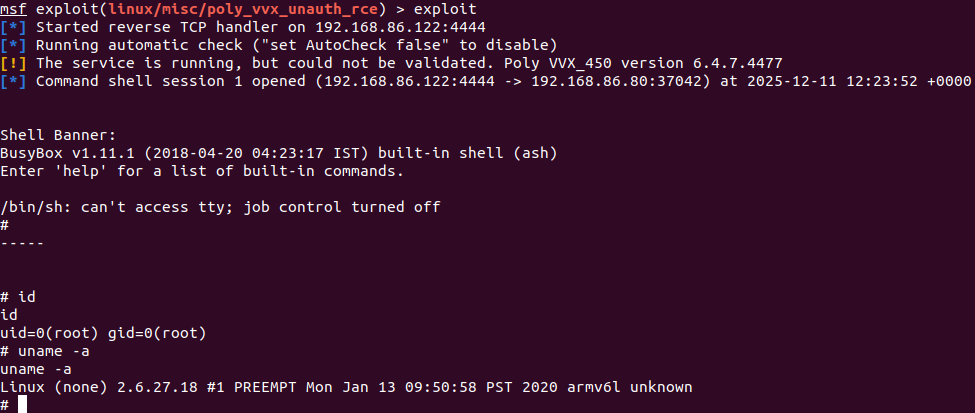
Metasploit exploit module targeting a Poly VVX 450 device | Image: Rapid7
Serious Flaw Discovered in Popular Office Hardware
A critical security flaw has been exposed in modern workplace communication equipment. Specifically, researchers from Rapid7 discovered a dangerous Poly VoIP phone vulnerability affecting multiple enterprise series. This vulnerability tracks officially as CVE-2026-0826 and holds a severe CVSS score of 9.2. Because full technical details and public exploit code released online, administrators must take immediate action. Consequently, threat actors can leverage this loophole to obtain complete administrative access.
Mechanics of the Parsing Error
To begin with, the underlying software bug resides within the device’s session protocol handling. The main system binary fails to validate string inputs during connectivity steps. According to the report, “This helper function ParseICECandidate contains a stack based buffer overflow.”
Furthermore, the code copies incoming parameters directly into a tiny 256-byte stack buffer. The analysis details that “No length check is performed to ensure the incoming string length is less than 256 bytes.” Therefore, an unauthenticated attacker can trigger a classic stack crash by sending an overly long request.
Weaponizing the Buffer Overflow
Subsequently, the adversary can weaponize this structural mismatch using standard exploitation frameworks. For instance, a Metasploit module can force the device to run remote scripts. The attacker crafts a special SIP INVITE message stuffed with padding characters.
Consequently, the overflow completely overrides the local program counter register. This manipulation grants the attacker root privileges without requiring any authentication. As a result, this active Poly VoIP phone vulnerability exposes internal corporate audio traffic.
Defeating NX Protections via ASLR Failure
Additionally, the hardware utilizes advanced endpoint mitigations like No Execute flags. To bypass this defense, attackers would normally require a separate memory leak. However, the device features an administrative configuration flaw in its memory layout.
The report notes: “Conveniently to our purpose, ASLR is not operating as expected on the device, and does not impact the load address of Shared Object (SO) libraries.” Specifically, the central C library always loads at a fixed virtual address. Therefore, engineers can easily construct static code chains to bypass system security boundaries.
Mandatory Upgrades and Mitigation Steps
Ultimately, organizations must patch their endpoints to eliminate the exploitation vector. HP Poly recommends disabling the vulnerable feature if your workspace environment does not require it. Additionally, administrators should update all devices via the management platform right away.
The vendor has released updated firmware versions across all affected series. For example, VVX systems must upgrade to UCS version 6.4.8 immediately. Applying these patches secures the network against remote takeover.
Support Our Threat Intelligence
If you find our CVE report and cybersecurity news helpful, consider supporting our work.
 Buy Me a Coffee
PayPal
Buy Me a Coffee
PayPal

