 Do Son
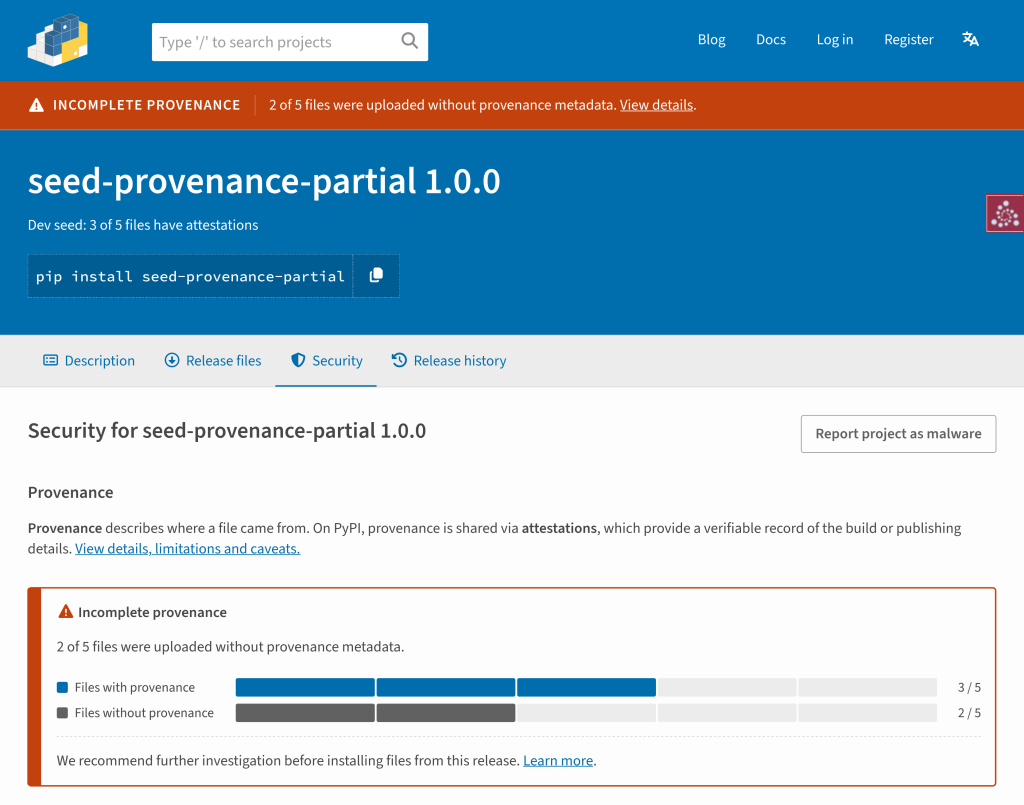
An example provenance warning on PyPI, showing a release with incomplete provenance
The Python Package Index recently completed a major redesign of its project detail pages. Specifically, the new PyPI Security Tab displays provenance statuses and digital attestations for every software release. Visitors can now inspect anomalous file warnings, search distribution artifacts, and review historical version states effortlessly. Primarily, PyPI introduced this update to make package origins transparent before developers install dependencies. Consequently, this feature strengthens ecosystem defenses against escalating software supply chain attacks.
Digital Attestations and Provenance Verification
The redesigned security interface evaluates cryptographic attestations across all files within a specific release. When every artifact carries valid cryptographic proof, the platform displays a full provenance badge. Conversely, releases lacking verified signatures display a clear status indicating missing provenance. These attestations combine PyPI Trusted Publisher records with SLSA build provenance metadata. Specifically, SLSA proofs link compiled artifacts directly to source commits, build platforms, and execution steps. Developers can inspect this cryptographic metadata and transparency logs directly on the project page. As detailed in the official PyPI announcement on project UI updates, these tools simplify artifact auditing.
However, legitimate repository migrations or build pipeline adjustments can occasionally trigger provenance alerts. Therefore, provenance verification serves strictly to authenticate publishing origins and build environments. Developers should still evaluate maintainer histories and project activity when assessing overall package risk.
Four Categories of Supply Chain Anomaly Warnings
To help developers spot suspicious releases quickly, PyPI introduced four distinct provenance warning categories. First, an incomplete provenance warning appears when only some files in a release include attestations. Second, an inconsistent provenance alert flags releases whose files originate from different build systems or repositories. Third, a changed provenance notice indicates that artifacts used a different repository or workflow than prior versions. Finally, a lost provenance warning alerts users when a previously attested project publishes unsigned files.
Upgraded Release Files and Version History Views
Furthermore, PyPI overhauled its release files and version history tabs to improve artifact visibility. The updated files view supports instant search, granular filtering, and per-file provenance indicators. For releases predating July 2026, PyPI displays an orange warning if someone uploaded files over fourteen days late. Notably, PyPI enforced a strict policy in July 2026 blocking file uploads fourteen days after initial release. Meanwhile, the version history page now surfaces file counts, provenance badges, and yanked or quarantined statuses. Ultimately, these transparent security indicators empower Python developers to detect supply chain tampering before installation.
Support Our Threat Intelligence
Find our tech and OS security coverage helpful? Support our work today and unlock a 100% ad-free reading experience!
 Buy Me a Coffee
