Qualcomm Acquires Arduino to Drive Edge AI and Unveils UNO Q Dual-Brain Development Board
 Do Son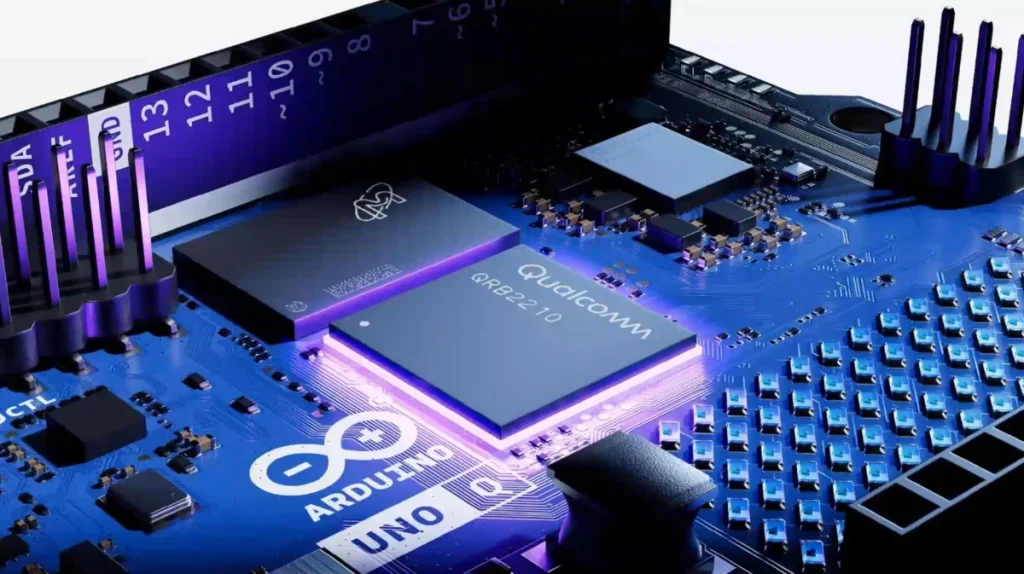
Qualcomm has announced its acquisition of Arduino, the globally renowned open-source hardware and software platform — a move that not only deepens Qualcomm’s connection with a vast community of developers but also underscores its long-term vision for edge computing and artificial intelligence applications.
With a community of over 33 million developers, Arduino plays a pivotal role across the global maker, education, and industrial sectors. Through this integration, the Arduino ecosystem will gain direct access to Qualcomm’s advanced computing technologies — including graphics processing, computer vision, and AI capabilities — to build a unified platform spanning from cloud to edge. Qualcomm emphasized that this acquisition continues its recent investments in Edge Impulse and Foundries.io, reinforcing the company’s strategy of empowering developers to harness AI and edge computing with greater ease.
As IoT and AI-driven devices become increasingly widespread, demand for platforms capable of balancing high-performance computation with real-time control has grown rapidly. Qualcomm noted that integrating Arduino will enable developers to move seamlessly from concept to product deployment within a single platform — unlocking new frontiers of innovation.
Founded in Ivrea, Italy, in 2005 by a group of design students and faculty, Arduino was conceived to make electronics and programming accessible even to those without an engineering background. Through its open-source hardware architecture and intuitive development environment, Arduino quickly became an essential tool for education, training, and rapid prototyping.
This philosophy helped ignite the global maker movement, empowering individuals to transform creative ideas into tangible prototypes at minimal cost. Today, Arduino stands not merely as a learning tool but as a cornerstone of the global innovation ecosystem.
To commemorate the acquisition, Qualcomm and Arduino hosted a launch event in Italy, unveiling the new UNO Q development board — the first to feature Qualcomm’s Dragonwing QRB2210 chip with a “dual-brain” architecture, combining high-performance Linux processing with precise real-time microcontroller control.
With this design, the UNO Q is positioned as an ideal platform for smart home, industrial automation, and edge AI applications, bringing the concept of “instant AI” into practical, real-world scenarios.
For developers, this represents a unified hardware environment that accommodates multiple computing demands — from prototyping to full deployment — while leveraging the combined strength of Qualcomm’s technology and Arduino’s thriving community. The result: shorter development cycles and lower costs for creators worldwide.
Arduino also announced the launch of App Lab, a new platform designed to help developers build applications optimized for edge computing, Linux-based environments, and edge AI use cases. Through guided templates and sample projects, developers can rapidly prototype solutions such as facial recognition, voice keyword detection, quality control, identity verification, and audio-visual analysis.
For Qualcomm, the acquisition signifies a strategic expansion beyond mobile computing and telecommunications, embedding AI, edge devices, and developer ecosystems into the company’s core growth strategy.
Arduino, in turn, stated that while it will now operate under Qualcomm ownership, it will retain its independence and will not be absorbed into Qualcomm’s internal structure.
Moreover, although the newly launched UNO Q utilizes Qualcomm’s Dragonwing QRB2210, Arduino reaffirmed its commitment to exploring a variety of processing components for future boards and maintaining partnerships with other industry players such as Arm, ensuring its ecosystem remains open and diverse.
At a time when NVIDIA, Intel, and other semiconductor leaders are racing to shape the future of edge AI, Qualcomm’s integration of Arduino grants it access to a massive developer community and strengthens its foothold across education, maker culture, and industrial markets. With the arrival of next-generation platforms like the Arduino UNO Q, all eyes are now on Qualcomm — to see whether it can truly accelerate the democratization and deployment of edge AI worldwide.
Related Posts:
- Chinese Smartphone Makers Unite for Google-Free OS
- DOJ Charges 18 in Cryptocurrency Fraud Case, Seizes Over $25 Million
- Raspberry Pi Unveils $4 Radio Module 2: Bringing Wi-Fi 4 & Bluetooth 5.2 to Custom Boards
- Google exposes a Microsoft Edge browser flaw
- The EU unease about Broadcom attempts to buy Qualcomm: Privacy data may be leaked
Support Our Threat Intelligence
Find our tech and OS security coverage helpful? Support our work today and unlock a 100% ad-free reading experience!
 Buy Me a Coffee
