 Do Son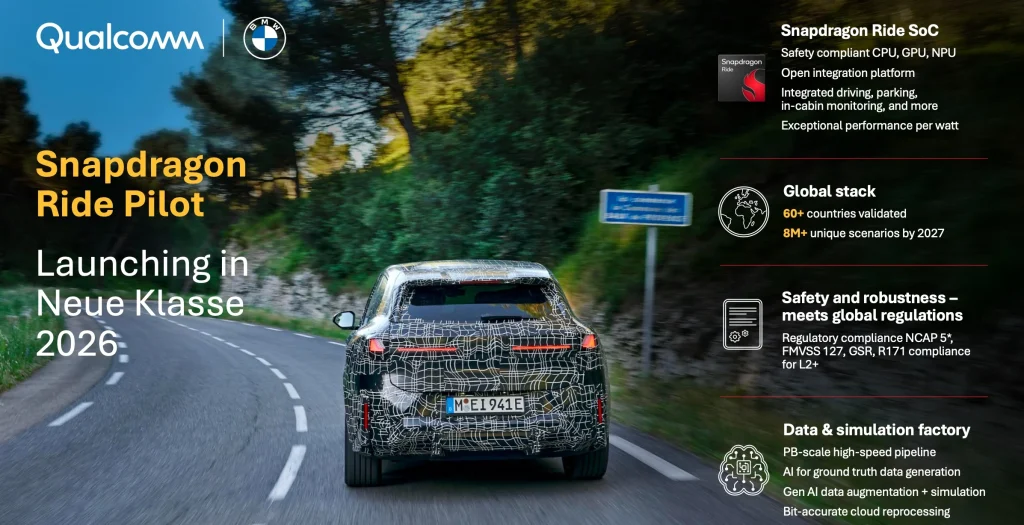
As autonomous driving technology steadily advances toward maturity, Qualcomm and BMW have announced a landmark collaboration. After three years of joint effort involving more than 1,400 engineers and experts across Germany, the United States, Sweden, Romania, and the Czech Republic, the two companies have completed the development of the Snapdragon Ride AD software stack, now debuting in the all-new BMW iX3 and laying the foundation for intelligent driving across the BMW Neue Klasse lineup.
Qualcomm noted that its Snapdragon Ride automotive platform is already in partnership with more than twenty global automakers, including Honda, Sony Honda Mobility, Beijing Hyundai, BAIC Group, SAIC Volkswagen, Nissan, FAW Group, Chery, Leapmotor, Volkswagen, Cariad, Renault, and BMW itself.
The company emphasized that by leveraging ADAS (Advanced Driver Assistance Systems), automakers can significantly reduce road fatalities, minimize collision rates, and alleviate traffic congestion. This, Qualcomm argues, not only enhances road safety but also saves time lost to traffic delays—factors that have elevated autonomous driving into one of the most promising frontiers in modern automotive development.
Nakul Duggal, Senior Vice President and General Manager of Qualcomm’s Automotive and Industrial IoT division, highlighted that the collaboration with BMW establishes new benchmarks for both safety and comfort in autonomous driving. Meanwhile, Dr. Mihiar Ayoubi, BMW’s Senior Vice President of Driving Experience Development, remarked that Qualcomm’s technologies empower BMW to deliver a groundbreaking intelligent driving experience in the Neue Klasse series, reflecting the brand’s philosophy of being “Smart, Symbiotic, and Safe.”
The newly unveiled Snapdragon Ride AD stack integrates Qualcomm’s advanced perception systems with BMW’s jointly developed driving strategy engine, offering carmakers and first-wave suppliers a flexible, scalable, and cost-efficient solution.
Key Technical Highlights:
- 360-Degree Perception: Multi-angle cameras, BEV (bird’s-eye view) architecture, fisheye lens data extraction, and low-level radar fusion enhance object detection and complex scene recognition.
- Safety First: Compliance with ASIL, FuSa, and SOTIF standards, as well as NCAP, FMVSS127, and DCAS regulations, supported by multi-layer encryption and threat detection mechanisms.
- Intelligent Driving Decisions: A hybrid approach balancing rule-based logic with AI models to handle complex scenarios such as urban intersections and proactive overtaking.
The system also includes a “Data and Simulation Factory”, merging real-world driving data with AI-generated scenarios to accelerate testing and training of autonomous driving algorithms, with OTA (over-the-air) updates ensuring continuous optimization.
The new BMW iX3 will be the first to feature Snapdragon Ride Pilot, powered by a computing platform twenty times more powerful than its predecessor. Combined with BMW’s central “Superbrain” architecture, it unifies high-resolution cameras, millimeter-wave radar, HD maps, and precise GNSS-based geolocation to deliver a highly reliable autonomous driving experience.
Real-World Features Include:
- Smart Lane Change: Triggered by subtle driver cues, such as glances in the rearview mirror or slight steering adjustments.
- Highway Assist: Hands-free driving capabilities on designated roads.
- AI Parking Assist: Advanced image recognition and cabin monitoring for seamless parking.
Additionally, the iX3 integrates Qualcomm’s V2X 200 chipset, enabling vehicle-to-everything (V2X) communication. This allows the car to detect hazards beyond its sensor range, such as pedestrians obscured by other vehicles or infrastructure alerts, further enhancing safety.
The collaboration between Snapdragon Ride Pilot and BMW Neue Klasse not only demonstrates the practical readiness of autonomous driving but also exemplifies the transformative potential of cross-industry partnerships between automakers and technology leaders. As adoption expands across future BMW models, this platform is poised to become the standard not only in the luxury segment but also in mainstream vehicles, ushering in a new era of safer, smarter, and more intelligent mobility for consumers worldwide.
Related Posts:
- North Korea’s Andariel Group Deploys New RID Hijacking Technique for Stealthy Attacks
- BMW models have been exposed to security flaws that can be remotely attacked by hackers
- APT29 Lures Victims with Fake BMW Ads in Latest Attack
- APT29’s Espionage Campaign Exploits WinRAR Flaw, Targets Embassies
Support Our Threat Intelligence
Find our tech and OS security coverage helpful? Support our work today and unlock a 100% ad-free reading experience!
 Buy Me a Coffee
