The “Surprise Metric”: Google’s New AI Architecture Outperforms GPT-4 in Memory
 Do Son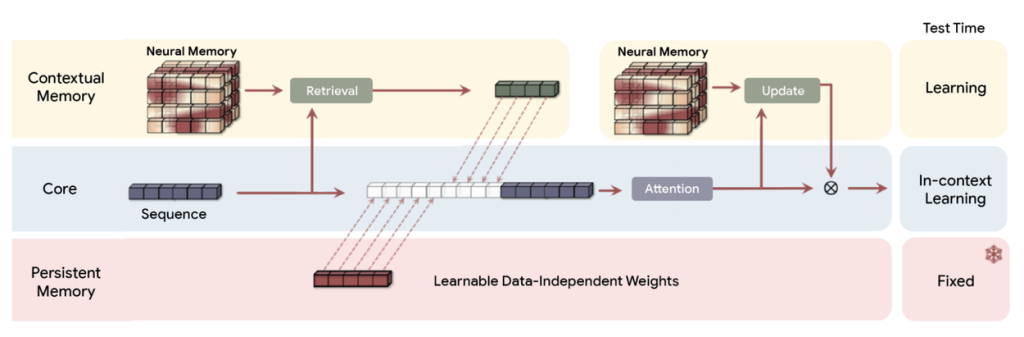
Do you recall the familiar frustration of reading a lengthy article only to forget the earlier sections by the time you reach the end? It appears that even AI now seeks to remedy this problem. Google’s research team has unveiled two groundbreaking innovations—the Titans architecture and the MIRAS framework—designed to enable AI models to “read while remembering,” dynamically updating their core memory in real time as they process vast quantities of information, much like the human brain.
This breakthrough not only resolves the computational bottlenecks that traditional Transformer models face when handling ultra-long sequences, but also demonstrates extraordinary performance in extreme long-context reasoning tests, surpassing even GPT-4, and managing contexts of up to two million tokens with remarkable ease.
Conventional recurrent neural networks (RNNs) typically store memory in fixed-size vectors—akin to giving a student a single sticky note on which to jot down all their thoughts, forcing them to erase old information once the space is filled. The Titans architecture’s most profound innovation lies in its introduction of an entirely new long-term memory module.
This module, itself a deep neural network (a multilayer perceptron), draws inspiration from the human brain’s separation of short-term and long-term memory. It endows AI systems with far greater expressive power, enabling them not merely to memorize but to comprehend and synthesize narrative structure, actively learning what information is truly worth preserving. The mechanism that determines “what to remember and what to forget” is particularly intriguing: the team refers to it as the “surprise metric.”
This metric mimics human psychology—we readily forget routine events yet vividly recall the unexpected. Within the Titans architecture, when incoming information diverges sharply from the model’s predicted memory state (for instance, encountering a picture of a banana peel in the middle of a serious financial report), its gradient—the degree of “surprise”—spikes, prompting the model to store the information preferentially in long-term memory.
Combined with momentum mechanisms and adaptive weight decay (a form of forgetting gate), the Titans architecture captures essential, long-range dependencies while discarding obsolete data, ensuring high efficiency even when processing extraordinarily long sequences. Released alongside Titans, the MIRAS framework offers a unified theoretical perspective: it treats sequence modeling as a set of approaches to the same foundational challenge—how to integrate new and existing information effectively.
MIRAS transcends the traditional models’ overreliance on mean-squared-error objectives, enabling the creation of novel architectures built on non-Euclidean loss functions. Using this framework, the research team developed three model variants—YAAD, MONETA, and MEMORA—each optimized for different specialized demands, such as noise robustness and stable long-term memory retention. In empirical evaluations, the Titans architecture and MIRAS-derived models consistently outperformed leading contemporary architectures like Mamba-2 and Transformer++ in language modeling and commonsense-reasoning tasks.
Most astonishing, however, is their performance on the BABILong extreme long-context benchmark. When confronted with reasoning tasks that require retrieving facts scattered across massive documents, the Titans architecture displayed overwhelming dominance. Despite having far fewer parameters than GPT-4, it delivered superior reasoning performance and scaled effectively to context windows exceeding two million tokens. This suggests that in future domains—ranging from whole-document comprehension to genomic analysis—AI may soon exhibit an unprecedented capacity for near-perfect recall.
Related Posts:
- Atlassian Confluence Vulnerability CVE-2023-22527 Exploited for Cryptomining
- Google launches new Titan Security Key
- New Android Rule: Google to Flag Battery-Draining Apps on Play Store Listings
Support Our Threat Intelligence
Find our tech and OS security coverage helpful? Support our work today and unlock a 100% ad-free reading experience!
 Buy Me a Coffee
