Qualcomm Unveils Snapdragon X2 Elite Chips: 5.0GHz Clock Speed to Power Next-Gen AI PCs
 Do Son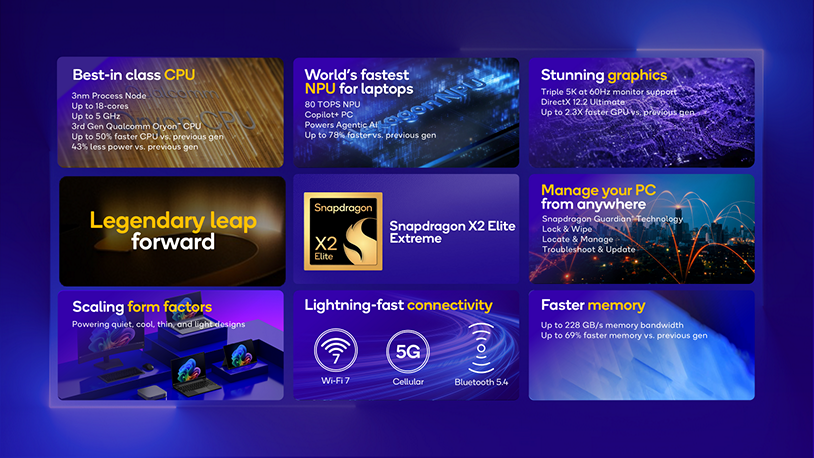
At the Snapdragon Summit 2025 in Hawaii, Qualcomm officially unveiled two new PC-class processors—Snapdragon X2 Elite Extreme and Snapdragon X2 Elite—purpose-built for Windows PCs. Fabricated on TSMC’s third-generation 3nm (N3P) process, both chips integrate Qualcomm’s third-generation custom-designed Oryon CPU, a rearchitected Adreno GPU, and a next-generation Hexagon NPU, promising breakthroughs in performance and power efficiency while unlocking greater AI processing capabilities and extended battery life.
The Snapdragon X2 Elite Extreme is positioned for the “ultra-flagship” segment, targeting professional creators, high-end business users, and specialists handling compute-intensive workloads. With the Oryon CPU, it delivers dramatically higher performance at the same power envelope, outperforming rival chips in its class by up to 75%, and becoming the first Arm-based CPU to achieve clock speeds of 5.0GHz.
The redesigned Adreno GPU delivers up to 2.3x performance-per-watt improvements, while the upgraded Hexagon NPU reaches 80 TOPS of AI compute—the fastest NPU performance globally, according to Qualcomm. This allows Copilot+ PCs to handle multiple AI workflows simultaneously, supporting multi-agent scenarios and real-time inference.
By contrast, the Snapdragon X2 Elite is aimed at the flagship tier, emphasizing efficiency in multitasking and resource-heavy applications. Qualcomm reports performance gains of 31% at the same power and up to 43% lower consumption compared with the previous generation, enabling thin and light laptops to run unplugged for extended periods while meeting modern productivity, entertainment, and AI demands.
Architectural highlights:
- X2 Elite Extreme (X2E-96-100): 18 cores total, with 12 Prime cores (all-core up to 4.4GHz, single/dual cores up to 5.0GHz) and 6 Performance cores (up to 3.6GHz), backed by 53MB cache. GPU model X2-90 clocks at 1.85GHz. NPU rated at 80 TOPS, with dual Micro NPU design for proactive workload sensing.
- X2 Elite: Two variants—(X2E-88-100) with 18 cores, and (X2E-80-100) with 12 cores (6 fewer Prime cores). Both reach 4.4GHz all-core, 4.7GHz single-core, and 4.4–4.7GHz dual-core boost depending on SKU. Performance cores (6) max at 3.4GHz. Cache: 53MB (88 model) or 34MB (80 model). GPUs clock at 1.7GHz (X2-90 and X2-85 options). NPU identical to Extreme.
Both processors support LPDDR5x, with the Extreme offering 228GB/s memory bandwidth and the Elite 152GB/s. The Extreme supports configurations above 128GB, with a launch SKU at 48GB. Both reach 9523 MT/s memory speeds. Notably, the Extreme adopts an integrated module design—simplifying OEM/ODM design, boosting transfer rates, and reducing costs—while the Elite retains a traditional modular laptop layout for flexible capacity scaling.
Connectivity and storage:
- Integrated Snapdragon X75 5G modem: up to 10Gbps down / 3.5Gbps up.
- FastConnect 7800: Wi-Fi 7, Bluetooth 5.4, LE Audio, UWB.
- Snapdragon Guardian: enhanced device security, remote lock, and tracking.
- Storage: dual PCIe 5.0 NVMe SSDs, UFS 4.0, SD Express SDUC, and UHS-I SDXC.
Both processors fully support Windows on Snapdragon, including Copilot+, Snapdragon Seamless cross-device collaboration, and Snapdragon Guardian security. They also bring DirectX 12.2 Ultimate, Vulkan 1.4, and OpenCL 3.0 compatibility—enabling broader game and app support on Windows PCs.
Qualcomm is extending its ecosystem by partnering with Microsoft, ASUS, and now Razer, whose Synapse software will natively support Snapdragon PCs, bridging into the gaming peripherals market. Collaborations with Yamaha expand MIDI hardware compatibility, empowering musicians and DJs with Snapdragon-powered creative PCs.
The first wave of Snapdragon X2 Elite devices will launch in early 2026, heralding a new AI PC upgrade cycle. Qualcomm has also introduced reference designs, allowing OEMs and ODMs to build sleeker, high-performance Windows PCs beyond conventional laptop form factors.
The Snapdragon X2 Elite family thus symbolizes Qualcomm’s accelerating push to transform the PC industry—shifting from legacy x86 dominance toward a high-performance Arm-based AI computing ecosystem, unlocking new possibilities for AI workflows, professional creativity, and mobile productivity.
Related Posts:
- Snapdragon 8 Elite Gen 5 Unveiled: The Fastest Mobile Chip Powers Next-Gen Agentic AI
- A Controversial Safeguard: Claude AI Now Ends Abusive Conversations to Protect Itself
- Extreme Networks Addresses Critical Security Vulnerabilities in HiveOS
Support Our Threat Intelligence
Find our tech and OS security coverage helpful? Support our work today and unlock a 100% ad-free reading experience!
 Buy Me a Coffee
