 Do Son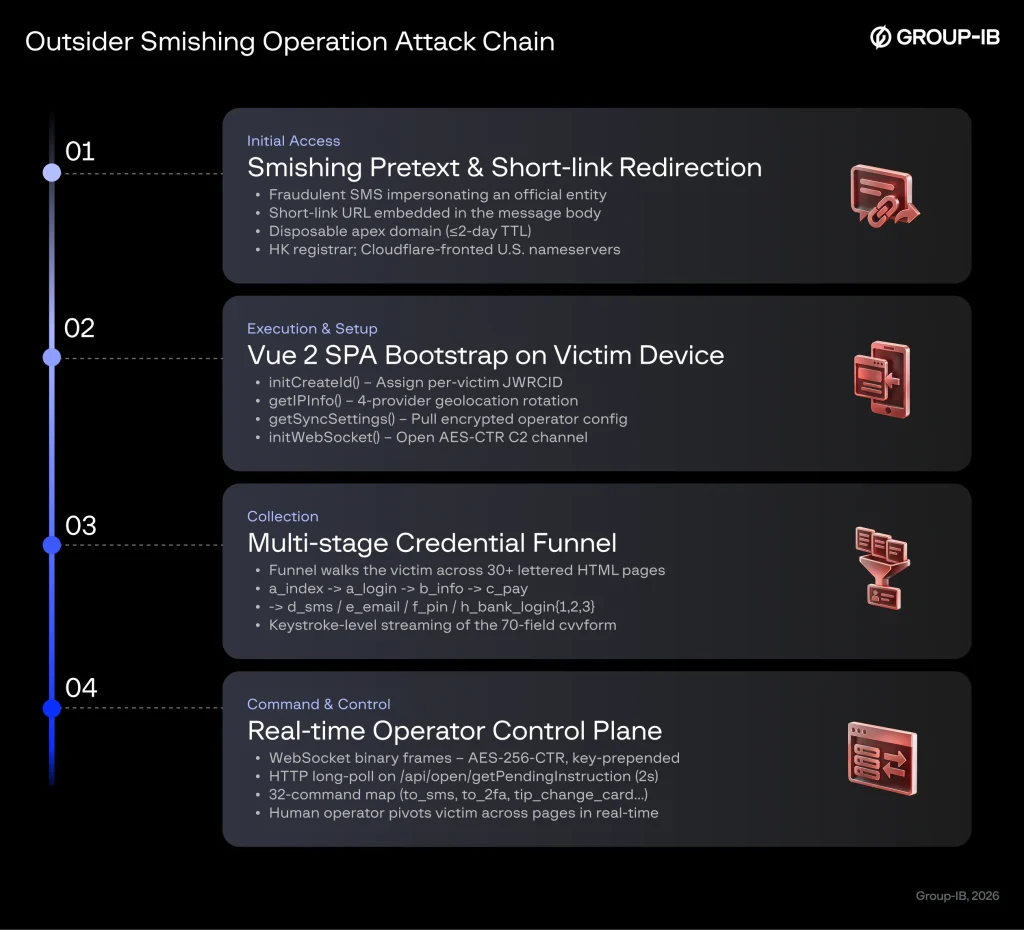
End-to-end attack chain of the Outsider smishing operation from SMS pretext through operator-driven exfiltration | Image: Group-IB
Security researchers at Group-IB recently published an investigation into a Smishing Triad phishing kit deployed across global fraud campaigns. The criminal operation sends fraudulent text messages to direct unsuspecting consumers toward disposable credential-theft pages. Consequently, victims face immediate risks of account takeovers and financial loss.
At a glance
- Actor or group: Outsider (suspected sub-cluster of the Smishing Triad)
- Activity type: Phishing-as-a-Service (PhaaS), real-time credential theft, and payment card fraud
- Targets or victims: Mobile banking customers and postal consumers across 121+ countries
- Scale: Over 194,000 malicious domains; estimated criminal revenues in the multi-billion-dollar range
- Jurisdiction or law-enforcement status: Active transnational criminal syndicate under ongoing global investigation
- Source: Group-IB Threat Intelligence
TL;DR
Group-IB analysts exposed a modular phishing platform tracked as JWR, operated by a criminal cluster named Outsider. The operation combines automated SMS lures with live operator handling to intercept banking logins and authentication codes. Organizations must deploy proactive domain monitoring and educate users on smishing pretexts to stop these intrusions.
What Happened
The attack sequence begins with an SMS message that impersonates a trusted authority or delivery service. These fraudulent messages instruct recipients to resolve overdue bills, verify identities, or confirm package delivery schedules. When a victim taps the enclosed shortened link, the browser redirects to a temporary landing domain.
The landing site runs as a single-page application built with modern web frameworks. Behind the graphical interface, a dedicated background worker manages real-time network communications. This worker connects to an external command server using WebSocket channels and regular HTTP polling. “The kit identifies itself, in every artifact we recovered, as JWR, a name burned into localStorage keys, CSS class prefixes, and per-victim identifiers.”
As the victim interacts with the site, the kit records every entered character. The system streams keystrokes directly to a remote operator panel before form submission occurs. Furthermore, the kit organizes captured data through a structured internal model. As Group-IB noted, “The single object that drives the entire kit is cvvform, declared verbatim at the top of main.js.” This model harvests complete personal identities, driver licenses, passport photos, and credit card details.
The platform also features a specialized validator module covering twelve legal jurisdictions. This module formats input fields live and validates tax numbers, identity cards, and card values. Additionally, a human operator can manually reroute the victim through thirty-two distinct diversion stages. These stages include one-time passcode requests, simulated bank portals, and PayPal verification screens.
To disguise outbound network traffic, the malware wraps data packets inside an AES encryption container. However, researchers discovered a glaring design flaw in the communication protocol. “The defining feature of this design is that the AES key is shipped in clear, prepended to every ciphertext.” This structure allows defenders to intercept and decode transmitted data easily.
Who Is Behind It
Group-IB attributes this activity with moderate confidence to a cybercrime group tracked as Outsider. Security analysts determine that Outsider operates as a dedicated affiliate within the broader Smishing Triad criminal syndicate. The Smishing Triad functions as an open cybercrime marketplace where independent developers sell software tools to various criminal crews.
Researchers identified the Outsider crew through consistent operational habits and language markers. The operational code includes Chinese status terms such as card-head for bank identifiers. Furthermore, operator-side control strings frequently contain distinctive punctuation and recurring project tags. The threat actors also register ephemeral web domains through Hong Kong registrars. They regularly hide these domains behind major cloud service providers for added infrastructure resilience.
Additionally, the Smishing Triad phishing kit shows signs of multi-platform expansion. The underlying codebase contains hostile integrations designed for WordPress and Shopify storefronts. These modules allow operators to inject the theft script directly into compromised merchant checkout flows.
Impact or Scale
The operational scale of this phishing ecosystem spans the entire globe. Threat researchers from multiple independent firms, including Palo Alto Networks Unit 42 and Silent Push, have tracked the syndicate. These collaborative intelligence reports associate the Smishing Triad with more than 194,000 malicious domains registered since 2024.
These malicious operations have impacted consumers across more than 121 countries. Industry analysts estimate that cumulative criminal revenues from these syndicates reach the multi-billion-dollar range. The attackers monetize stolen records by draining bank balances, opening fraudulent lines of credit, and reselling harvested identities.
Protection and Future Outlook
The Smishing Triad phishing kit represents a growing industrialization of mobile fraud. Because the developers sell these tools on underground marketplaces, multiple criminal crews will continue deploying them.
To combat this threat, telecom providers must filter suspicious SMS traffic containing deceptive short links. Financial institutions should enhance transaction monitoring to detect out-of-pattern account access. Security teams can fingerprint the kit by inspecting network requests for specific URI paths and static token suffixes.
Consumers must remain vigilant when receiving unsolicited text messages regarding deliveries or unpaid fines. Users should never enter financial information on websites accessed through unsolicited SMS links. Instead, customers should navigate to official service portals directly through verified browser bookmarks. Finally, enabling biometric multi-factor authentication provides strong protection against automated credential-harvesting tools.
Support Our Threat Intelligence
Find our threat intelligence and malware analysis helpful? Support our work today and unlock a 100% ad-free reading experience!
 Buy Me a Coffee
