 Do Son
TL;DR
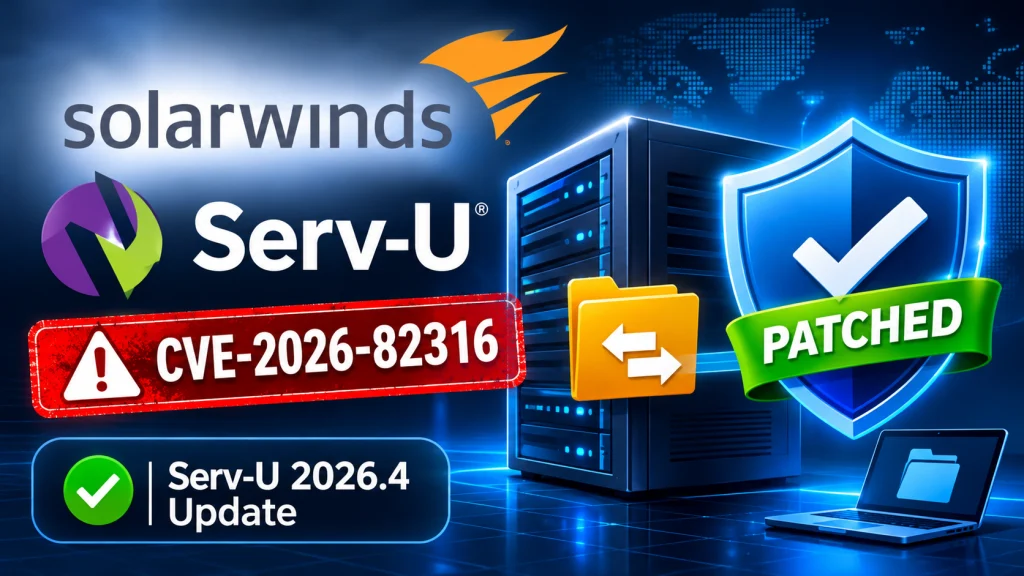
SolarWinds released the Serv-U 2026.4 update on November 24, 2026, patching 18 SolarWinds Serv-U vulnerabilities across Linux and Windows hosts. Notably, nine bugs carry a critical CVSS 9.1 score and allow code runs or root takeover. Therefore, admins must install the patch now to protect file transfer servers.
- Total: 18 CVEs
- Severity: 9 Critical · 2 High · 7 Medium
- Actively exploited: None confirmed
- Highest severity: 9.1 (Critical · CVSSv3) — CVE-2026-82316
- Action: Apply the latest security updates now
Notable CVEs
| CVE | CVSS (CVSSv3) | Type | Status |
|---|---|---|---|
| CVE-2026-82316 | 9.1 | CWE-367 | Not exploited |
| CVE-2026-82315 | 9.1 | CWE-367 | Not exploited |
| CVE-2026-82319 | 9.1 | CWE-367 | Not exploited |
| CVE-2026-82322 | 9.1 | CWE-284 | Not exploited |
| CVE-2026-82321 | 9.1 | CWE-843 | Not exploited |
| CVE-2026-82320 | 9.1 | CWE-843 | Not exploited |
| CVE-2026-123168 | 9.1 | CWE-20 | Not exploited |
| CVE-2026-123167 | 9.1 | CWE-35 | Not exploited |
Why It Matters
Many firms rely on SolarWinds Serv-U to move files across corporate networks. Because these servers handle sensitive data, severe bugs create a major risk. Specifically, Linux hosts face the highest danger from these nine critical flaws. On Windows hosts, SolarWinds notes that the risk is lower.
At press time, advisories from SolarWinds, NVD, and CISA confirm no active attacks in the wild. Likewise, researchers have not confirmed any public exploit code. Still, threat groups often target managed file transfer tools soon after patch day. Installing the Serv-U 2026.4 update early keeps your servers safe.
How the Attack Works
Critical TOCTOU and Privilege Escalation Flaws
Nine critical SolarWinds Serv-U vulnerabilities (CVSS 9.1) let domain admins gain root or system control. First, three Time-of-Check to Time-of-Use (TOCTOU) bugs (CVE-2026-82316, CVE-2026-82315, and CVE-2026-82319) let attackers edit protected files outside their home folder. As a result, they can run arbitrary code on the host.
Next, two type confusion flaws (CVE-2026-82321 and CVE-2026-82320) and an IDOR bug (CVE-2026-82322) let domain admins take server admin rights. In addition, CVE-2026-123168, CVE-2026-123167, and CVE-2026-123172 grant root access or restricted file reads through weak checks.
High-Risk Injection and Medium-Risk Auth Bugs
Beyond the critical list, two high-risk bugs enable code runs. For example, CVE-2026-82313 (CVSS 8.4) abuses a business logic flaw when an SMTP server is active. Meanwhile, CVE-2026-123166 (CVSS 7.2) lets Windows admins inject commands through unsafe input.
Seven medium-risk flaws weaken web and login safety. Specifically, CVE-2026-123173 allows remote memory reads without a login, while CVE-2026-123170 and CVE-2026-123169 allow password and TOTP brute-force tries. Also, CVE-2026-123171 leaks valid user names, and CVE-2026-123165 enables HTTP header injection. Finally, CVE-2026-82317 causes stored XSS on Linux, and CVE-2026-82314 triggers RAM drain via SMTP.
Affected Versions
- Affected Releases: SolarWinds Serv-U versions 2026.3 and earlier on Linux and Windows.
- Platform Notes: CVE-2026-82317 affects Linux only, while CVE-2026-123166 affects Windows only.
- Fixed Release: SolarWinds Serv-U 2026.4.
Patch and Mitigation Steps
Admins should review the official SolarWinds Serv-U 2026.4 release notes and upgrade right away. Applying the Serv-U 2026.4 update resolves all 18 flaws in one step. Make sure to back up your server settings before you start the upgrade.
If you cannot patch today, audit all domain admin accounts and limit access to trusted staff. Furthermore, block direct public access to management ports and watch login logs for brute-force tries. Acting fast on these SolarWinds Serv-U vulnerabilities cuts your exposure window.
Support Our Threat Intelligence
Find our vulnerability reports and weekly recaps helpful? Support our work today and unlock a 100% ad-free reading experience!
 Buy Me a Coffee
