 Do Son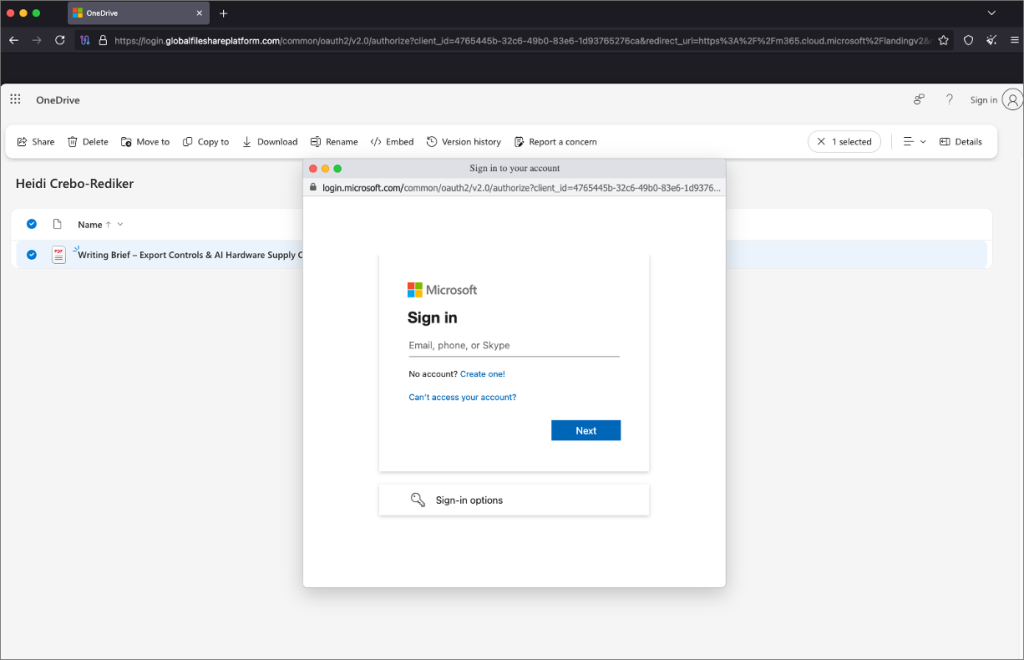
Example TA419 AitM and BitB phishing page observed in July 2026 | Image: Proofpoint
At a Glance Summary
| Attribute | Details |
|---|---|
| Actor or Group | TA419 (China-aligned cyberespionage group) |
| Activity Type | Spear-phishing, AitM credential theft, persona impersonation |
| Targets or Victims | US artificial intelligence policy experts, think tanks, and universities |
| Scale | Multiple targeted organizations across academic, defense, and legal sectors |
| Jurisdiction / Status | Suspected state-sponsored espionage group; uncharged |
| Source | Proofpoint Threat Insight |
Executive Summary
Proofpoint researchers discovered an espionage campaign targeting American artificial intelligence policy specialists in July 2026. The attackers impersonated former government officials to steal cloud credentials through browser-based phishing kits. Consequently, this campaign gives adversaries direct insight into emerging western technology regulations.
What Happened During the AI Phishing Waves
In July 2026, security analysts identified new operations tied to China-aligned TA419 credential phishing. Threat actors contacted artificial intelligence policy specialists using benign introductory emails. The messages invited targets to join a fictitious advisory committee. Alternatively, other emails asked experts to contribute to congressional reports on semiconductor supply chains.
The attackers impersonated prominent public figures to build trust with their targets. For instance, the group spoofed Lynne Parker, a former leader within the White House Office of Science and Technology Policy. Another wave impersonated foreign policy economist Heidi Crebo-Rediker. As Proofpoint explained, “The group first sent benign conversation starter emails, which included calls to action themed around AI policy such as joining an ‘AI Policy Advisory Committee’, to build rapport and solicit a response from the target.”
Once a target replied, the attackers sent a malicious hyperlink. This link directed the recipient through URL shorteners to an intermediate validation gate. The site displayed a fake OneDrive interface protected by a Cloudflare Turnstile verification challenge. After passing this check, the target landed on an Adversary-in-the-Middle phishing portal.
The phishing framework relied on an open-source tool known as Frameless BitB. This tool generates a deceptive browser window inside the existing web page. Behind this visual trick, the system proxies live traffic directly to Microsoft authentication servers. The attackers injected custom JavaScript files to monitor user inputs and capture session cookies. As Proofpoint reported, “Behind a BitB overlay, the proxy relays the sign-in to genuine Microsoft infrastructure, so the target’s password, MFA code, and conditional access checks all succeed while the attacker captures the resulting session cookies.”
Who Is Behind It
Proofpoint attributes this malicious activity to TA419 with moderate confidence. Analysts describe the group as an espionage-motivated cluster aligned with Chinese state interests. The threat actor has operated regular intelligence collection campaigns since at least April 2025. Previously, the group targeted Japanese diplomatic entities, defense contractors, and policy think tanks.
Technical evidence confirms consistent operational patterns. The group registers domain names through NameSilo and conceals backend hosting addresses behind content delivery networks. Furthermore, server headers revealed virtual private servers sharing specific self-signed security certificates. The operators also route outbound emails through residential proxy services to disguise their true geographical location.
Impact and Operational Scale
This targeted TA419 credential phishing campaign specifically focused on high-level technology policy specialists. The intrusion waves targeted analysts at think tanks, academic institutions, and corporate law firms. Additionally, the attackers ran an earlier campaign in February 2026 spoofing Anthropic personnel to discuss military applications of Claude.
These attacks aim to gather intelligence regarding western regulatory strategies. Geopolitical competition surrounding advanced computing, model development, and export controls continues to intensify. Therefore, obtaining internal discussions allows foreign intelligence agencies to anticipate upcoming trade sanctions and technology policies.
What Comes Next and Defense Guidance
Organizations working in technology governance must strengthen their authentication defenses. Traditional multi-factor authentication methods remain susceptible to reverse proxy attacks. Security teams should deploy origin-bound, phishing-resistant credentials such as passkeys.
Furthermore, individuals should treat unsolicited professional invitations with caution. Analysts should verify unexpected partnership requests through a trusted secondary communication channel. Regular security awareness training ensures staff members recognize multi-stage lure tactics before sharing credentials.
Support Our Threat Intelligence
Find our threat intelligence and malware analysis helpful? Support our work today and unlock a 100% ad-free reading experience!
 Buy Me a Coffee
