 Do Son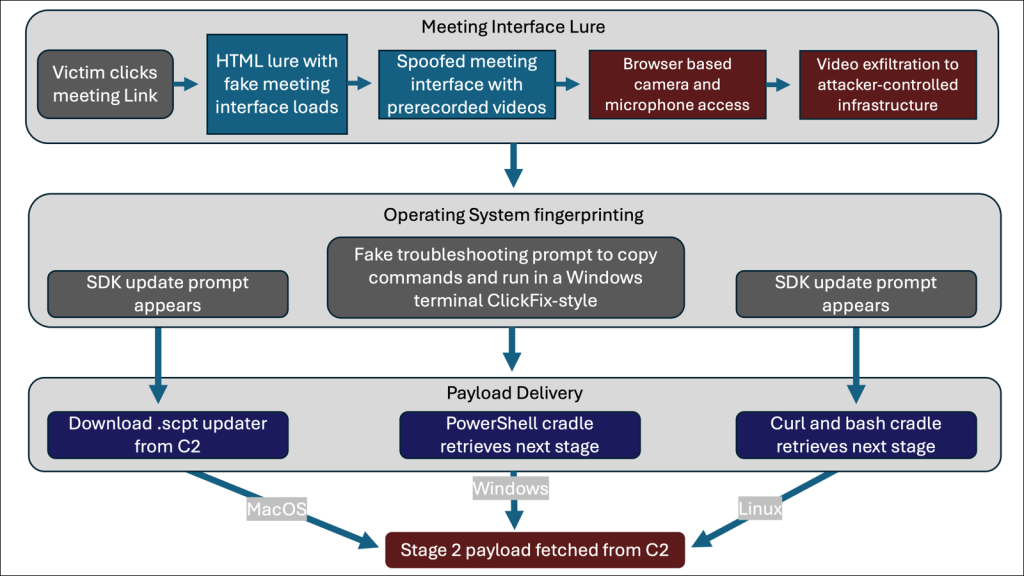
HTML execution flow diagram showing the branching logic from initial page load through OS-conditional payload delivery | Image: Arctic Wolf
Cybersecurity researchers at Arctic Wolf have uncovered a sophisticated, globally distributed campaign by the North Korean state-sponsored threat actor BlueNoroff. This subgroup of the notorious Lazarus Group is now utilizing a “self-reinforcing” deepfake production pipeline to plunder cryptocurrency and Web3 companies.
While the initial social engineering phase can span months, the transition from a victim clicking a link to a full system compromise occurs in under five minutes.
The attack typically begins with a high-trust social engineering lure. Threat actors impersonate reputable figures in the Fintech or legal space, often reaching out via Telegram or LinkedIn to schedule a meeting. They use Calendly to book the session, but then covertly modify the event details.
According to the report, “The event details were covertly modified by the threat actor and replaced with a legitimate meeting link with a typo-squatted Zoom URL”.
Arctic Wolf identified over 80 typo-squatted Zoom and Teams domains registered on the same infrastructure for this campaign. When a victim clicks these links, they don’t land on a real conferencing platform but on a self-contained JavaScript application that renders a “perfect replica” of a Zoom or Teams interface.
To make the fake meeting rooms appear legitimate, BlueNoroff has built a professional-grade media production pipeline. They don’t just use random AI images; they use stolen footage from previous victims.
The report details three types of “fake participants” found in these meetings:
- Real People, Stolen Footage: Authentic webcam video exfiltrated from prior victims during earlier attacks.
- AI-Generated Still Images: Static headshots fabricated using OpenAI’s GPT-4o.
- Deepfake Composite Video: The most advanced asset, where an AI-generated face is digitally applied to a body and motion source.
Once the victim is “in” the meeting, the attacker simulates a technical glitch, such as a deprecated SDK. A persistent overlay prompts the victim to “Update Now,” leading to a ClickFix-style attack.
On Windows, victims are shown a fake troubleshooting prompt containing what appear to be benign terminal commands. When the victim copies and runs these, they inadvertently execute a PowerShell-based C2 implant.
The campaign is laser-focused on high-value targets within the cryptocurrency ecosystem. Arctic Wolf’s analysis of 100 identified targets revealed:
- 80% operate in cryptocurrency/blockchain finance or adjacent investment sectors.
- 76% of targets hold C-suite, Founder, or senior leadership positions.
- 45% of the entire target set are CEOs or Founders.
Evidence points squarely at BlueNoroff, with activity timestamps revealing a telling pattern. Operator activity is heavily concentrated during DPRK business hours (08:00–18:00 KST) with almost no activity on weekends.
“This pattern is consistent with state-sponsored operations operating on a standard workday schedule,” the report concludes.
Support Our Threat Intelligence
Find our threat intelligence and malware analysis helpful? Support our work today and unlock a 100% ad-free reading experience!
 Buy Me a Coffee
