 Do Son
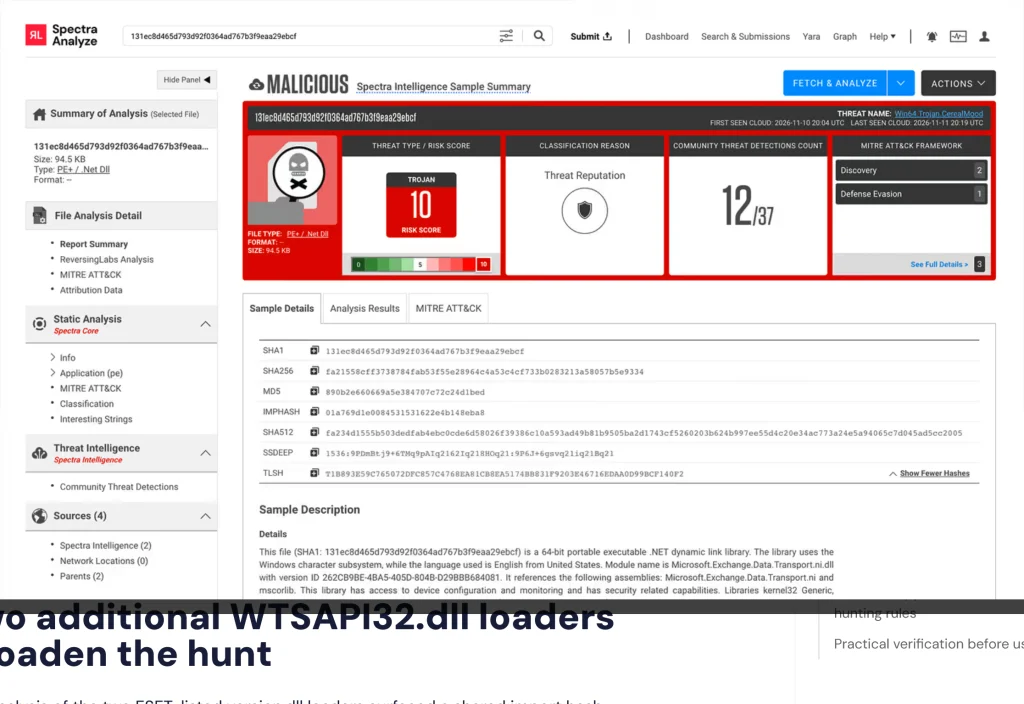
A byte-different copy received in November 2026 | Image: ReversingLabs
| At a glance | |
| Malware family | Cereal toolset: CerealLoader (also labeled BlankPage and CerealMood), CerealNeuron, and CerealBox |
| Threat actor | Turla, a Russia-aligned group; attributed by ESET with high confidence |
| Targets | Microsoft Exchange servers at government bodies in Kazakhstan and Romania |
| Delivery vector | Not disclosed; loaders side-load as fake Windows libraries on Exchange hosts |
| Key capabilities | Passive web listener, in-memory mail interception, selective email theft |
TL;DR
Recently, ESET disclosed Cereal, a Turla espionage toolset that hid inside Microsoft Exchange servers at two government bodies. ReversingLabs has now linked 12 related Turla Cereal malware loaders, including two that ESET did not list. One loader sat in RL’s file collection as early as May 2022.
Delivery
ESET found the tooling at a government organization in Kazakhstan on November 28, 2025. At a Romanian government body, it traced a compromise back to December 23, 2025. There, the attackers selectively copied emails involving NATO and EU institutions while normal delivery carried on.
Neither ESET nor ReversingLabs has described how Turla first planted the Exchange server malware. RL stresses that its work “does not establish additional victims or a new initial-access method.”
Infection chain
Loaders posing as Windows files
CerealLoader is the .NET component written to disk. It decrypts and runs the other parts of the toolset. RL found that some builds pose as genuine Windows libraries. Their exports forward to the real System32 DLLs, which is a classic side-loading proxy design.
Notably, several loaders stayed quiet in generic sandboxes. RL says this is “consistent with code awaiting its intended host context.” In other words, they only wake up inside the right Exchange or Windows process.
One family, many names
Naming made the hunt harder. ESET calls the loader CerealLoader. Microsoft Defender labels it BlankPage, while other engines use CerealMood or Trojan.Turla. As a result, RL warns that a search for one family name “can miss matches.”
The history also runs deeper than expected. RL first saw one ESET-listed loader on May 11, 2022. That matches the date ESET says the earliest sample reached VirusTotal from Kazakhstan. However, RL notes a first-seen date “should not be confused with the first known use in an intrusion.”
Two new loader candidates
By pivoting on a shared import hash, RL found two extra loaders named after a Windows terminal services library. One is a high-confidence match. The other is a moderate-confidence match that reached RL on November 18, 2025, ten days before ESET’s first detection. RL also found four byte-different copies of known builds, likely changed by analysis tools rather than new attacks.
Command-and-control and data exfiltration
This Exchange server malware never phones home. Instead, CerealNeuron waits for encrypted requests sent to web paths that look like Outlook Web Access, Autodiscover, and ActiveSync. So defenders hunting for outbound beacons will not see it.
Meanwhile, CerealBox steals selected email from inside the Exchange transport process. It wraps handlers of transport agents that already exist. Therefore, no new agent appears in the server’s configuration.
Who is behind it
ESET attributes the Turla Cereal malware to the Russia-aligned group with high confidence. RL does not make its own attribution. Instead, it focuses on file evidence. The design also echoes older Turla tools. The UK’s NCSC described Turla’s Neuron in 2017, and ESET later exposed LightNeuron, which abused Exchange transport agents. ESET sees CerealNeuron as a separate family that may have drawn inspiration from Neuron.
To test that link, RL reviewed 152 published hashes for Turla and related server malware and found 81 in its corpus. It also found two more copies of a 2019 NetInjector build that Unit 42 had covered in 2021.
Defense and detection guidance
RL recommends a targeted hunt for organizations running on-premises or hybrid Exchange, not panic across every environment. Key steps include:
- Check live HTTP.sys listeners and review proxy and WAF logs, not just IIS logs, for the reported CerealNeuron paths.
- Search Exchange and Windows folders for unexpected managed DLLs that pose as Windows libraries.
- Compare the .NET native image cache against a known-good Exchange server of the same build.
- Review module loads in EdgeTransport.exe and WmiPrvSE.exe for odd paths or unsigned files.
- Hunt across every alias, including CerealLoader, BlankPage, and CerealMood.
- Test YARA rules against legitimate Exchange files before using them for alerts.
That last step matters. An early RL rule matched 60 legitimate Microsoft-signed Exchange files alongside six malicious ones. In short, catching Turla Cereal malware takes combined signals and careful baselining, not a single hash list.
Support Our Threat Intelligence
Find our threat intelligence and malware analysis helpful? Support our work today and unlock a 100% ad-free reading experience!
 Buy Me a Coffee
