 Do Son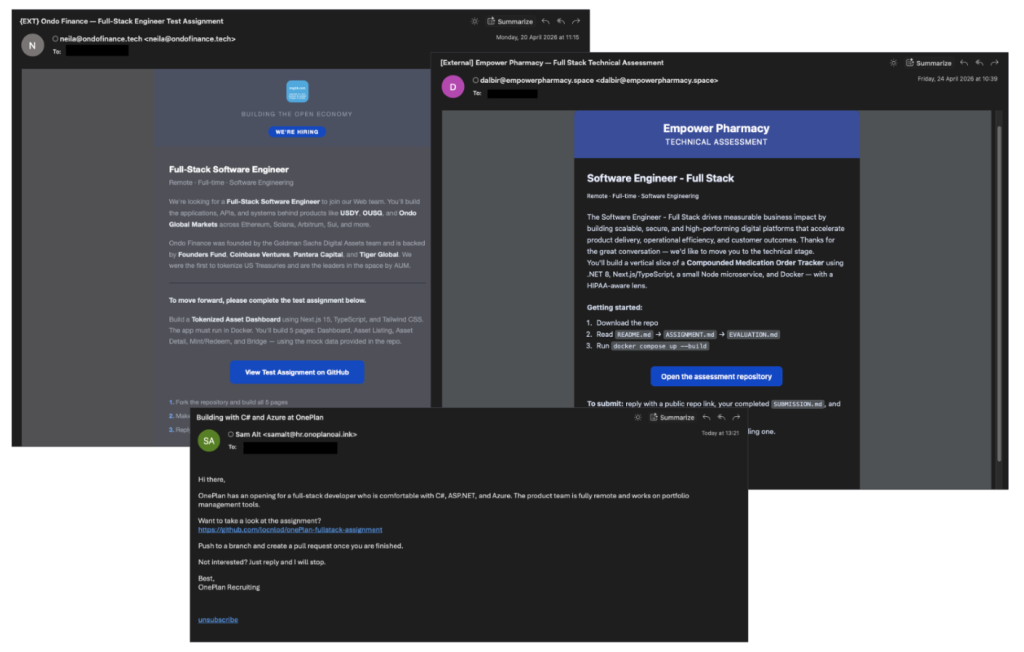
UNK_DeadDrop emails containing job offers for developer roles | Image: Proofpoint Threat Research
In the ever-evolving landscape of cyber warfare, software developers have become prime targets for state-sponsored threat actors. Recently, security researchers at Proofpoint identified a massive, highly sophisticated wave of UNK_DeadDrop phishing campaigns aimed directly at software engineers. By leveraging fake job offers and deceptive code review requests, these likely North Korea-aligned hackers are successfully infiltrating corporate networks to steal cryptocurrency assets, proprietary source code, and sensitive system credentials.
The success of these UNK_DeadDrop phishing campaigns relies heavily on elaborate social engineering tactics. Between April and May 2026, attackers approached targets in close to 100 organizations across the finance, cryptocurrency, education, and technology sectors. They assumed the identities of legitimate recruiters from real companies like Ondo Finance, Empower Pharmacy, and NXLog. The attackers sent unsolicited job offers for “Full-Stack Engineer” roles or asked developers to review open-source crypto prediction projects like Pulsynk and Trixauvex. These well-crafted emails built immediate trust, leading victims directly into a meticulously prepared digital trap.
Once a developer engaged with the fake recruiter, they received a link to a GitHub repository containing a supposed technical assessment or project codebase. As detailed in the recent report on how this phishing campaign targets developers to steal, the repositories appeared highly professional. They featured legitimate-looking README files, working scripts, and realistic directory structures. However, this was a dangerous fade. According to Proofpoint, “The infection chain begins with emails containing links to actor-controlled GitHub repositories hosting malicious scripts that result in the execution of cross-platform malware for macOS, Linux, and Windows, including an open-source Go framework named Overlord.”
The technical ingenuity of the attack lies in how it compromises the developer’s environment without requiring them to explicitly run a malicious executable file. The attackers deliberately hid a tasks.json file inside the .vscode directory. This file abused a Visual Studio Code feature to silently execute shell scripts or Windows command files the exact moment the victim opened the repository in their editor. For users of the popular Cursor IDE, this execution occurred silently with zero user interaction, completely bypassing the typical security trust dialogs seen in standard VS Code environments.
Following the initial automated execution, the scripts install a malicious Visual Studio Extension (VSIX) that masquerades as a legitimate Google update service. This extension ensures deep persistence on macOS and Linux systems. From here, the infection chain diverges based on the victim’s operating system. On macOS and Linux, the attack deploys native Go binaries built on the Overlord command-and-control framework. These binaries establish a persistent WebSocket Secure (WSS) connection to the attacker’s remote server.
Once the Overlord Remote Access Trojan (RAT) is active, it systematically hunts for cryptocurrency wallets, browser extension data, and standalone wallet directories. To steal system passwords, the macOS variant launches a fake system dialogue demanding the user’s keychain password, while the Linux version uses a deceptive Zenity prompt. On Windows, the attack operates entirely in memory using the editor’s built-in Node.js runtime. It actively bypasses Windows DPAPI and Chrome’s App-Bound Encryption by abusing COM Elevation to silently extract saved passwords and session cookies.
Analysts have noted striking similarities between this activity and previous campaigns attributed to a North Korean group known as Contagious Interview. Both operations heavily target developers in the Web3 space, utilize GitHub for delivery, and abuse IDE functionalities. However, the latest tactics represent a clear operational shift. Instead of actively conducting fake interviews over social media platforms like LinkedIn, the attackers have industrialized their approach using massive email blasts. Furthermore, by embedding their payloads directly within the repositories rather than hosting them externally, the threat actors have significantly increased their operational resilience against infrastructure takedowns.
After successfully exfiltrating the data, the malware executes anti-forensic cleanup routines to erase its tracks from the cloned repository. These highly coordinated UNK_DeadDrop phishing campaigns demonstrate a significant escalation in malicious tradecraft. As the researchers note, “UNK_DeadDrop activity suggests North Korea-aligned operations targeting developers for financial gain are maturing and evolving.” Organizations must urgently train their engineering teams to recognize these elaborate social engineering schemes and strictly monitor development environments for unauthorized task executions.
Support Our Threat Intelligence
Find our threat intelligence and malware analysis helpful? Support our work today and unlock a 100% ad-free reading experience!
 Buy Me a Coffee
