 Do Son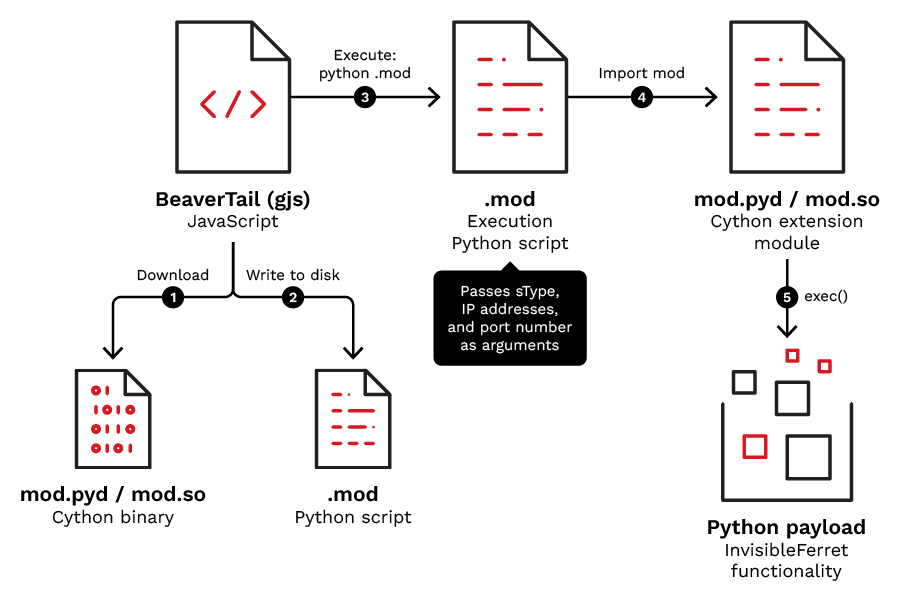
The execution process from BeaverTail to InvisibleFerret | Image: TrendAI Research
North Korea-aligned threat actors are updating their malicious toolsets to target software developers globally. Specifically, TrendAI Research recently uncovered a significant evolution in the Void Dokkaebi Cython malware pipeline. The intrusion set, also tracked as Famous Chollima, has migrated its primary implant from readable Python scripts into compiled binaries. This strategic shift aims to evade standard script-based security filters entirely. Consequently, security teams must adapt their detection tools to address native binary execution.
The Migration to Cython Compilation
To begin with, the attackers leverage Cython to convert regular Python source code into C/C++ configurations. Afterward, developers use compilation tools to build native machine binaries. Therefore, the revised InvisibleFerret payload distributes as .pyd files on Windows and .so components on macOS. Because these compiled files act as extension modules, they cannot execute independently. Thus, the malicious framework generates a lightweight runtime script to launch the core implant.
Handling Extension Module Mechanics
Furthermore, this operational modification introduces major complications for defensive telemetry monitoring. The threat report describes this risk to modern network monitoring infrastructures. Specifically, the analysis notes: “Although IP addresses and port numbers can be extracted from the Cython binaries through binary analysis, the runtime Python execution scripts could override these values with different C&C destinations passed as command-line arguments”. As a result, analysts cannot determine the exact command infrastructure from the standalone binary alone. This technique grants the operators exceptional tactical flexibility during ongoing intrusions.
Evasion and Command Infrastructure
To establish control, the initial execution sequence loads platform-specific versions of the main backdoor. For example, the software automatically separates execution paths for Windows and macOS systems. Historically, the group targeted corporate software engineers through fabricated online job interviews. During these interactions, the threat actors posed as technical recruiters from fake cryptocurrency firms. They then tricked victims into cloning compromised repositories locally. As a result, the engineering workstations ran the malicious components seamlessly.
Analyzing the BeaverTail Payload Delivery
In addition to the Cython shift, the campaign relies on intricate secondary defense mechanisms. For instance, the delivery framework utilizes a multi-stage component called BeaverTail to manage data harvesting. This component shuffles an extensive array of Base64 fragments during system initialization. Next, a specialized lookup function extracts these pieces using unique hexadecimal keys. To bypass simple signature recognition, the software prepends a random junk byte to each encoded string. Finally, sensitive items like execution paths undergo XOR encryption with a distinct 4-byte key. This rigorous masking layer ensures the Void Dokkaebi Cython malware remains hidden from simple security monitors.
Broad Target Footprints and Extension Tampering
Meanwhile, the modular threat has expanded its objective parameters significantly. The updated BeaverTail variants now harvest critical credentials, private master keys, and seed phrases. Additionally, the specialized mc.so module installs trojanized browser extensions directly into Chrome and Brave. To achieve this goal, the malware explicitly targets extensions like MetaMask, Coinbase Wallet, and Phantom. Surprisingly, the software also drops a downgrade routine onto infected targets. The advisory clarifies: “This is done to bypass Google’s enforced transition to Manifest V3 for Chrome extensions”. Consequently, the browser continues to run older Manifest V2 modifications seamlessly.
Evolving Threats in Active Development
Ultimately, forensic examinations reveal that this campaign is undergoing continuous modification. For example, the AnyDesk installer component still relies on readable Python structures. This particular component lacks the updated XOR decoding function required for full binary parity. Consequently, the script fails to execute because the legacy Base64 decoding string is commented out. However, defenders should quickly move away from script-centric verification models. Security teams must deploy binary-aware tracing strategies to expose these hidden extension modules. By analyzing recovered string layouts, organizations can identify active threat clusters before total data exfiltration occurs.
Support Our Threat Intelligence
Find our threat intelligence and malware analysis helpful? Support our work today and unlock a 100% ad-free reading experience!
 Buy Me a Coffee
