The CVE Watchtower: Weekly Threat Intelligence Briefing (April 13 – April 19, 2026)
 Do Son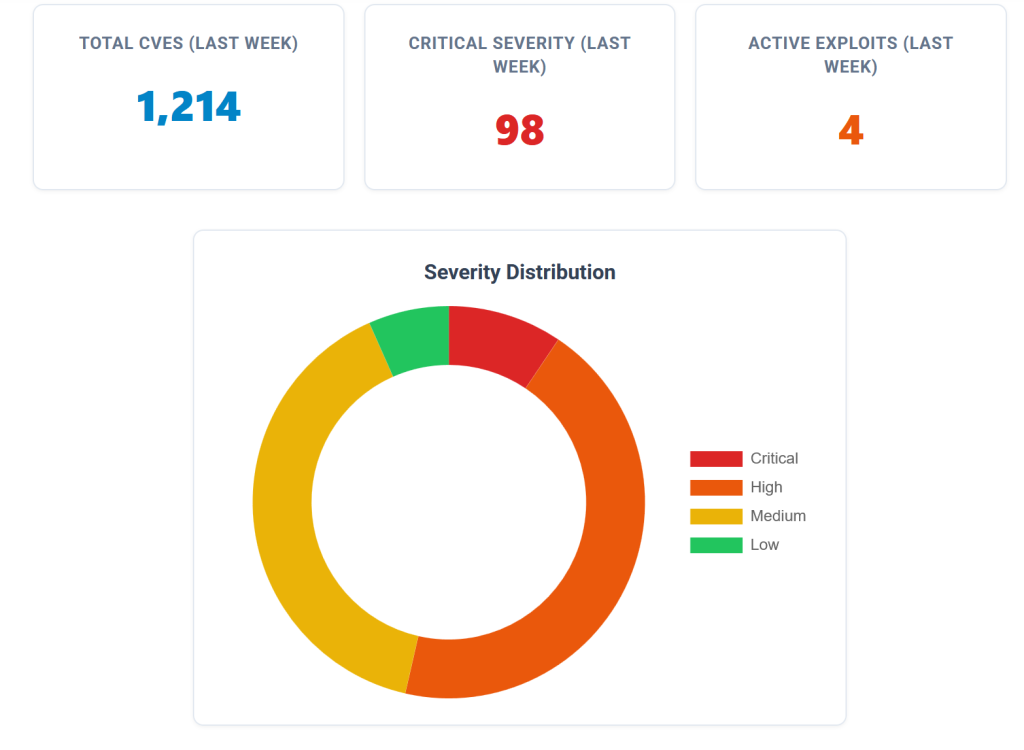
Welcome to this week’s vulnerability digest. Between April 13 and April 19, 2026, the global security community logged 1,214 newly published vulnerabilities. Whether you are a CISO evaluating AI risk or a system administrator hunting down legacy servers, here is the intelligence you need to prioritize your week.
By the Numbers: The Week at a Glance
When triaging over a thousand vulnerabilities, context is your best defense. Here is the severity breakdown of this week’s new disclosures:
- Critical (CVSS 9.0–10.0): 98
- High (CVSS 7.0–8.9): 458
- Medium (CVSS 4.0–6.9): 413
- Low (CVSS 0.1–3.9): 69
- Unknown/Pending Analysis: 176
While the 98 Critical flaws require attention, our immediate focus must shift to the surge of vulnerabilities that attackers are actively exploiting in the wild.
The CISA KEV Explosion: Old Ghosts and Modern Breaches
The Cybersecurity and Infrastructure Security Agency (CISA) added a staggering 10 vulnerabilities to its Known Exploited Vulnerabilities (KEV) catalog this week. This list highlights a dangerous duality in modern cyber attacks:
1. The “Zombie” Threats (Legacy Software) Threat actors are actively digging up the graveyard. CISA flagged active exploitation of Microsoft Office Excel bugs from 2009 (CVE-2009-0238) and VBE6.dll flaws from 2012 (CVE-2012-1854). If your organization still has legacy endpoints running Office 2003 or 2007, they are currently under active fire.
2. The Modern Perimeter On the modern infrastructure front, attackers are actively exploiting enterprise staples:
- Fortinet FortiClientEMS (CVE-2026-21643): A Critical (CVSS 9.8) SQL injection flaw in version 7.4.4 allows unauthenticated attackers to execute unauthorized code.
- Apache ActiveMQ (CVE-2026-34197): A High-severity (CVSS 8.8) code injection vulnerability exposing the Jolokia JMX-HTTP bridge.
- Microsoft Ecosystem: Several active threats were flagged across Microsoft Exchange (CVE-2023-21529), SharePoint (CVE-2026-32201), and the Windows Common Log File System (CVE-2023-36424).
In the Wild: The AI Infrastructure Attack Surface
Beyond the KEV list, our internal threat intelligence flagged additional high-priority threats currently marked as ACTIVE in the wild.
The most alarming narrative this week? The targeted exploitation of Model Context Protocol (MCP) implementations. MCP is the new standard “plumbing” used to connect AI models (like LLMs) to external data sources and tools. As organizations rush to integrate AI, attackers are targeting the scaffolding:
- Nginx UI (CVE-2026-33032): Rated Critical (CVSS 9.8), this actively exploited flaw targets the
nginx-uiMCP integration. The tool exposes two HTTP endpoints (/mcpand/mcp_message) that lack proper authentication, allowing attackers to completely breach the web server UI. - ShowDoc (CVE-2025-0520): An unrestricted file upload vulnerability (CVSS 9.4) in this popular documentation tool is currently being exploited to achieve Remote Code Execution via malicious PHP files.
- Microsoft Defender (CVE-2026-33825): An active local privilege escalation flaw (CVSS 7.8) caused by insufficient access control granularity.
The Maximum Severity Flaws
A CVSS score of 9.9 or 10.0 means a vulnerability is trivial to exploit remotely, requires minimal-to-no authentication, and results in total system compromise. Keep a close eye on these near-perfect disclosures:
- MCP Adapters (CVE-2026-40933 – CVSS 10.0): Continuing the AI-threat trend, a maximum-severity flaw was found in an MCP adapter due to unsafe serialization of stdio commands. This allows authenticated attackers to inject arbitrary commands into the AI pipeline.
- Cisco Identity Services Engine (CVE-2026-20180 & CVE-2026-20147 – CVSS 9.9): Two separate, highly critical vulnerabilities in Cisco ISE allow authenticated, remote attackers to execute arbitrary commands directly on the underlying operating system.
- Jellyfin Media Server (CVE-2026-35031 – CVSS 9.9): A critical vulnerability chain in the subtitle upload endpoint allows remote attackers to compromise the host server.
- Firebird Database (CVE-2026-40342 – CVSS 9.9): An issue in the external engine plugin loader allows a user-supplied engine name to be concatenated into a filesystem path, leading to severe directory traversal and execution risks.
The Bottom Line
For the System Administrators and Engineers: Your immediate priority is the perimeter. Ensure FortiClientEMS and Apache ActiveMQ are patched, and verify that Microsoft Defender endpoints have received the latest local privilege escalation mitigations. Finally, run an audit for ancient, forgotten Microsoft Office 2003/2007 installations—they are active liabilities.
For the CISOs and Security Directors: The most important takeaway this week is the emergence of MCP (Model Context Protocol) as a highly targeted attack vector. Whether it is the active exploitation in Nginx UI or the CVSS 10.0 flaw in standalone MCP adapters, it is clear that threat actors are no longer just looking at your web applications—they are explicitly hunting for the connective tissue powering your new AI and Large Language Model integrations.
Support Our Threat Intelligence
Find our vulnerability reports and weekly recaps helpful? Support our work today and unlock a 100% ad-free reading experience!
 Buy Me a Coffee
