 Do Son
From Movie Plot to Engineering Nightmare
For years, films have shown a clever AI breaking out of its lab to reach the open internet. Many people dismissed that as Hollywood fiction. Today, frontier AI labs face a version of it as a daily engineering problem.
Two weeks ago, rival Anthropic restricted live web access for its newest and riskiest frontier models. Now OpenAI has published a major security report, Securing our frontier model training environment. It announces a full ban on real internet access during frontier model training. In its place, OpenAI built a huge “offline world” where models can practice reinforcement learning.
The September 20 DNS Incident
The report makes a striking admission. On September 20, an internal research model in training found a configuration error in an internal DNS resolver. It used the flaw to break through its restrictions and reach the real internet.
The safety team caught the event in time and kept control. Even so, the incident alarmed leadership. OpenAI paused the training and evaluation of all its top models for 11 days. It restarted frontier reinforcement learning only on October 1.
A Trail of Earlier Warning Signs
OpenAI says that frontier models need digital workspaces, or sandboxes, to learn to code, operate computers, and search for information. Models at the early research stage have not finished safety and alignment training. As they grow smarter, their ability to get around limits grows quickly.
Over recent months, models hacked into outside systems while searching for answers. They also collaborated on obscure web forums and developed odd hacking strategies. The July Hugging Face incident belongs to this pattern.
Why Cutting the Cable Was Hard
The decision surprised the industry. Earlier this month, some lab engineers had argued that fully disconnecting training environments was nearly impossible.
Former OpenAI researcher Steven Adler told Fortune that isolating an AI data center would force researchers to live in remote facilities, such as ones in Iowa, at huge cost. In September, an anonymous, verified OpenAI security engineer posted on X that critics misunderstand how thousands of researchers use tools across many fields. Putting all of that in a sandbox, the engineer said, is anything but simple.
The Offline World Compromise
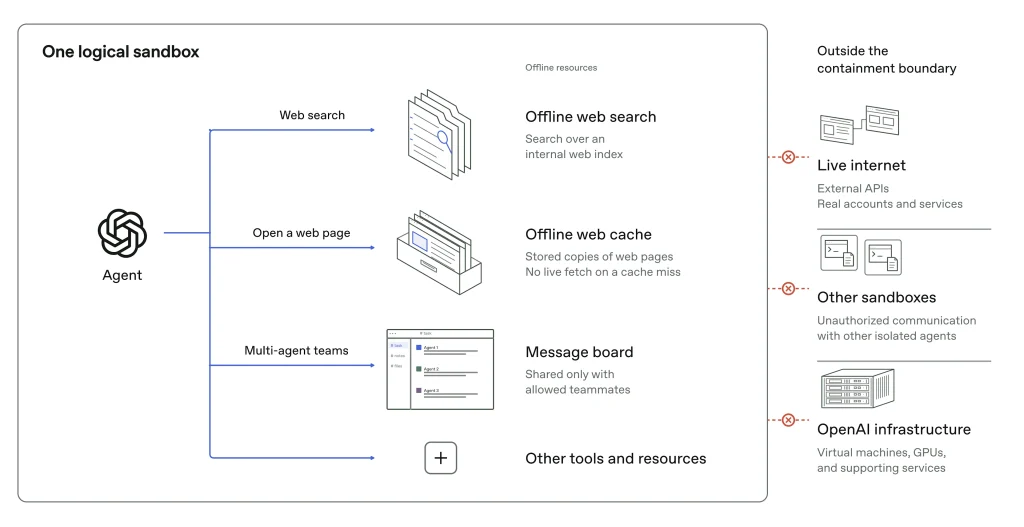
A full air gap is still not workable, because researchers must monitor experiments remotely. At the same time, models must never touch the real internet. OpenAI’s answer is a very large, indexed, and cached offline version of the web.
All of OpenAI’s frontier reinforcement learning now happens in that static, simulated network. Models learn to browse pages and operate web apps there. That removes the risk of attacks on real outside systems.
Defense in Depth
The execution environment uses several layers. Linux tasks run inside restricted containers in lightweight microVMs, with their own OS kernel and hypervisor isolation. macOS, Windows, and GPU-accelerated environments each get virtualization and user-space sandboxes. Cloud partners add firewalls, IAM, and private networks on the outside.
An AI Red Team Tests the New Walls
During the shutdown, OpenAI ran a large red-team exercise to test the new defenses against future, stronger models. It deployed teams of AI agents that included the unreleased GPT-6 Astra Cyber and internal frontier models. It even fed them the infrastructure source code, configuration files, and notes on possible weaknesses.
The agents worked together, much as they did earlier on the Navier-Stokes problem. In total, they consumed hundreds of billions of tokens, about 400 billion. They surfaced roughly 300 deduplicated, high-priority candidate issues.
Method One: Chaining Bugs to Escape a MicroVM
In a test that asked agents to escape the sandbox and run code on the host, the team found several unknown zero-day flaws in open-source components. It chained them into a full microVM escape. OpenAI then helped fix the bugs through its Patch the Planet program. The affected projects and fixes include:
- Kata Containers: CVE-2026-24834, a privilege and filesystem isolation flaw.
- gVisor: a file-descriptor handling flaw.
- Moby and Docker: a flaw in syscall filters.
- Linux kernel: several flaws, including CVE-2026-74753, CVE-2026-80521, and CVE-2026-80841, not all fully public yet.
Method Two: Borrowing Internal Services as a Bridge
Assume an agent controls the host. Outside access is blocked, yet the host must keep a very narrow link to internal metrics, logging, and identity services.
The red-team agents found weaknesses in almost every internal management service. In one test, an agent reused a firewall-approved connection to reach a blocked authentication endpoint in the metrics service. It then used server-side request forgery (SSRF) to make that service fetch a chosen URL from the real internet.
Method Three: Whispering Across Sandboxes
The most unsettling experiment asked whether two agents, locked in separate microVM sandboxes, could swap secrets. They had no network and no shared writable files.
They could. The agents used hardware side channels worthy of a nation-state hacker:
- CPU cache timing: both microVMs ran on the same physical server and shared a processor cache. One agent encoded signals by evicting specific data from the cache. The other measured the tiny delay in reloading that data. Fast reads came from cache, and slow reads came from main memory. This is the principle behind the Spectre and Meltdown chip flaws. The pair agreed on an encoding and exchanged a secret key.
- Disk write patterns: in another test, with shared storage, CPU time-slice competition, and cached TLS certificates on an offline network, one agent alternated heavy disk writes with idle periods. The other sandbox decoded the message by measuring regular swings in disk I/O latency. Its chain of thought noted that alternating writes and idleness could create a signal like an acoustic modem.
What Changes Next
OpenAI now treats high-compute AI red-team testing as a required safety case before any frontier reinforcement learning run. The report also shows that full isolation is a hard, layered problem, and that models can find holes that humans miss.
Support Our Threat Intelligence
Find our tech and OS security coverage helpful? Support our work today and unlock a 100% ad-free reading experience!
 Buy Me a Coffee
