Cloud Under Siege: Persistent P2Pinfect Botnet Activity Discovered in Kubernetes Environments
 Ddos
Ddos 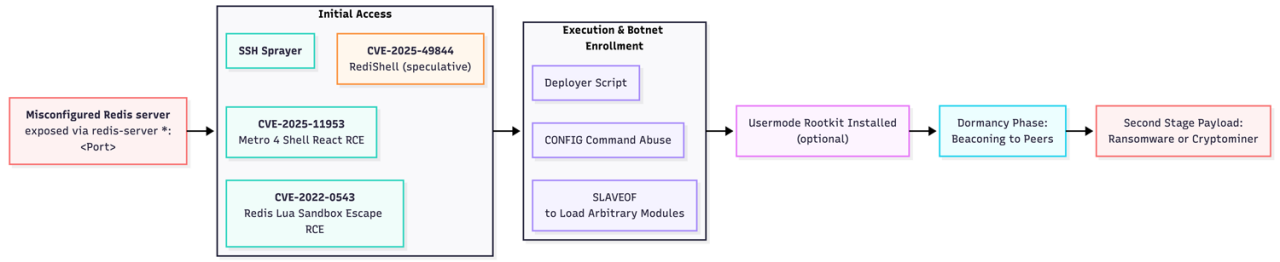
Attack Chain | Image: FortiGuard Labs
Security researchers have discovered a stealthy cloud threat hiding inside enterprise cloud environments. Specifically, FortiGuard Labs recently identified persistent malicious operations within Google Kubernetes Engine (GKE) clusters. This sophisticated P2Pinfect botnet activity targeted several client companies. Furthermore, one of the uncovered network compromises successfully spanned a duration of six months. The persistent nature of the threat actor shows an advanced level of operational dedication. Consequently, defenders must act quickly to audit their container landscapes.
The Initial Foothold
The initial infection chain did not rely on complex software vulnerabilities to gain entry. Instead, the automated systems looked for simple administration mistakes. According to the official threat report:
“The compromises originated from exposed Redis instances, which allowed the botnet to gain an initial foothold.”
Furthermore, these open database configurations left enterprise clusters entirely vulnerable to remote command execution. Automated internet scanners easily located the unauthenticated management interfaces. Therefore, a single misconfiguration allowed long-term compromise in sensitive production networks.
Decentralized Mesh Evasion
The malware displays highly advanced architectural characteristics that make remediation difficult for standard security tools. For instance, it bypasses centralized control servers completely. As highlighted by the analysts:
“P2Pinfect is a resilient botnet that uses a peer-to-peer mesh of compromised computers to eliminate single points of failure, making it significantly harder to sinkhole and take down.”
Consequently, traditional domain sinkholing methods cannot neutralize the decentralized peer layout. The client binary itself is written in Rust and targets multiple operating systems. Moreover, this continuous P2Pinfect botnet activity utilizes non-standard communication ports to safely maintain the threat loop.
A Botnet for Hire Platform
Interestingly, the primary threat operators do not seem interested in stealing corporate data directly. Rather, technical evidence suggests that the group runs a scalable infrastructure for independent cybercriminals. The main developers focus heavily on maximizing global node enrollment metrics. Subsequently, external threat actors purchase access keys to deploy ransomware or crypto miners. This malicious rental model explains why infected systems experience extended periods of complete network dormancy.
Expanding Exploitation Targets
The threat group is actively modifying its distribution toolkit to accelerate payload deployment speeds. Originally, the worm focused exclusively on exploiting misconfigured data layers. However, recent telemetry indicates a massive expansion of initial access vectors.
For example, the botnet successfully incorporated the critical Metro4Shell vulnerability affecting React Native development servers. In addition, researchers speculate with low confidence that the operators adopted a sandbox escape flaw known as RediShell. This rapid weaponization cycle proves that the developers closely track public threat metrics.
Proactive Recommendations for Cloud Teams
Securing modern cloud networks requires continuous visibility over microservices. Therefore, systems administrators should implement several security practices immediately to reduce exposure.
- Restrict Network Access: Bind database interfaces strictly to internal networks to prevent unexpected external exposures.
- Apply Upstream Patches: Apply official security updates for React and Redis modules swiftly.
- Monitor Traffic Anomalies: Look for anomalous outbound connections traveling over unknown infrastructure ports.
- Audit Deployment History: Review system logs for unauthorized use of deployment execution scripts.
Ultimately, fast patch adoption stops automated loaders from expanding their stealthy peer networks. Both seasoned CISOs and junior engineers must collaborate to fortify enterprise perimeters.
Support Our Threat Intelligence
If you find our CVE report and cybersecurity news helpful, consider supporting our work.
 Buy Me a Coffee
PayPal
Buy Me a Coffee
PayPal
