A Decade of Espionage: How a Russian APT Exploited Cisco Devices (CVE-2018-0171) for Years
 Do Son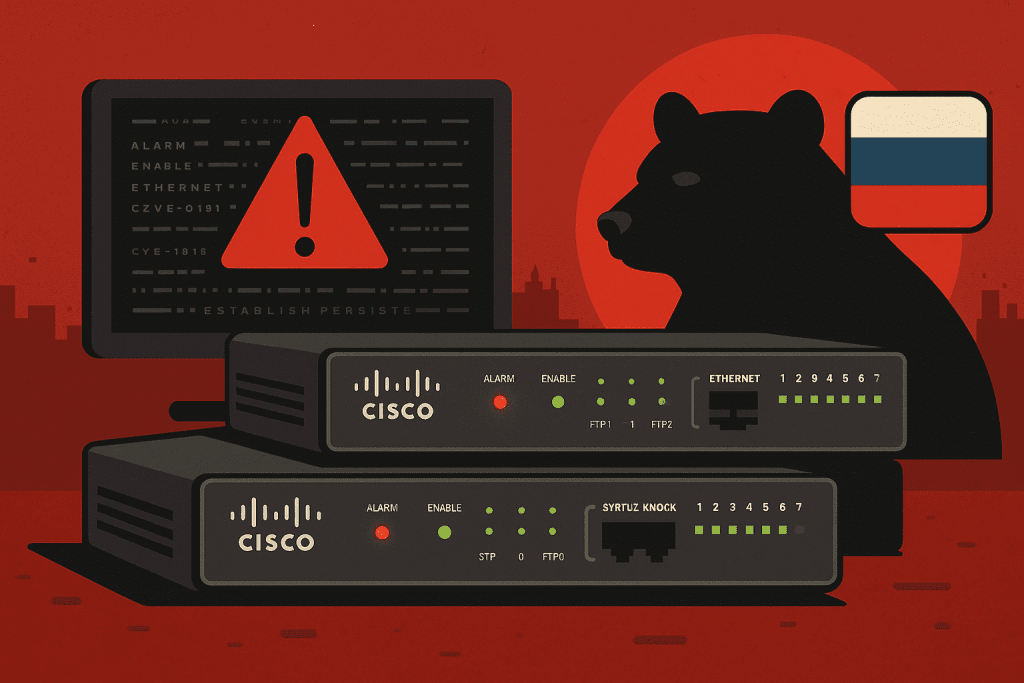
Cisco Talos has released a new analysis exposing “Static Tundra,” a Russian state-sponsored threat actor that has been exploiting unpatched and end-of-life Cisco devices for more than a decade. The group, assessed to be linked to Russia’s FSB, has carried out long-term cyber espionage campaigns against telecommunications, higher education, and manufacturing sectors worldwide.
According to Cisco Talos, “Talos assesses with high confidence that Static Tundra is a Russian state-sponsored cyber espionage group specializing in network device exploitation to support long-term intrusion campaigns into organizations that are of strategic interest to the Russian government.”
Researchers believe the group is a sub-cluster of the infamous Energetic Bear (aka BERSERK BEAR), previously tied to FSB’s Center 16 in a U.S. Department of Justice indictment. With overlaps in tactics and victimology, Talos also connects Static Tundra to the historic “SYNful Knock” implant first reported in 2015.
Static Tundra specializes in exploiting unpatched Cisco devices, often after they have reached end-of-life. The group relies heavily on CVE-2018-0171, a Smart Install vulnerability in Cisco IOS and IOS XE software.
Once compromised, the attackers exfiltrate startup configurations via TFTP servers, revealing sensitive credentials and SNMP strings. These footholds allow further lateral movement, persistence, and long-term monitoring of target environments.
Static Tundra demonstrates persistence, maintaining access to victim networks for years. Talos explains that the group has leveraged SYNful Knock, “a modular implant that attackers inject into a Cisco IOS image … providing a stealthy means of access that will persist through reboots.”
By using “magic packets” in TCP SYN requests, the implant gives attackers covert remote access, enabling them to monitor and control network traffic without detection.
Since 2015, Static Tundra has focused on global sectors aligned with Russia’s strategic interests. Talos highlights that “Static Tundra’s operations against entities in Ukraine escalated at the start of the Russia-Ukraine war, and have remained high since then.”
Victims include organizations in telecommunications, manufacturing, and higher education, with campaigns also observed across North America, Europe, Africa, and Asia.
Once inside, the group captures sensitive network data. Talos notes, “Static Tundra establishes Generic Routing Encapsulation (GRE) tunnels that redirect traffic of interest to attacker-controlled infrastructure, which can then be captured and further analyzed.”
They also leverage NetFlow exfiltration, SNMP manipulation, and FTP/TFTP transfers to extract configurations and data valuable for intelligence operations.
Related Posts:
- Seven Years Later: Cisco CVE-2018-0171 Still Exposes Thousands to RCE
- German defense minister: cyber attacks are the biggest threat to global stability
- Intel Discontinues Clear Linux: End of an Era for High-Performance OS Amid Cost Cuts
- How Spyware Evades Detection through Advanced Obfuscation
- Advanced Cyber Espionage: SugarGh0st RAT Attacks Uzbek and South Korean Entities
Support Our Threat Intelligence
Find our vulnerability reports and weekly recaps helpful? Support our work today and unlock a 100% ad-free reading experience!
 Buy Me a Coffee
