 Do Son
Microsoft Security Research team recently uncovered the AutoJack AI agent exploit. This flaw impacts popular developer tools. Specifically, a major AutoGen Studio vulnerability exposed systems to remote code execution. Hackers could leverage this AutoJack AI agent exploit easily. They simply needed the local agent to visit a malicious webpage.
Track every Microsoft CVE the moment it's exploited.
Get free email alertsThe Nature of Modern AI Agents
Modern AI agents do much more than chat. The report states, “Modern AI agents are not just text generators. They read files, browse pages, call APIs, and shell out to tools.” Consequently, this immense utility creates new attack surfaces. Developers often rely on localhost as a perfectly safe zone. However, the AutoJack AI agent exploit proves this assumption completely wrong.
The vulnerability chains three distinct weaknesses together seamlessly. First, the system trusted localhost connections implicitly without validating the agent. Second, authentication was entirely optional for certain communication paths. Finally, the tool executed URLs verbatim without proper security checks. Therefore, attackers could easily bypass existing defensive measures.
Understanding the AutoGen Studio Vulnerability
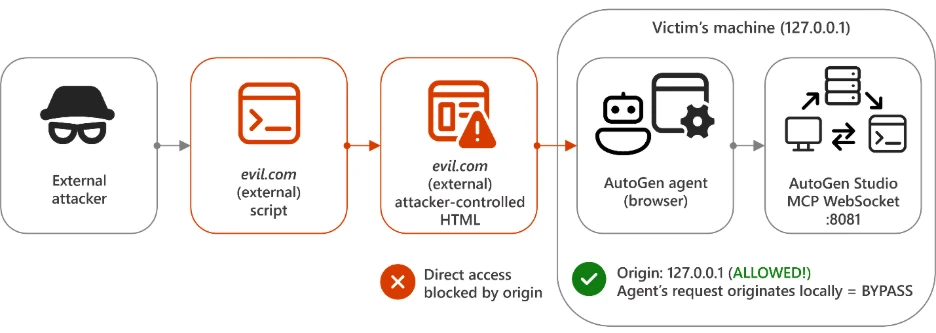
The attack begins with a very simple action. A local agent visits an attacker-controlled web page. Next, the malicious page triggers a local WebSocket connection. Because the agent runs locally, the system inherently trusts the origin. This local origin essentially acts as a free pass.
The researchers explain the danger clearly. “The technique, which we call AutoJack, jacks the agent into becoming the attacker’s last-mile delivery vehicle by crossing the localhost trust boundary that many developer tools rely on.” Thus, the local browser essentially becomes a dangerous weapon.
The Three-Step Exploit Chain
The first issue involves a missing origin validation step. The system allowed connections from the local IP address exclusively. A headless browser navigating to a bad site naturally inherits this trust. Therefore, the malicious JavaScript bypassed the origin filter easily.
The second issue involves an authentication middleware opt-out. AutoGen Studio skipped checks for specific Model Context Protocol paths. Consequently, the WebSocket accepted connections without any necessary authentication. This critical oversight removed a major layer of defense.
Execution Without Interaction
The third issue allows direct command execution. The system accepted a specific parameter directly from the URL. It base64-decoded a payload and spawned arbitrary server processes. For example, it happily ran commands like the local calculator app or a shell script.
First, the local agent browses a compromised site. Then, the site’s JavaScript opens the vulnerable local WebSocket. Next, the server decodes the attacker’s hidden payload. It runs arbitrary commands under the developer’s user account. This happens instantly. Furthermore, no extra user interaction is necessary whatsoever. The AutoGen Studio vulnerability allows immediate, silent execution.
Securing the Localhost Trust Boundary
Fortunately, the project maintainers acted quickly. They patched the vulnerability securely before a major public release. Users installing via standard packages remain completely safe today. Still, the broader lesson remains absolutely vital for all developers.
The researchers offer a stern warning regarding prototypes. “The takeaway is not to avoid prototypes. It is this: when an agent on your core server or laptop can browse the open web and communicate with privileged local services, localhost stops being a trust boundary.”
How to Protect Your AI Projects
You must take active steps to secure your agents. Always treat tool parameters as completely untrusted inputs. Additionally, enforce strong authentication on all local control planes. Never assume a local network environment is inherently safe.
Finally, strictly separate your agent’s identity from your developer account. Always use isolated containers or secure virtual machines. These robust barriers limit the potential blast radius significantly. Remember to stay highly vigilant as AI tools evolve rapidly.
Support Our Threat Intelligence
Find our vulnerability reports and weekly recaps helpful? Support our work today and unlock a 100% ad-free reading experience!
 Buy Me a Coffee
