CVSS 10.0 Alert: Critical Cisco Secure Workload Exploit Grants Unauthenticated Site Admin Access
 Do Son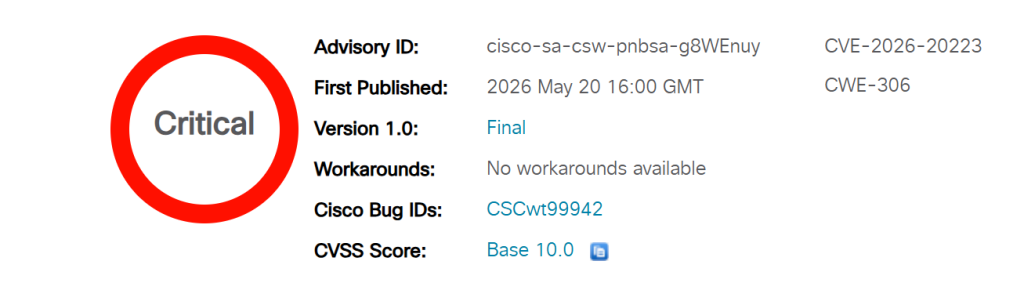
Cisco has issued an urgent security advisory addressing a maximum-severity vulnerability discovered within its zero-trust microsegmentation and cloud security platform, Cisco Secure Workload.
Tracked as CVE-2026-20223, the security flaw has been assigned a maximum CVSS base score of 10.0, indicating the highest possible level of risk to enterprise network perimeters. The vulnerability allows remote, completely unauthenticated threat actors to cross isolated tenant boundaries and gain full control over data center and cloud infrastructure configurations.
The advisory explicitly outlines the severe nature of the access control failure:
“A vulnerability in the access validation of internal REST APIs of Cisco Secure Workload could allow an unauthenticated, remote attacker to access site resources with the privileges of the Site Admin role.”
The root cause of the vulnerability stems from insufficient validation and authentication mechanisms governing Cisco Secure Workload’s internal Representational State Transfer (REST) API endpoints.
In multi-tenant cloud environments, robust logical partitions are strictly enforced to prevent users under one corporate account from viewing or modifying the assets of another tenant. However, CVE-2026-20223 completely short-circuits this identity boundary. Because the underlying internal REST APIs fail to safely challenge and verify incoming requests, an attacker needs no prior foothold, valid cryptographic token, or active session cookie to manipulate the target system.
Cisco notes that the flaw is uniquely situated within the platform’s backend communication mechanics:
“This vulnerability is due to insufficient validation and authentication when accessing REST API endpoints. An attacker could exploit this vulnerability if they are able to send a crafted API request to an affected endpoint.”
Once a malicious network packet lands on a vulnerable endpoint, the application automatically processes the request under the highest privilege tier available on the platform—the Site Admin role. This flaw does not, however, compromise the standard web-based administrative management interface, meaning security teams looking purely at front-end user portal logs may completely miss active, automated API exploitation happening in the background.
By executing commands with Site Admin authority, an unauthenticated remote attacker can systematically pull down deeply sensitive network telemetry, view application dependency mappings, and harvest confidential data caches.
Furthermore, the vulnerability enables hostile configuration modifications. Attackers can silently alter microsegmentation firewalls, open unauthorized network communication pathways, delete critical system rules, or establish persistence across multiple separate organization boundaries simultaneously.
Cisco has rolled out dedicated engineering fixes to plug the authentication gap. Security teams must review their active software versions and immediately coordinate updates to the following fixed baselines:
- Releases 3.9 and earlier: No direct software patch will be issued for these legacy codebases. Organizations managing these deployments must immediately migrate their infrastructure to a modern, supported fixed release line.
- Release 3.10: Update immediately to version 3.10.8.3 or later.
- Release 4.0: Update immediately to version 4.0.3.17 or later.
Support Our Threat Intelligence
Find our vulnerability reports and weekly recaps helpful? Support our work today and unlock a 100% ad-free reading experience!
 Buy Me a Coffee
