Skip to content
July 4, 2026
  • Linkedin
  • Twitter
  • Facebook
  • Youtube

Daily CyberSecurity

Zero-hour alerts. Unmatched analysis.

Primary Menu
  • Home
  • CVE Watchtower
  • Cyber Criminals
  • Data Leak
  • Linux
  • Malware
  • Vulnerability
  • Submit Press Release
  • Vulnerability Report
Light/Dark Button
  • Home
  • News
  • Malware
  • Malware-as-a-Service Exposed: Cisco Talos Unmasks Developer Behind Prolific “BadIIS” Web Server Toolkit
  • Malware

Malware-as-a-Service Exposed: Cisco Talos Unmasks Developer Behind Prolific “BadIIS” Web Server Toolkit

Do Son May 22, 2026 4 minutes read
0
BadIIS Malware as a Service

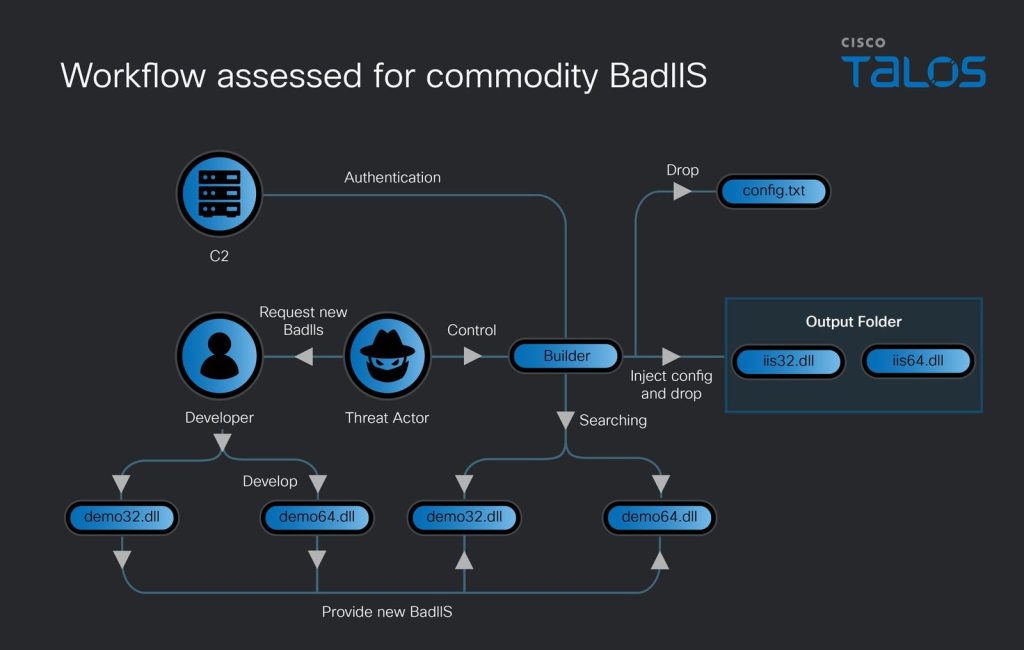
Workflow assessed for commodity BadIIS | Image: Cisco Talos

Add as a preferred
source on Google

A sweeping forensic threat intelligence report has exposed the inner workings of a sophisticated, highly commercialized cybercriminal operation targeting web infrastructure.

Security researchers at Cisco Talos have uncovered a prominent variant of the notorious BadIIS server malware. Operating under a highly lucrative Malware-as-a-Service (MaaS) business model, the developers behind this toolkit have spent nearly half a decade equipping global cybercrime syndicates with the tools necessary to turn hijacked web servers into silent cash cows.

As Cisco Talos explains in the executive summary of its investigation:

“This variant is likely sold or shared among multiple Chinese-speaking cybercrime groups that operate under a malware-as-a-service (MaaS) model for continuous monetization.”

The breakthrough in tracking the operational history of this threat didn’t stem from volatile network indicators, but rather from a treasure trove of metadata accidentally left behind during software compilation: embedded Program Database (PDB) strings.

By analyzing these local file path artifacts, Talos successfully mapped out the developmental timeline of a single, prolific malware author operating under the digital moniker “lwxat”. The PDB tracks expose a remarkably disciplined, long-term software engineering lifecycle.

According to the report:

“Analysis of program database (PDB) file paths reveals a sustained, multi-year development effort by an author operating under the alias ‘lwxat’, spanning from at least September 2021 through January 2026, with evidence of rapid iterative updates, feature branching, and reactive evasion tactics…”

During this five-year development run, the author executed rapid, sprint-like development cycles—evidenced by folder structures logging progressive calendar dates. The author even engaged in specialized administrative troubleshooting, building a specific directory branch labeled “dll-no503”. This specific build was “likely represents a troubleshooting build designed to resolve an issue where the malware caused IIS to throw ‘503 Service Unavailable’ errors, which would otherwise alert server administrators to the infection”.

To scale their commercial operations, “lwxat” engineered a dedicated graphical builder application that automates the compilation of custom payload configurations for downstream buyers.

When a threat actor licenses the software, they use the builder tool to generate customized JavaScript redirectors, server configuration tables, and PHP backlink injections without needing to write a single line of raw code. The builder facilitates a diverse menu of illicit capabilities:

  • Traffic Redirection: Forcibly hijacking legitimate consumer browser traffic and routing it directly to underground spam infrastructure, illegal gambling arenas, or adult content platforms.
  • Reverse Proxying: Intentionally intercepting search engine crawlers. When a crawler arrives, the malware acts as a reverse proxy, silently pulling black-hat SEO spam data from the attacker’s backend and rendering it to the search engine to manipulate public rankings.
  • Content Hijacking: Modifying target title, description, and keyword (TDK) metadata at a configurable percentage rate to silently piggyback off the victim site’s domain authority.

The modularity of the MaaS ecosystem means that customers can order highly customized, premium features directly from the author. Talos recovered specialized builds displaying folder structures translated as “compatible with Baidu browser + hijacking robots.txt” and “bypass Norton,” highlighting a highly reactive workflow designed to defeat active security vendor signatures.

The ultimate proof of this custom-order pipeline surfaced in a series of PDB strings tailored for a high-value client or buyer operating under the alias “x神” (xshen).

The report states:

“This suggests that the author created a dedicated development folder for a user or client named ‘xshen’ (x神), indicating that this particular BadIIS variant was a customized build tailored specifically for ‘xshen’s’ requirements that a full-site traffic hijacking with redirection logic based on the victim’s browser language settings.”

To establish persistence for these customized implants, the operation utilizes a suite of multi-stage service installers and module initialization droppers that bundle the malicious binaries inside standalone executables. These installers copy the payloads straight into native IIS resource trees—impersonating trusted core processes like svchost.exe or FaxService.

If an antivirus solution flags and removes the active hooking module, the persistent Windows service automatically extracts a fresh copy from a hidden backup directory (C:\Windows\Logs) upon the next server restart, ensuring durable, long-term survival.

Get Zero-Hour Vulnerability Alerts

Critical CVEs, CVSS scores, and PoC updates — straight to your inbox every week.


We respect your inbox. Unsubscribe anytime.

Related coverage

  • Head Mare and Twelve: Inside the Collaboration Targeting Russian Companies
  • GPU-Powered Evasion: Unpacking the Sophisticated CoffeeLoader Malware
  • Obfuscated Malware Delivered via Google Calendar Invites and Unicode PUAs
  • Fickle Stealer: The New Rust-Based Malware Masquerading as GitHub Desktop
  • Hacker can use Smartphone Apps to control industrial processes

Support Our Threat Intelligence

If you find our CVE report and cybersecurity news helpful, consider supporting our work.

Buy Me a Coffee Logo Buy Me a Coffee PayPal
Crypto QR Code
USDT (TRC20):
TN8BdV8cp4T1Cd28gK9qTAnZknzzuwyUtm
USDT (ERC20):
0x3725e1a7d3bc5765499fa6aaafe307fabcd75bce

Share this article:

Facebook Post LinkedIn Telegram
Written by
@DdoS · Security Researcher

Do Son

Do Son is the Founder and Editor of SecurityOnline.info. Working in cybersecurity since 2013, he reports on vulnerabilities, malware, and emerging threats, providing timely analysis to help organizations and individuals stay ahead of evolving risks.

Tags: BadIIS Variant Black-Hat SEO Proxy Cisco Talos Content Hijacking Cyber Security IIS Extension infosec lwxat Developer Malware-as-a-Service PDB Metadata Leak Traffic Redirection

Leave a Reply Cancel reply

You must be logged in to post a comment.

Search

Translation

CVE WATCHTOWER
🚨

Receive alerts for vulnerabilities being exploited in the wild.

⚡

Get notified instantly when a Proof of Concept (PoC) exploit is published.

🔍

Access critical info on vulnerabilities even when marked as "RESERVED".

🧠

Insights powered by decades of expertise and global intelligence sources.

🎯

Customize alerts with up to 10 keywords for your specific tech stack.

📊

Export the raw CVE database for SIEM integration and reporting.

Upgrade Package

🚨 Active Exploits in the Wild

  • CVE-2026-48282CVSS 10.0
    ColdFusion versions 2025.9, 2023.20 and earlier are affected by an Improper Limitation of a Pathname to a Restricted...
    Admin intel📅 Updated: Jul 3, 2026
  • CVE-2024-14037CVSS 9.8
    Redsea Cloud eHR contains an arbitrary file upload vulnerability that allows unauthenticated attackers to achieve remote code execution...
    Admin intel📅 Updated: Jul 3, 2026
  • CVE-2026-8451CVSS 8.8
    Insufficient input validation in NetScaler ADC and NetScaler Gateway leading to memory overread if NetScaler ADC or NetScaler Gateway is configured...
    Admin intel📅 Updated: Jul 2, 2026
  • CVE-2026-8037CVSS 9.6
    OS Command Injection Remote Code Execution Vulnerability in API in Progress ADC Products allows an un-authenticated attacker to...
    Admin intel📅 Updated: Jul 1, 2026
  • CVE-2026-45659CVSS 8.8
    Deserialization of untrusted data in Microsoft Office SharePoint allows an authorized attacker to execute code over a network.
    CISA KEV📅 Added to KEV: Jul 1, 2026
  • CVE-2026-48558CVSS 10.0
    SimpleHelp versions 5.5.15 and prior and 6.0 pre-release versions contain an authentication bypass vulnerability in the OIDC authentication...
    Admin intelCISA KEV📅 Added to KEV: Jun 29, 2026📅 Updated: Jun 29, 2026
  • CVE-2026-46817CVSS 9.8
    Vulnerability in the Oracle Payments product of Oracle E-Business Suite (component: File Transmission). Supported versions that are affected...
    Admin intel📅 Updated: Jun 29, 2026
  • CVE-2026-28496CVSS 9.4
    FOSSBilling is a free, open-source billing and client management system. Versions prior to 0.8.0 have a Server-Side Template...
    Admin intel📅 Updated: Jun 25, 2026
Powered by CVE Watchtower

🔴 Live Critical Threats

  • CVE-2026-58426CVSS 9.6
    Gitea Actions Artifacts V4 signed URL HMAC ambiguity allows cross-repository artifact read...
  • CVE-2026-58289CVSS 9.0
    Access of resource using incompatible type ('type confusion') in Microsoft Edge (Chromium-based)...
  • CVE-2026-22874CVSS 9.6
    Gitea versions up to and including 1.26.2 have incomplete SSRF protection in...
  • CVE-2026-20896CVSS 9.8
    Gitea Docker image versions up to and including 1.26.2 use REVERSE_PROXY_TRUSTED_PROXIES=* by...
  • CVE-2026-4321CVSS 9.8
    Improper neutralization of special elements used in an SQL command ('SQL injection')...
  • CVE-2026-14544CVSS 9.8
    A flaw was found in HPLIP (HP Linux Imaging and Printing Software)....
  • CVE-2026-9725CVSS 9.1
    The Printcart Web to Print Product Designer for WooCommerce plugin for WordPress...
  • CVE-2026-13768CVSS 10.0
    Gardyn devices expose a privileged iothubowner key. Access to this key will...
  • CVE-2026-57100CVSS 9.9
    Server-side request forgery (ssrf) in Microsoft Entra Provisioning Service (SyncFabric) allows an...
  • CVE-2026-45499CVSS 9.9
    Server-side request forgery (ssrf) in Azure OpenAI allows an authorized attacker to...
Powered by CVE WATCHTOWER

Get Zero-Hour Vulnerability Alerts

Critical CVEs, CVSS scores, and PoC updates — straight to your inbox every week.

    We respect your inbox. Unsubscribe anytime.

    Our Websites
  • Penetration Testing Tools
  • The Daily Information Technology
  • Daily CyberSecurity

    • About SecurityOnline.info
    • Advertise with us
    • Announcement
    • Contact
    • Contributor Register
    • Login
    • About SecurityOnline.info
    • Advertise on SecurityOnline.info
    • Contact Us

    When you purchase through links on our site, we may earn an affiliate commission. Here’s how it works

    • Disclaimer
    • Privacy Policy
    • DMCA NOTICE
    • Linkedin
    • Twitter
    • Facebook
    • Youtube
    © 2017 - 2026 Daily CyberSecurity. All Rights Reserved.