Russian COLD RELIC Phishing Turns Stolen Cloud Directories Into Downstream Attacks
 Do Son

TL;DR
Incident responders uncovered a series of linked intrusions showing how Russian COLD RELIC phishing operations use data stolen from one victim to breach partner organizations. After compromising a U.S. organization’s cloud tenant in late 2025 via a multi-factor authentication fatigue attack, the hackers exported the staff directory. Then, they impersonated an employee on an encrypted messaging app to breach a second U.S. target in 2026. Furthermore, the attackers enrolled rogue passkeys to survive password resets. They also deleted security alerts to hide their tracks.
What Happened in the Linked Intrusions
In late 2025, threat actors breached the cloud productivity environment of a U.S.-based organization using stolen Super Admin credentials and a U.S. residential proxy located near the victim. According to an investigation into COLD RELIC impersonation and compromise by Mandiant and the Google Threat Intelligence Group (GTIG), the attackers bombarded the administrator with multi-factor authentication (MFA) push notifications until the user accepted one. Immediately afterward, the intruders registered an unrecognized device model and MFA backup codes. They also registered rogue passkeys to lock in persistent access.
“Once COLD RELIC compromises a target, it uses stolen emails and data to establish authentic pretexts and impersonate contacts when reaching out to subsequent targets,” Mandiant researchers wrote. Using Super Admin rights, the actors exported full employee rosters and shared drive files with external accounts. In addition, they ran a domain-wide data export using Google Workspace Customer Takeout. To cover their tracks, the intruders queried email audit logs inside the Admin Console and deleted Alert Center notifications. Even after administrators reset passwords and sessions, the attackers logged back in for several months using unrevoked passkeys. They also synced inboxes via OAuth.
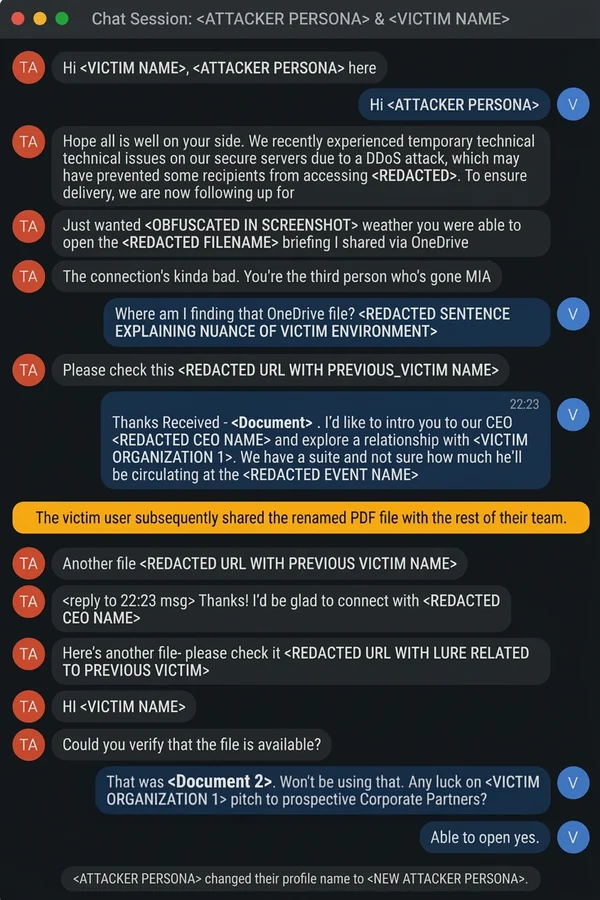
Impersonation and Cross-Cloud SSO Hijacking
In 2026, Mandiant investigated a second U.S.-based organization that used Microsoft Entra ID as its federated single sign-on (SSO) provider for Google Workspace. The attackers initiated contact with an employee over an encrypted messaging app while posing as a staff member from the first victim organization. Claiming that a distributed denial-of-service (DDoS) attack had disrupted their servers, the impersonator sent links hosted on compromised websites. These links contained URL query parameters that referenced the first victim’s name.
When clicked, the redirector fingerprinted the visitor and routed them to an Entra ID credential-harvesting page. The attackers also included a benign PDF briefing lure on the page. After capturing the login credentials and session tokens, the intruders enrolled a new MFA device in the SSO platform. They then downloaded bulk files from the victim’s cloud drive and renamed their messaging profile to impersonate a new individual for future attacks.
Who Is Behind the Activity
Mandiant and GTIG attribute both intrusions with high confidence to COLD RELIC, a Russian state-sponsored espionage group tracked since 2015 (formerly known as COLDRIVER and UNC4057, and tracked by other vendors as Star Blizzard, Callisto, and Gossamer Bear). In prior legal actions, the U.S. Department of Justice assessed that the group operates within Russia’s Federal Security Service (FSB). Additionally, GTIG noted that COLD RELIC phishing campaigns remain active as recently as November 2026.
Impact and How Organizations Can Stay Protected
Across compromised tenants, the group searches for credentials, personnel rosters, event schedules, resumes, and .pst email archives to fuel a continuous chain of third-party compromises against defense contractors, NGOs, and government officials. “By obtaining access to strategic personnel rosters and operational documents, Russian intelligence services turn legitimate business communications into attack vectors against trusted partners,” the report noted.
Recommended Defense Steps
To defend against Russian COLD RELIC phishing, organizations should disable push-based MFA in favor of phishing-resistant FIDO2 security keys while strictly auditing newly registered passkeys and MFA devices. Cloud administrators should monitor Google Workspace Admin audit logs for unexpected CUSTOMER_TAKEOUT_CREATED events, Alert Center deletions, and unauthorized OAuth email sync grants. Finally, when remediating a compromised account, incident responders must revoke all active passkeys, MFA backup codes, and federated SSO tokens across every connected cloud platform.
Support Our Threat Intelligence
Find our threat intelligence and malware analysis helpful? Support our work today and unlock a 100% ad-free reading experience!
 Buy Me a Coffee
