 Do Son
At a Glance
| Actor or Group | Com-linked threat actors, including Bling Libra (ShinyHunters) and clusters Vortex, Cinder, and Helix |
|---|---|
| Activity Type | Voice phishing (vishing), AiTM phishing, cloud data theft, and non-encryption extortion |
| Targets or Victims | Healthcare, finance, and legal firms in the US, UK, and Australia |
| Scale | Tens of millions of CRM and hiring records stolen in some cases; total victim count not shared |
| Law-Enforcement Status | Reported arrests of suspected Bling Libra members and an alleged extortion-site operator |
TL;DR
Since August 2026, Com vishing attacks have surged against healthcare, finance, and legal firms in the US, UK, and Australia. Callers pose as IT staff and use AiTM phishing kits to steal logins, add rogue MFA devices, and take cloud files. Meanwhile, police have reportedly arrested several suspected Bling Libra members.
What Happened
Researchers at Palo Alto Networks Unit 42 tracked a wide wave of Com vishing attacks in late 2026. According to Unit 42’s report on Com-affiliated vishing campaigns, the crews skipped file encryption and aimed for fast data theft. They called staff while posing as IT help desk workers to fix fake login bugs.
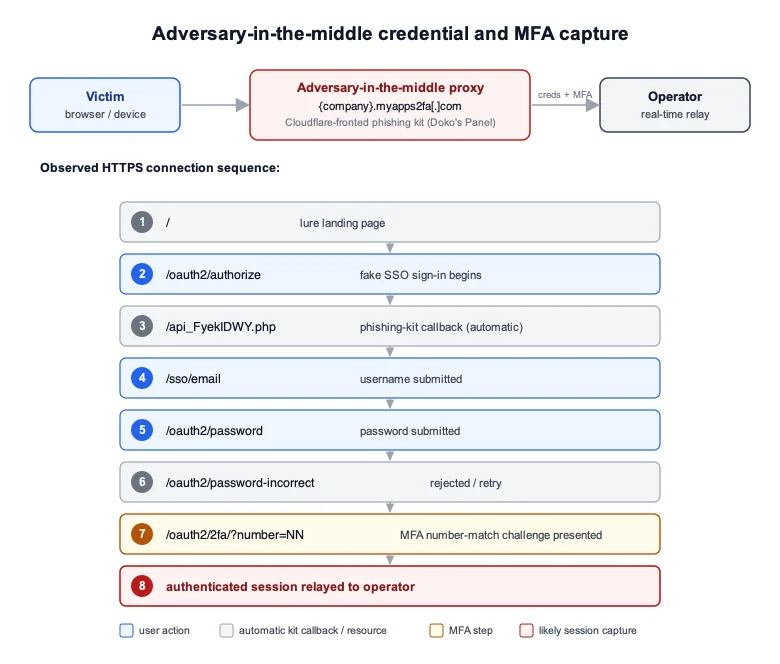
During each call, the caller sent staff to a custom web page made for that firm. These sites worked as adversary-in-the-middle (AiTM) phishing proxies that took passwords and MFA codes live. Unit 42 noted: “After the AiTM kit captures credentials and session tokens, the attackers quickly enroll their own MFA devices, misuse cloud utilities and, in some cases, deploy malicious browser extensions to exfiltrate data and extort victims.”
Shared Tools and Fake Browser Add-Ons
Other firms like Push Security and Microsoft also saw how these crews share tools. For example, Push Security found an Okta variant of Doko’s Panel with a custom backend path. Unit 42 then saw that same path on many Com domains. Likewise, Microsoft flagged passkey lure domains that Unit 42 tied to Cloudflare Pages links.
In addition, one crew pushed a fake browser add-on named “Google Chrome” via Developer Mode. Once loaded, it logged keys, took Microsoft and Google cookies, scanned QR codes for MFA tokens, and streamed webcams. Next, the crew sent threats in Microsoft Teams and email, pointing staff to Tor chat sites.
Who Is Behind It
Unit 42 links this wave to Com threat actors, including Bling Libra, also known as ShinyHunters. Beside Bling Libra, analysts track six clusters: Redact, Pink, Falcon, Helix, Vortex, and Cinder. Google also tracks part of Helix, Vortex, and Cinder as UNC6671.
Vortex and Cinder first showed up in September 2026. Vortex hit health and drug firms hard, often using one phone named “Pixel 10a” for rogue MFA logins. Meanwhile, Cinder replayed Duo session tokens to skip MFA prompts and ran Python scripts on SharePoint and OneDrive. Unit 42 thinks with moderate confidence that Helix built the fake Chrome add-on, though other crews may share it.
Law Enforcement Arrests
Skipping file locks has not kept these crews safe from police. Unit 42 wrote: “However, shifting away from using encryption no longer seems to be enough to keep them under the radar.” Police reportedly arrested suspected Bling Libra members named “Rey” and “Umbreon” around the time of the group’s alleged FBI breach claims. Officers also reportedly arrested a person who allegedly ran Bling Libra’s leak site.
Impact and Scale
Unit 42 did not share a full victim count or total cash loss for these waves. Still, the report says crews at times took tens of millions of CRM and hiring records in one breach. Targets were mostly English-speaking firms with remote staff and cloud apps.
Targets also shifted fast in late 2026. In August, crews hit finance firms twice as often as health firms. By September and October, healthcare took the top spot. US firms still faced the most hits at 76.2% of tracked subdomains in October. Yet hits on Australian firms jumped from under 1% in August to 13% in October, making Australia number two.
What Comes Next and How to Stay Protected
Unit 42 expects data theft without encryption and Com vishing attacks to keep going into 2027. Because these crews move fast with built-in cloud tools, teams must lock down logins now. Firms should take five key steps to cut risk:
- Check help desk calls: Use strict ID checks before any password or MFA reset.
- Use strong MFA: Move staff to FIDO2 keys or passkeys to stop AiTM phishing proxies.
- Block rogue add-ons: Set strict browser extension allowlists and turn off Developer Mode installs.
- Watch login logs: Alert on new MFA phones, OAuth app grants, and proxy logins.
- Flag bulk exports: Watch for sudden file pulls from SharePoint, OneDrive, and cloud mail.
Support Our Threat Intelligence
Find our threat intelligence and malware analysis helpful? Support our work today and unlock a 100% ad-free reading experience!
 Buy Me a Coffee
