The $9.5 Million Blind Spot: How a Fake Ledger App Evaded Apple’s Vetting to Empty User Wallets
 Do Son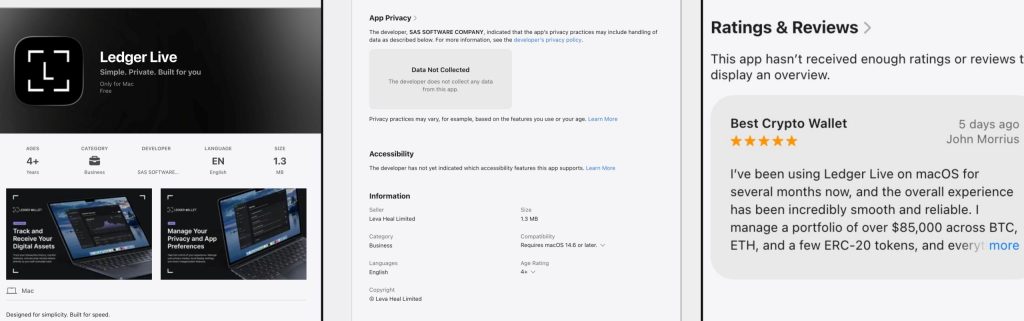
Image: ZachXBT
The imprimatur of the Apple App Store does not confer an absolute guarantee of integrity. Between April 7 and April 13, 2026, a malicious application impersonating the Ledger Live cryptocurrency wallet precipitated substantial financial ruin for over fifty individuals. Aggregate data indicates that the collective losses have now ascended to $9.5 million.
Ledger, the French purveyor of hardware security modules, does indeed offer a companion utility entitled Ledger Live for the Mac platform. However, the critical distinction lies in its distribution: the authentic software is not hosted on the Mac App Store but is dispensed exclusively as a direct installation package via the company’s official portal.
The predatory application successfully bypassed Apple’s vetting process to secure a presence on the Mac App Store. Upon installation, the software coerced users into divulging their recovery seed phrases under the guise of “wallet restoration.” Once these mnemonic phrases were surrendered, the perpetrators swiftly exfiltrated the entirety of the victims’ digital assets.
On-chain analytics reveal that the purloined assets were laundered through the Audi A6 mixer platform before being transferred to the KuCoin exchange, where they were converted into various cryptocurrencies to obfuscate their trail. Following multiple subsequent exchanges, the trail of these stolen funds has become exceedingly difficult to reconstruct.
Audi A6 is a centralized mixing service that exacts high premiums to shroud the origins of illicit capital. Such platforms operate without verifying the provenance of funds, facilitating anonymity for any actor willing to pay the requisite commission to evade forensic tracking.
It is essential to note that the official Ledger Live utility never solicits a user’s seed phrase; the hardware wallet is managed through physical interaction. These phrases are only necessitated for recovery in the event of hardware loss or a forgotten passcode.
The successful infiltration of a fraudulent app into the Apple ecosystem, resulting in monumental losses, raises poignant questions regarding liability. Blockchain investigator ZachXBT contends that Apple bears responsibility for its oversight failures, suggesting that victims might pursue a class-action lawsuit for restitution.
Among the victims is @Glove, a retired musician who first brought this calamity to light. His entire life savings—5.9 Bitcoin accumulated over a decade—were vanished in an instant. One can scarcely fathom the profound despair of such a loss. Under current circumstances, the likelihood of recovering these assets on-chain is marginal, and securing compensation from a titan like Apple remains a formidable challenge. Should these efforts fail, the musician may be forced to abandon his retirement and return to the workforce.
Support Our Threat Intelligence
Find our threat intelligence and malware analysis helpful? Support our work today and unlock a 100% ad-free reading experience!
 Buy Me a Coffee
