From Search to Sale: How Google’s “Agent Commerce” Turns Gemini into Your Personal Buyer
 Do Son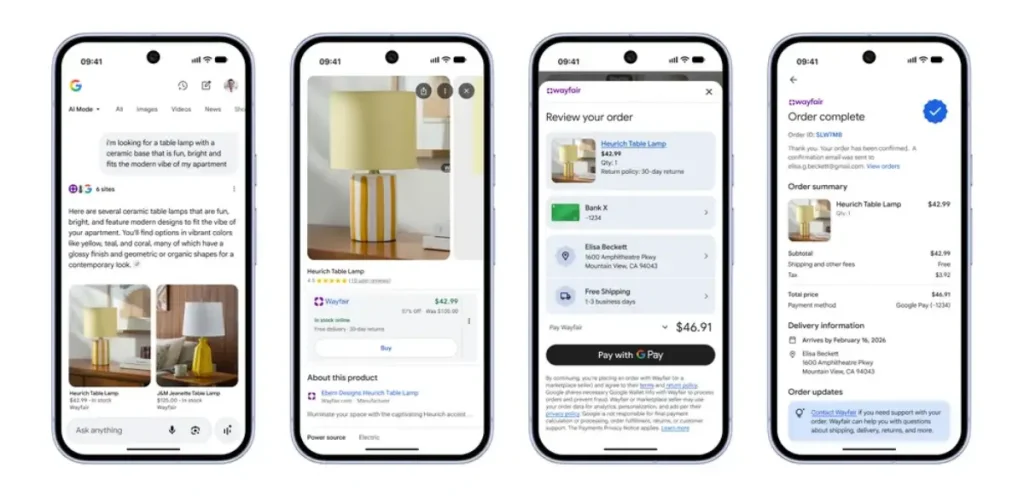
Vidhya Srinivasan, Vice President and General Manager of Ads at Google, articulated in her 2026 annual missive that the era of “Agent Commerce”—wherein AI agents execute intricate transactions on behalf of users—is poised to transition from mere conceptualization to robust operational reality.
To facilitate this paradigm shift, Google is aggressively championing its “Universal Commerce Protocol” (UCP). This open standard is engineered to permit AI to interface seamlessly with major e-commerce platforms, enabling the completion of purchases before the user even exits the dialogue interface. In essence, Agent Commerce signifies the metamorphosis of AI from a mere conversationalist into a proactive digital concierge.
Srinivasan emphasized that the deployment of the UCP framework is expanding rapidly, with the “AI Mode” in Google Search and the Gemini application already operational within the United States. Through this protocol, when a user solicits interior design counsel, the AI does not merely provide inspiration; it cross-references real-time inventory and pricing from partners such as Etsy or Wayfair, finalizing the transaction within the chat window and obviating the need for external redirection.
As search behaviors evolve, so too must the architecture of digital marketing. Google has unveiled several innovative AI-driven advertising strategies:
-
Contextual Sponsored Integration: Google is piloting the natural infusion of sponsored links within AI-generated responses. Rather than manifesting as intrusive banners, highly relevant products appear as organic suggestions tailored to the user’s specific inquiry.
-
Direct Offers: Calibrated for users exhibiting high purchase intent, this feature empowers the AI to discern a user’s genuine readiness to buy, subsequently presenting exclusive discount codes or ephemeral promotions to expedite the decision-making process.
On the advertiser’s front, Google has significantly augmented its “Asset Studio” by integrating Veo 3, its latest generative video model. This advancement allows brands to synthesize high-fidelity promotional videos from simple text prompts or product imagery, with the AI autonomously adjusting content to suit diverse user contexts. Furthermore, YouTube has enhanced its AI-matching capabilities to analytically align brand content with the most appropriate creator communities.
“Agent Commerce” represents the apotheosis of “Search as a Service.” Historically, the consumer journey involved a tedious sequence: search, click, navigate, add to cart, and checkout. In the 2026 epoch, this is condensed into a singular flow: express a desire to the AI, receive a curated recommendation, and confirm the order. The friction of navigating multiple web pages is entirely excised.
For Google, this evolution is a strategic necessity. Should users gravitate toward competitors like ChatGPT or Claude for problem-solving, Google’s lucrative search advertising revenue faces existential peril. Through the UCP, Google endeavors to establish the definitive “AI-era shopping standard,” re-anchoring e-commerce entities within its ecosystem.
However, this transition introduces ethical complexities. When an AI acts as a shopping proxy, the distinction between a recommendation based on personal suitability and one driven by the highest advertising bid may become increasingly opaque. For e-commerce retailers, the future may prioritize robust API integration over aesthetic web design, ensuring their inventory remains “legible” to the AI agents that now hold the keys to the digital marketplace.
Related Posts:
- OpenAI Launches Instant Checkout in ChatGPT, Teaming with Stripe to Reshape E-commerce
- Adobe Issues Critical Security Updates for Commerce and Magento Platforms
- Secure Your Print Jobs: Microsoft Rolls Out Universal Print Anywhere for Everyone
- The End of the Shopping Tab: Google Unveils “Agentic Commerce” and UCP
Support Our Threat Intelligence
Find our tech and OS security coverage helpful? Support our work today and unlock a 100% ad-free reading experience!
 Buy Me a Coffee
