GPU Legend Raja Koduri Launches Oxmiq Labs: A New RISC-V Challenge to NVIDIA’s CUDA
 Do Son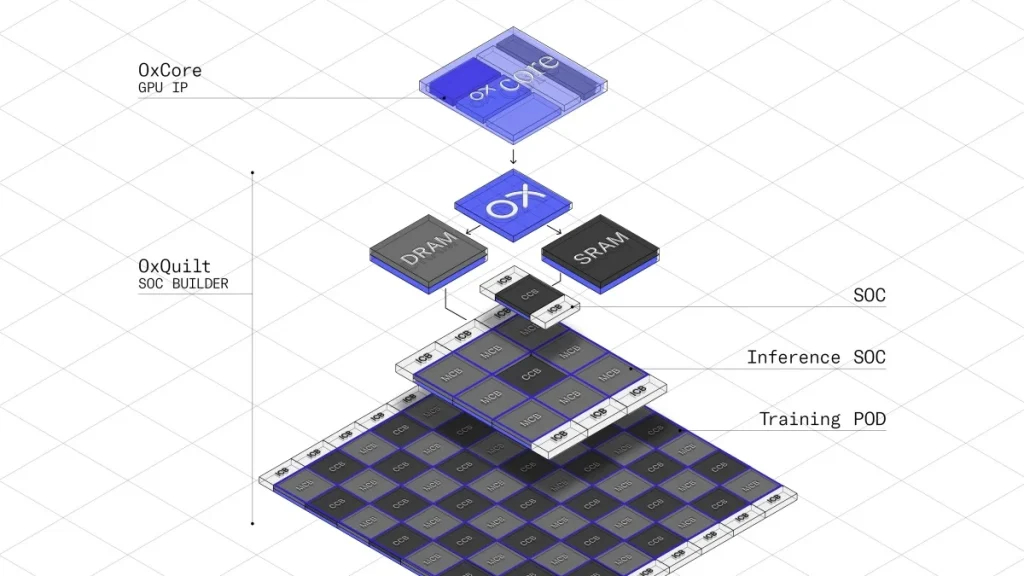
Former architect at AMD and Apple, and a key figure behind several breakthroughs in graphics technologies, the legendary chip designer Raja Koduri—who departed Intel in March 2023—has now announced the launch of a new startup, Oxmiq Labs, via his personal X (formerly Twitter) account. The company aims to challenge NVIDIA’s entrenched CUDA computing ecosystem by developing a novel GPU based on the RISC-V architecture, coupled with an innovative software stack.
Oxmiq Labs will focus on both GPU hardware and software development and will operate on a licensing model. Its most prominent innovation lies in a software layer called OXPython, which allows developers to run Python-based CUDA workloads on non-NVIDIA GPU hardware without any modifications to the source code. This significantly enhances openness and flexibility across computing platforms.
At the heart of Oxmiq’s hardware lies OxCore, a RISC-V ISA-based processor that integrates scalar, vector, and tensor compute units, supporting near-memory and embedded memory operations. With the OxQuilt chiplet-based SoC architecture toolset, customers can rapidly assemble compute, memory, and interconnect modules into tailored chip solutions for workloads ranging from edge AI inference to large-scale AI training.
While the hardware is compelling, Oxmiq Labs places even greater emphasis on its software stack. The core platform, OXCapsule, abstracts underlying hardware differences with a unified runtime and scheduling layer. It encapsulates application services into independently operable “heterogeneous containers,” enabling developers to deploy tasks across CPUs, GPUs, and AI accelerators without grappling with complex system configurations.
OXPython, in particular, translates Python applications built on CUDA into Oxmiq’s execution environment. The first supported platforms will include the Wormhole AI processor and Blackhole AI accelerator from Tenstorrent, a chip startup backed by Amazon founder Jeff Bezos and Samsung. Tenstorrent CEO Jim Keller remarked that Oxmiq Labs’ technology would greatly enhance portability for developers and aligns with the trajectory toward open AI software-hardware ecosystems.
Despite Raja Koduri’s legacy in leading major GPU architecture initiatives, Oxmiq Labs has no plans to produce consumer-grade graphics cards. Its platform lacks ray tracing and display output capabilities, positioning itself purely as an IP licensing model. Partners seeking to build complete GPU solutions will need to develop and integrate additional modules independently.
Embracing an “asset-light” strategy, Oxmiq Labs steers clear of costly chip manufacturing, focusing instead on IP and software licensing. The startup has already raised $20 million in seed funding from investors including MediaTek, and it has begun generating revenue from initial software licenses. Given MediaTek’s investment, it is likely the firm may leverage Oxmiq’s software capabilities to bolster computing in mobile devices, automotive electronics, and edge AI applications.
Raja Koduri sees Oxmiq Labs as one of the rare GPU-centric startups to emerge from Silicon Valley in the past 25 years. Through a decoupled hardware-software development strategy, the company seeks to extend the CUDA ecosystem beyond NVIDIA’s domain and into the broader heterogeneous computing landscape, offering developers unprecedented cross-platform flexibility.
Koduri also envisions Oxmiq Labs contributing to India’s growing prominence in the global AI and semiconductor arenas, positioning the country as a formidable contender in the high-stakes technological race.
Related Posts:
- NVIDIA Brings CUDA to RISC-V: A Game-Changer for AI and Heterogeneous Computing
- RISC-V’s open source architecture impacts chip design
- Qakbot Mastermind Indicted: Russian Architect of $50M Malware Empire Charged
- Debian 13 “Trixie” Nears Release with Official RISC-V Architecture Support
- Researcher Exposes Critical Vulnerabilities in Google Cloud
Support Our Threat Intelligence
Find our tech and OS security coverage helpful? Support our work today and unlock a 100% ad-free reading experience!
 Buy Me a Coffee
