The Intel “AppDomain” Hijack: Unmasking a Sophisticated Post-Exploitation Framework
 Do Son
A new and highly advanced threat has emerged in the financial sectors of the Middle East and EMEA, signaling a shift toward elite-level offensive tradecraft. Security researchers at CYFIRMA have uncovered a multi-stage post-exploitation framework that effectively turns trusted system utilities into “stealthy execution containers” to bypass the most rigorous enterprise defenses.
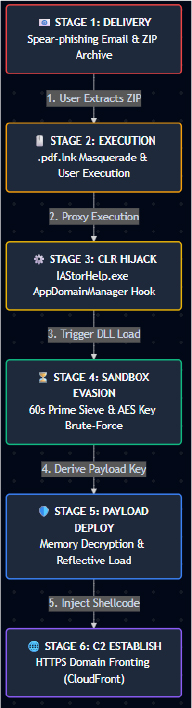
The framework’s core innovation lies in its ability to operate within a trusted environment without altering legitimate system files. According to the analysis, the threat actor leverages IAStorHelp.exe, a digitally signed Intel utility, by exploiting the .NET AppDomain Manager mechanism.
As the report details:
“This approach allows malicious code to be executed within a trusted environment. It bypasses conventional security controls without modifying the original signed binary”.
By hijacking the AppDomain Manager, the malware ensures that the legitimate Intel process loads a malicious DLL instead of its intended components. This technique allows the framework to hide in plain sight, as security tools see only the activity of a verified, vendor-signed application.
The framework is built with a singular focus on remaining undetected during and after the initial compromise. It employs a “highly structured execution pipeline” that uses advanced memory forensics-defying techniques.
Key evasion capabilities include:
- JIT-Based Trampolining: The framework achieves shellcode execution via “advanced JIT-based trampolining, enabling in-memory execution without reliance on conventional APIs”.
- Computational Delays: To evade automated sandboxes, it uses “computational delays and constrained key derivation loops,” ensuring the malicious activity only triggers after the analysis period has ended.
- Code Dilution: To defeat static analysis, the framework utilizes “extensive code dilution and obfuscation, including numerous junk classes, layered try/catch chains, and centralized string de-obfuscation”.
Beyond the local endpoint, the framework demonstrates sophisticated network operational discipline. The command-and-control (C2) infrastructure is built on Amazon CloudFront, utilizing domain fronting to provide both resilience and stealth in network communication.
This ensures that outbound traffic appears to be bound for a legitimate CDN, making it nearly impossible for network defenders to distinguish the C2 heartbeat from routine web traffic. Furthermore, the framework exhibits high fault tolerance through “heap-based context recovery mechanisms,” allowing it to maintain operational continuity even in unstable network conditions.
The CYFIRMA report concludes that the level of modular design and operational discipline observed in this framework is comparable to mature offensive tools like Cobalt Strike, Brute Ratel C4, and NightHawk.
“Overall, the combination of stealth, modularity, and resilience reflects a highly sophisticated threat capability that challenges conventional detection mechanisms and necessitates a shift toward behavior-driven security monitoring, memory forensics, and encrypted traffic inspection,” the report concludes.
When threat actors can turn trusted Intel utilities into weapons, relying on signatures and file-based detection is no longer enough. The future of defense lies in monitoring the behavior of every process—even the ones you trust the most.
Support Our Threat Intelligence
Find our threat intelligence and malware analysis helpful? Support our work today and unlock a 100% ad-free reading experience!
 Buy Me a Coffee
